
Biomedical Engineering in 3D Printing: A Day in the Life of a Healthcare Innovator
Welcome to another insightful installment of #Working3D, our dedicated series exploring the diverse and dynamic career paths within the additive manufacturing industry. In this edition, we delve into a pivotal role within one of 3D printing’s most transformative sectors: healthcare. The medical sector is rapidly embracing additive manufacturing, with market projections by Global Market Insights indicating a staggering value of $19.5 billion by 2032. This remarkable growth is fueled by significant private and public investments in research and development (R&D), propelling innovations that are reshaping patient care. To understand the practical applications and daily realities of this exciting field, we sat down with María Álvarez, a distinguished biomedical engineer and quality manager at SIMIM3D. Join us as María shares her professional journey, her integral relationship with 3D technologies, and the profound impact of her work on healthcare innovation.
Meet María Álvarez: A Pioneer in Medical 3D Printing

María Álvarez Caballero, biomedical engineer.
My name is María Álvarez Caballero, and my journey into the world of biomedical engineering began at the Polytechnic University of Madrid (UPM), where I graduated in 2016 with a degree specializing in medical devices, biomaterials, and biomechanics. Eager to deepen my expertise, I pursued a Master’s Degree in Biomedical Engineering at the Polytechnic University of Valencia (UPV), focusing on advanced implant design techniques and tissue engineering, which I completed in 2017. Today, I proudly serve as both a biomedical engineer and a quality manager at the Simulation and 3D Printing Platform (SIMIM3D), an integral part of the Health Area of La Coruña. My passion lies in leveraging cutting-edge technology to enhance medical practices and ultimately improve patient outcomes.
Journey into Additive Manufacturing: From Simulation to Patient-Specific Solutions
My professional career truly took off at the Hospital Universitario y Politécnico La Fe in Valencia, where I initially worked as a biomedical engineer within the Clinical Simulation and Patient Safety Area. My primary responsibility involved providing technological and logistical support for recreating various clinical situations and environments. This allowed healthcare professionals to engage in realistic representations of actual medical events, serving a multitude of purposes: practicing complex procedures, facilitating continuous learning, evaluating new techniques, and conducting critical experiments in a safe, controlled setting.
It was in this capacity that I first encountered the immense potential of 3D printing. This technology stood out as a powerful tool for supporting deliberate practice in healthcare. It achieved this through the meticulous design, development, and manufacturing of highly realistic simulators – devices engineered to replicate the essential characteristics of a task, including anatomical, physiological, and haptic feedback. Beyond simulators, 3D printing proved invaluable in producing a wide array of props and simulation elements, significantly increasing the fidelity of the training environment. By precisely reproducing the appearance and functionality of real-world scenarios, these 3D-printed aids bridge the gap between theoretical knowledge and practical application. The opportunity to further explore and expand upon the numerous clinical applications of this transformative technology ultimately led me to SIMIM3D, where I could contribute to pushing the boundaries of medical innovation.
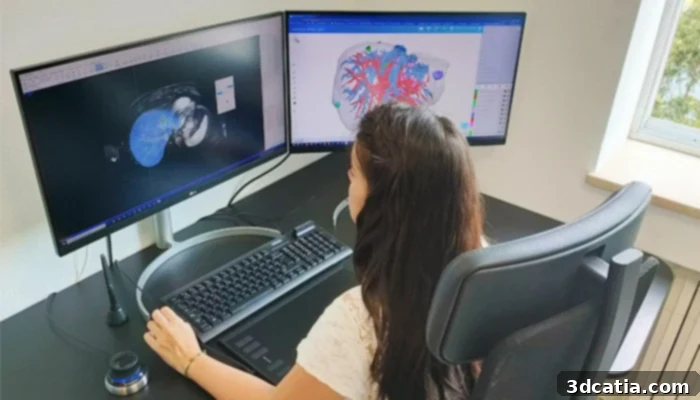
María Álvarez is currently working on the 3D Simulation and Printing Platform, SIMIM3D
My Multifaceted Role at SIMIM3D: From Design to Quality Assurance
At SIMIM3D, my role is wonderfully diverse, combining the responsibilities of a biomedical engineer with those of a quality manager. This dual function allows me to engage deeply with both the technical intricacies of our projects and the critical aspects of system management. Our core work revolves around a suite of advanced technologies: medical image processing, 3D scanning, CAD design, and various 3D printing methods, primarily Fused Filament Fabrication (FFF) and Stereolithography (SLA). These tools enable us to create innovative solutions across several key areas.
Beyond the educational applications I previously mentioned, we provide essential support for medical research. This includes rapid prototyping of novel medical devices, developing specialized tools to facilitate experimental surgery and microsurgery, and creating detailed anatomical models for illustrating scientific publications. We also play a crucial role in validating new surgical techniques and medical devices, particularly patient-specific (PS) solutions. A fundamental part of our mission is the in-house development and production of tailor-made PS devices for direct healthcare purposes. These can profoundly impact the clinical decision-making process for diagnosis and treatment, such as highly accurate digital and printed anatomical models used for surgical planning. Furthermore, we produce devices that intervene directly in treatment, like custom surgical cutting guides that ensure unparalleled precision during operations.
As I mentioned, my daily tasks are a dynamic blend of design, development, meticulous documentation, and management of new products and services. Simultaneously, I am responsible for the continuous maintenance, monitoring, and improvement of our Quality Management System (QMS). This unwavering commitment to quality ensures that we adhere to the highest production standards, strive for user satisfaction, and, most importantly, guarantee the ultimate benefit and safety of our patients. Given that SIMIM3D operates as a central, entirely transversal service within the Healthcare Area, the ongoing enhancement of our QMS also necessitates seamless hospital integration at all levels, ensuring our systems and procedures are harmonized with broader hospital operations. This comprehensive approach ensures that our innovative 3D printing solutions are not only groundbreaking but also safe, effective, and fully compliant with regulatory requirements.
Essential Qualifications for a Biomedical Engineer in 3D Printing
The world of 3D technologies is inherently defined by its versatility and multi-disciplinarity. On a technical level, a biomedical engineer can contribute to numerous areas, as exemplified by my own experience, or choose to specialize more intensely in specific domains such as medical image segmentation, digital design, or 3D printing itself. Regardless of the chosen path, a deep understanding of healthcare principles and clinical needs is absolutely crucial. This foundational knowledge ensures that the services and products we develop are not only technologically advanced but also clinically relevant, safe, and effective for patient care.
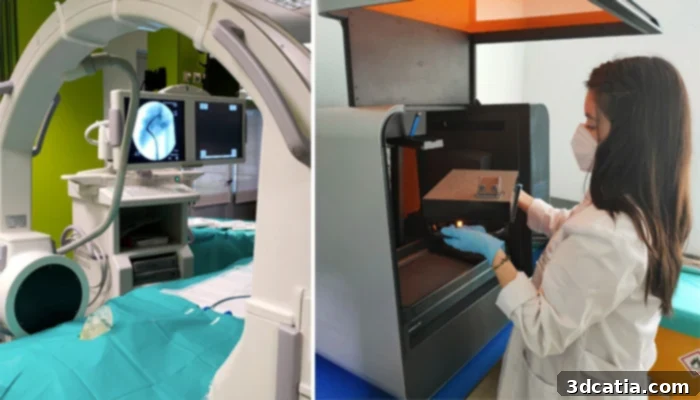
Training in medical image segmentation, digital design and 3D printing is key
Insights from the Ethical-Legal Working Group of the 3D(BIO)PRINTING HUB, part of the ISCIII Biobanks and Biomodels Platform – a group I coordinate – reveal that, at a national level, the most prevalent professional profile in this field is engineering, with biomedical and industrial engineers being particularly prominent. However, there is also a significant percentage of professionals from clinical backgrounds, especially within hospital environments. Among these, radiologists and surgeons frequently stand out, bringing invaluable clinical perspectives. Additionally, specialized technicians in printing, radiology, or simulation play vital support roles. Ultimately, the essential ingredient for success in this domain is an insatiable curiosity about these technologies and their transformative applications, coupled with a proactive approach to acquiring specialized knowledge.
Furthermore, for those directly involved in the manufacturing of patient-specific (PS) devices, a fundamental understanding of Quality Management Systems (QMS), relevant regulations, and application standards is indispensable. This foundational knowledge will need to be continuously expanded and refined, directly correlating with the specific responsibilities and complexities of one’s job. Adherence to these standards is not just about compliance; it’s about ensuring patient safety and the efficacy of medical interventions, making quality assurance a cornerstone of this innovative sector.
Navigating the Challenges: Integrating Innovation in Hospital Settings
The establishment and full integration of 3D printing units within hospital systems represent a relatively nascent development. As is often the case with rapidly advancing fields, innovation and technological development tend to outpace the regulatory frameworks and the seamless integration of these innovations into established, everyday systems. This disparity presents one of the most significant challenges we currently face. My team and I have dedicated several years to this endeavor, and I believe that one of our greatest ongoing challenges is to fully complete the successful hospital integration of our service. This involves not only technical implementation but also extensive awareness-raising and training initiatives among healthcare personnel. The goal is to ensure widespread compliance with the good practices and stringent documentary requirements mandated by the current regulatory framework. Bridging this gap is crucial for realizing the full potential of 3D printing in patient care, ensuring that these advanced solutions are not just available but also safely and effectively utilized throughout the healthcare ecosystem.
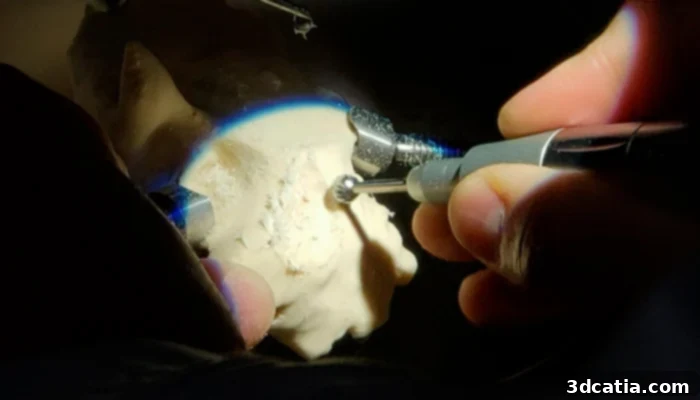
Photo Credits: SIMIM3D
Advice for Aspiring Biomedical Engineers in Medical 3D Printing
For any biomedical engineer aspiring to make a significant impact within a hospital 3D unit, I believe several key attributes are paramount: an unyielding curiosity, a strong willingness to continuously learn, a commitment to ongoing improvement of both one’s personal skills and the work being performed, and an openness to embracing constant challenges. These qualities are absolutely essential for adding substantial value in such a dynamic and evolving environment. The same advice holds true for professionals from diverse backgrounds who are eager to enter this exciting field. Ultimately, while technical expertise is foundational, it is often the non-technical skills – such as communication, collaboration, problem-solving, and adaptability – that prove most critical and decisive for a project’s success and long-term prosperity. Cultivating these soft skills alongside technical proficiency will undoubtedly set you apart and enable you to thrive in the innovative world of medical additive manufacturing.
What are your thoughts on the pivotal role of a biomedical engineer working with 3D printing in healthcare? We invite you to share your perspectives in a comment below or join the conversation on ourLinkedIn,Facebook, andTwitter pages! Don’t miss out on the latest advancements and sign up for our free weeklyNewsletter here, delivering cutting-edge 3D printing news directly to your inbox! You can also explore all our informative videos on ourYouTube channel.