
Revolutionizing Oral Health: Personalized Gum Grafts with AI-Powered 3D Bioprinting
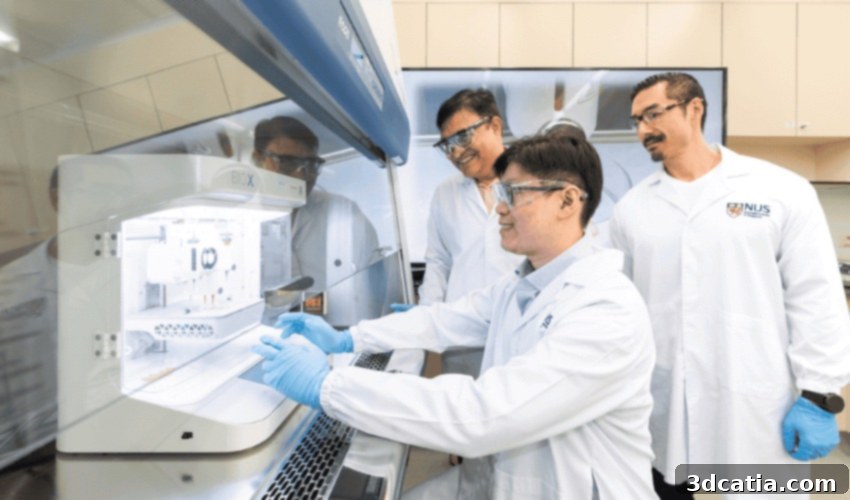
A groundbreaking innovation from the National University of Singapore (NUS) is poised to transform dental and oral healthcare. A dedicated team, led by Assistant Professor Gopu Sriram from the Faculty of Dentistry, has successfully pioneered a novel method for creating customized gum grafts. This advanced technique masterfully integrates the precision of 3D bioprinting with the analytical power of artificial intelligence (AI), promising a future where gum disease and related complications are treated with unprecedented accuracy and patient comfort.
Unlike conventional methods that typically necessitate harvesting tissue from other parts of the patient’s mouth – a procedure often associated with pain, discomfort, and limitations in available tissue – this new NUS approach offers a significantly more adaptable and less intrusive solution. By eliminating the need for a donor site within the patient’s mouth, it dramatically reduces surgical invasiveness, patient discomfort, and potential complications, marking a significant leap forward in regenerative dentistry.
Addressing the Challenges of Traditional Gum Grafting
For decades, addressing conditions like periodontal disease or complications arising from dental implants, which often lead to gum recession or insufficient gum tissue, has relied heavily on traditional grafting techniques. These methods primarily involve autogenous grafts, where tissue is surgically removed from another part of the patient’s mouth, typically the palate. While effective, this process carries several drawbacks:
- Patient Discomfort and Pain: The donor site can be a source of considerable pain and tenderness during the healing period, sometimes more so than the graft site itself.
- Limited Tissue Availability: The amount of tissue that can be harvested is restricted, limiting the scope and size of grafts that can be performed, especially for extensive oral tissue regeneration needs.
- Risk of Complications: Both the donor and recipient sites are susceptible to complications such as infection, bleeding, and delayed healing.
- Aesthetic Concerns: The donor site may heal with some scarring or changes in texture, and the graft itself, while functional, might not perfectly blend with the surrounding natural tissue.
- Prolonged Recovery: Patients often experience a longer recovery time due to the need for two surgical sites to heal concurrently.
These inherent limitations have underscored the urgent need for innovative solutions that can provide effective, personalized, and minimally invasive alternatives. The NUS team’s work directly addresses these critical challenges, aiming to simplify the treatment paradigm for gum problems and significantly enhance patient outcomes and experience.
The Breakthrough: 3D Bioprinting and AI for Personalized Oral Tissue Grafts
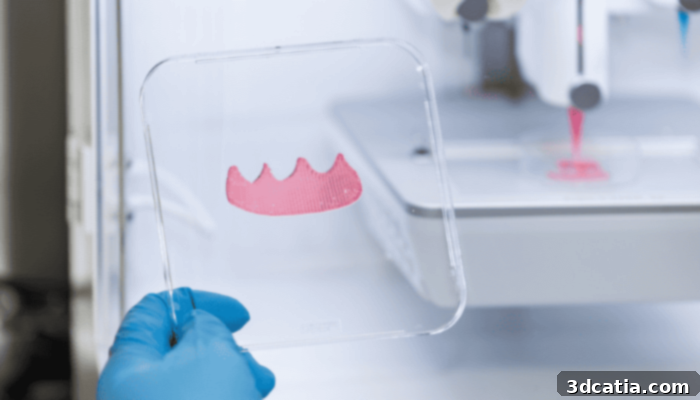
The researchers at NUS have turned to 3D bioprinting as a cornerstone of their innovative approach. This cutting-edge technology allows for the precise fabrication of biological structures layer by layer, offering unprecedented control over graft architecture and composition. Unlike conventional methods, 3D bioprinting enables the creation of grafts that are perfectly tailored to the unique anatomical requirements of each patient, ensuring optimal fit and integration with existing tissues.
Central to the success of this bioprinting technique is the development of a specialized bioink. This advanced material is not merely a structural scaffold; it is ingeniously designed to actively promote cellular regeneration. Composed of biocompatible polymers and living cells, the bioink provides a nurturing environment for new tissue growth while maintaining the accurate printability and structural stability crucial for a functional graft. This proprietary bioink ensures that the printed tissue not only mimics the physical properties of natural gums but also stimulates the body’s natural healing processes.
AI’s Pivotal Role in Optimizing Bioprinting Parameters
While 3D bioprinting offers immense potential, its success is critically dependent on the precise adjustment of numerous operational parameters. Factors such as extrusion pressure, printing speed, nozzle size, bioink viscosity, and printer temperature must be meticulously controlled to achieve high-quality, viable tissue constructs. Historically, optimizing these parameters was a laborious, time-consuming, and costly process, often relying on extensive manual trial-and-error experiments that could run into thousands of combinations.
To overcome this significant bottleneck, the NUS team ingeniously integrated artificial intelligence into their bioprinting workflow. This integration has revolutionized the optimization process, transforming it from a guessing game into an efficient, data-driven endeavor. Professor Dean Ho, who heads the biomedical engineering department at NUS, emphasized the impact of this synergy: “To speed up the 3D bioprinting process, we integrated AI into our workflow to address this critical bottleneck. This approach greatly streamlines the process by reducing the number of experiments needed to optimize the bioprinting parameters — from potentially thousands to just 25 combinations.”
This dramatic reduction in experimental iterations is achieved through AI algorithms that can predict optimal parameter settings based on a smaller set of initial experiments. Machine learning models analyze various combinations and their outcomes, identifying the most efficient pathways to success. This not only accelerates research and development but also significantly reduces material waste and operational costs, making the entire process more sustainable and scalable for future clinical applications.
Unprecedented Success and Biomimetic Qualities
The results of the NUS team’s research have been remarkably promising. Gum grafts created using this AI-assisted bioprinting method exhibited outstanding biomimetic characteristics, closely replicating the natural properties of oral tissues. Immediately after printing, the grafts demonstrated an impressive cell viability in excess of 90%, a crucial indicator of tissue health and potential for integration. This high viability was maintained for a significant period of 18 days in culture, underscoring the robustness and regenerative capacity of the bioprinted tissue.
Furthermore, the bioprinted grafts consistently retained their intended shape and structural integrity, a vital attribute for successful implantation and long-term function. Detailed analyses revealed the presence of essential proteins within the tissue constructs, alongside a sophisticated multilayered organization that strikingly resembled that of natural gums. These findings confirm that the engineered grafts are not merely inert scaffolds but are biologically active and structurally complex, capable of integrating seamlessly into the oral environment.
Assistant Professor Sriram further highlighted the broader implications of their work: “This research demonstrates how AI and 3D bioprinting can converge to solve complex medical problems through precision medicine. By optimizing tissue grafts for individual patients, we can reduce the invasiveness of dental procedures while ensuring better healing and recovery.” This emphasis on precision medicine signifies a shift towards treatments that are not only effective but also highly individualized, minimizing patient discomfort and accelerating the path to recovery.
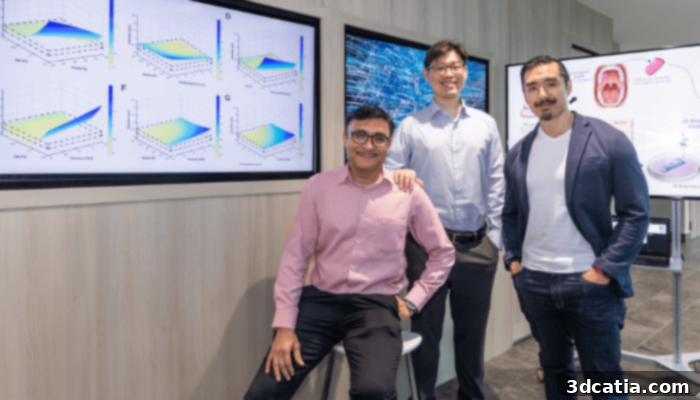
Professor Gopu Sriram, Dr Jacob Chew and Professor Dean Ho from NUS present their innovative AI-assisted 3D bioprinting method for creating personalized gum grafts.
Wider Applications: Beyond Oral Tissues to Scarless Healing
The profound ability of these engineered oral tissues to repair and regenerate without scarring holds immense potential far beyond the confines of dental care. The fundamental principles and technologies developed in this study could indeed pave the way for the creation of grafts for other critical tissues, such as skin. Imagine a future where severe burns or wounds heal without leaving disfiguring marks, improving both the functional and aesthetic outcomes for countless patients.
This research opens new avenues in the field of regenerative medicine, particularly in wound healing and reconstructive surgery. The ability to precisely control tissue regeneration at a cellular level, guided by AI, means that personalized treatments for a myriad of conditions requiring tissue replacement or repair could become a reality. This could lead to a paradigm shift in how we approach tissue engineering, making complex procedures more accessible, less invasive, and ultimately, more successful. Further details on this groundbreaking study are available in the official press release from the National University of Singapore, which can be accessed HERE.
The Future of Dental and Regenerative Medicine
The integration of AI and 3D bioprinting by the NUS team represents a monumental step forward in personalized medicine. This innovation not only addresses long-standing challenges in dental gum grafting but also lays a robust foundation for future advancements across various medical disciplines. As this technology matures, we can anticipate clinical trials and eventual widespread adoption, offering patients a less painful, more effective, and truly personalized approach to tissue regeneration. This promises to redefine standards of care and improve the quality of life for millions suffering from tissue loss or damage.
What are your thoughts on the revolutionary use of AI and 3D bioprinting for gum tissue grafts and other regenerative medicine applications? We’d love to hear your perspective! Let us know in a comment below or join the conversation on our LinkedIn, Facebook, and Twitter pages! Don’t forget to sign up for our free weekly Newsletter here to receive the latest 3D printing news straight to your inbox! You can also find all our compelling videos on our YouTube channel. If you’re interested in discovering more 3D printing news specifically within the medical and dental sector, click HERE.
*All Photo Credits: National University of Singapore