
Signify’s 3D Printed Lighting: Illuminating the Future of Sustainable and Customized Interior Design
The landscape of manufacturing and design has been profoundly reshaped by the advent of 3D printing, also known as additive manufacturing. Once primarily recognized for its transformative applications in specialized fields like automotive, aerospace, and architecture, this innovative technology has rapidly permeated numerous other sectors, bringing unprecedented capabilities and efficiencies. One such area experiencing a remarkable revolution is interior design, where 3D printing is not just a trend but a powerful tool for crafting functional objects and decorative elements. For homeowners, businesses, and designers alike, additive manufacturing offers a compelling suite of advantages, fundamentally altering how we conceive and produce items for our living and working spaces. It empowers the creation of highly personalized objects meticulously tailored to the unique desires, aesthetic preferences, and practical needs of inhabitants. Moreover, it champions a more sustainable production paradigm, significantly reducing waste and promoting eco-conscious manufacturing practices.
At the forefront of this innovative wave is Signify, a global leader in lighting solutions, which has strategically embraced 3D printing to redefine the lighting market. The company is actively producing lighting fixtures using additive manufacturing, a move designed to champion the circular economy and revolutionize conventional manufacturing processes. This commitment underscores Signify’s dedication to sustainable innovation and responsiveness to modern design demands. To support this ambitious vision, Signify has recently established a dedicated industrial 3D printing department within its existing lighting factory in Vadodara, India. This strategic localization not only enhances production capabilities but also aligns with regional initiatives promoting self-reliance and advanced manufacturing, marking a significant step in democratizing access to cutting-edge lighting technology.
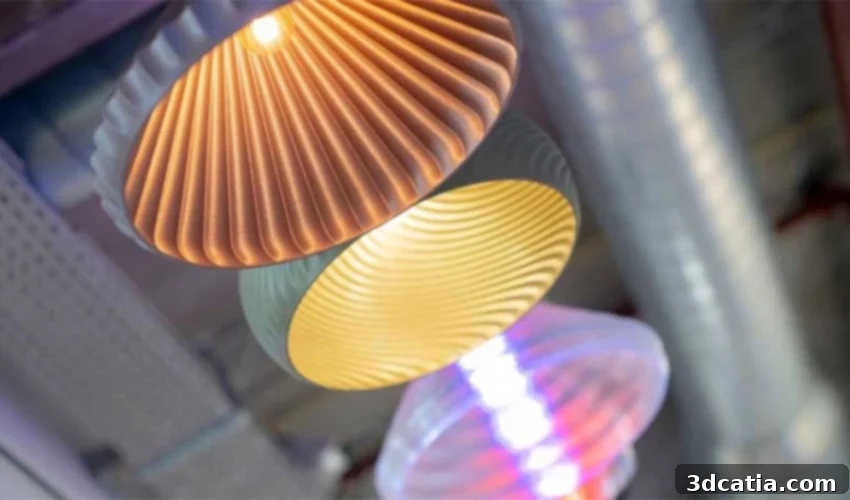
Signify’s innovative line of 3D printed lighting fixtures is meticulously engineered to cater to a broad spectrum of clients and environments. From the luxurious ambiance of hotels and the dynamic workspaces of modern offices to the inviting displays of retail shops and the intimate settings of individual homes, these luminaires are remarkably versatile. The company emphasizes that its lighting solutions can be seamlessly adapted to virtually any type of location or aesthetic requirement, offering unparalleled flexibility in design and application. Sumit Joshi, the esteemed Vice President and General Manager at Signify Innovations India, eloquently articulated the profound significance of this development: “We are immensely proud to be recognized as the pioneering lighting manufacturer to produce 3D printed luminaires on an industrial scale within India. This achievement resonates deeply with the Indian government’s progressive agenda for a self-reliant India, underscoring our contribution to local innovation and manufacturing excellence. Furthermore, it powerfully reinforces our established position at the very forefront of lighting technology and sustainable innovation.”
Mr. Joshi further elaborated on the multifaceted benefits inherent in this advanced manufacturing approach: “The ability to print luminaires provides a vastly more flexible, incredibly fast, and significantly more environmentally friendly method of manufacturing. This is because we possess the capability to either create entirely new designs or customize existing ones with unprecedented speed, directly fulfilling specific customer needs without the burden of colossal investments and protracted development cycles that are typical of traditional manufacturing. Customers can witness their innovative ideas brought to life in a matter of days rather than the arduous months previously required. Moreover, the 3D printing process itself demands substantially less energy, contributing to a reduced carbon footprint throughout the product lifecycle. This paradigm shift in production not only accelerates market responsiveness but also champions ecological responsibility, making it a win-win for both our clients and the planet.” This strategic pivot by Signify reflects a deep understanding of evolving market demands for personalized, sustainable, and rapidly deployable lighting solutions, positioning the company as a true innovator in the global lighting industry.
Photo Credits: Signify
Unveiling the Unique Features of Signify’s 3D Printed Lighting Fixtures
One of the most compelling aspects of Signify’s 3D printed lighting fixtures lies in their unprecedented level of customization, directly empowering consumers to become co-creators in the design process. To acquire these cutting-edge luminaires, customers are invited to engage with an intuitive online platform on Signify’s website, where they can actively design and order their personalized lighting solutions. This direct-to-consumer approach, facilitated by the inherent flexibility of additive manufacturing, ensures that each fixture can be uniquely adapted to individual tastes and specific interior themes. The customization options are extensive and thoughtfully curated, allowing clients to meticulously craft a luminaire that perfectly complements their space.
Customers are granted the freedom to select from a diverse range of textures, which not only enhance the tactile quality of the fixture but also subtly influence how light interacts with and diffuses through the material. This attention to detail allows for nuanced atmospheric effects, from smooth, contemporary finishes to more tactile, organic surfaces. Alongside texture, an expansive palette of colors is available, enabling designers and individuals to choose hues that seamlessly integrate with existing decor or boldly stand out as a focal point. This personalized color selection ensures that the lighting fixture is not merely a source of illumination but an integral part of the overall design narrative, capable of evoking specific moods and enhancing spatial aesthetics.
Further enhancing this bespoke experience, Signify offers a choice of finishes, including opaque, metallic, and translucent options. An opaque finish provides focused light distribution, often ideal for task lighting or creating dramatic shadows. Metallic finishes introduce a touch of industrial chic or modern elegance, reflecting ambient light and adding visual interest. Translucent options, on the other hand, allow for softer, more diffused light, creating a gentle glow that can enhance comfort and relaxation. Each finish offers distinct visual and functional characteristics, ensuring that every design choice contributes to the fixture’s ultimate impact. Beyond aesthetics, Signify emphasizes the practical benefits of these luminaires. A key feature is their remarkably light weight, which, according to the company, is approximately two-thirds the weight of a conventional luminaire. This significant weight reduction simplifies installation, lowers shipping costs, and reduces the overall material consumption, further contributing to their eco-friendly profile. This combination of advanced customization and practical design makes Signify’s 3D printed lights a truly innovative solution for modern interior design challenges.
Pioneering Sustainability Through 3D Printing and the Circular Economy
Signify’s venture into 3D printing extends far beyond mere aesthetic customization; it represents a profound commitment to environmental stewardship and the principles of the circular economy. Through the strategic integration of additive manufacturing and the exclusive use of environmentally friendly materials, Signify aims to drastically reduce its ecological footprint across its product lifecycles. A cornerstone of this sustainable approach is the material choice: the lights are meticulously 3D printed from 100% recyclable polycarbonate. This advanced, durable polymer is not only robust but also fully capable of being repurposed, enabling the lights to be either reused in new applications or refurbished to extend their operational lifespan. When a product reaches its end-of-life, the polycarbonate can be efficiently recycled, minimizing waste and ensuring that valuable resources remain within the economic loop.
By embracing this recyclable material and the on-demand production capabilities of 3D printing, Signify actively champions the circular economy model. This approach stands in stark contrast to the traditional linear “take-make-dispose” model of manufacturing, advocating for products designed for longevity, reusability, and ultimate recyclability. In doing so, Signify not only sets a high standard for sustainable manufacturing but also actively encourages its customers to adopt eco-responsible behaviors. This ethos is increasingly shared by a growing number of forward-thinking companies, particularly within the dynamic 3D printing sector, where material innovation and waste reduction are key drivers of progress.
The environmental benefits are quantifiable and significant. Compared to a traditionally constructed metal luminaire, Signify’s tailored 3D printed luminaires boast an impressive 47% lower carbon footprint. This substantial reduction is achieved through a combination of factors, including more efficient material utilization, the localized production facilitated by the Vadodara factory (which reduces transportation-related emissions), and the lower energy consumption of the additive manufacturing process itself. This focus on carbon footprint reduction is an increasingly critical consideration for consumers and businesses alike, who are actively seeking more sustainable and “green” products to align with their environmental values and corporate social responsibilities. Signify’s initiative demonstrates how advanced manufacturing technologies can be harnessed to create not only aesthetically pleasing and functional products but also those that contribute positively to global sustainability efforts. This holistic approach solidifies Signify’s position as a leader in both lighting innovation and environmental responsibility, paving the way for a brighter, more sustainable future. You can discover more about Signify’s pioneering work and their sustainable innovations by visiting their comprehensive website HERE.
Signify’s strategic adoption of industrial 3D printing for lighting fixtures represents a powerful convergence of design innovation, manufacturing efficiency, and environmental stewardship. By offering highly customizable, lightweight, and sustainably produced luminaires, the company is not only meeting the evolving demands of modern interior design but also setting a new benchmark for responsible manufacturing. Their commitment to the circular economy, exemplified by the use of 100% recyclable polycarbonate and significantly reduced carbon footprint, positions them as a true leader in fostering a more sustainable future. This initiative in Vadodara, India, further underscores the global shift towards localized, intelligent manufacturing that benefits both consumers and the planet. What are your thoughts on Signify’s innovative 3D printed luminaires and their broader implications for sustainable design? We invite you to share your insights in a comment below or join the conversation on our Facebook, Twitter, and LinkedIn pages! For the latest updates and breaking news in the world of 3D printing, be sure to sign up for our free weekly Newsletter here, delivered straight to your inbox!