

Rocket Lab’s Electron: Propelling the Future of Space Access with 3D Printed Engines
Just over two years ago, a nascent startup based in California, Rocket Lab, captivated the aerospace world with a bold announcement: they had successfully developed the world’s first battery-powered orbital rocket. This groundbreaking vehicle, christened “Electron,” promised to revolutionize small satellite launches by offering unparalleled accessibility and cost-effectiveness. Fast forward to today, and the Electron rocket has not only materialized but has also made history. Central to its innovative design is the 3D printed Rutherford engine, a testament to the power of additive manufacturing in modern rocketry. The path to its maiden flight was filled with anticipation; after securing a ten-day launch window commencing on May 22nd, the culmination of years of tireless effort finally bore fruit. Rocket Lab successfully launched their Electron rocket from their dedicated launch complex located on New Zealand’s remote Mahia Peninsula. This wasn’t merely a significant event for a private company; it marked New Zealand’s first attempt at an orbital space launch, charting a new course for the nation without a traditional government-backed space program.
The Vision Behind Rocket Lab: Pioneering Commercial Space
Rocket Lab stands as a prominent private aerospace manufacturer and small satellite launch service provider, distinguished by its innovative approach to space access. The company’s vision is rooted in making space more accessible for commercial enterprises, scientific research, and national security missions by offering frequent and dedicated launch opportunities. This ambitious undertaking has garnered substantial support from a consortium of high-profile investors, including industry giants like Lockheed Martin, who recognize the transformative potential of Rocket Lab’s technology. Earlier this year, the company secured a significant $75 million investment round, bringing their total investment to a staggering $148 million. This robust financial backing has propelled Rocket Lab’s valuation to approximately $1 billion among private investors, solidifying its position as a key player in the burgeoning commercial space sector. The successful maiden launch of the Electron rocket is therefore not just a triumph for Rocket Lab and for New Zealand, but it also represents a monumental leap forward for the entire aerospace industry, particularly in the realm of advanced manufacturing techniques.
The Electron Rocket: A New Era of Launch Vehicles

The test took place on a small peninsula in the east of New Zealand, showcasing the Mahia launch site.
The Electron rocket itself is a marvel of modern engineering, designed specifically for the rapidly expanding small satellite market. Standing at an impressive 17 meters (approximately 56 feet) tall and measuring 1.2 meters (nearly 4 feet) in diameter, the fully loaded vehicle tips the scales at 10.5 tons. Its streamlined composite structure contributes to its lightweight design, a critical factor for achieving orbital velocity efficiently. The launch sequence for the Electron is executed in two distinct stages. The first stage is powered by an array of nine Rutherford engines, each individually providing the necessary thrust to escape Earth’s lower atmosphere. These engines work in concert, generating immense power through a unique electric-pump-fed propulsion system, setting them apart from traditional gas-generator cycle engines. Following the separation of the first stage, the second stage takes over, propelled by a single vacuum-optimized Rutherford engine, specifically designed for efficient operation in the vacuum of space to push the payload towards its intended orbit. This modular and highly efficient design underscores Rocket Lab’s commitment to optimizing every aspect of the launch process.
The Rutherford Engine: Additive Manufacturing’s Aerospace Breakthrough
At the heart of the Electron rocket’s innovation lies its revolutionary Rutherford engine, a prime example of how additive manufacturing, commonly known as 3D printing, is transforming the aerospace industry. The vast majority of the Rutherford engine’s primary components are produced using advanced 3D printing techniques. This strategic reliance on additive manufacturing offers a myriad of advantages that are particularly critical in the demanding field of rocketry. Firstly, it drastically reduces manufacturing time, allowing for faster production cycles and more frequent launches. Traditional manufacturing methods for complex engine parts can take months, whereas 3D printing can reduce this to mere days or weeks. Secondly, and perhaps most crucially for space applications, 3D printing enables the creation of incredibly complex geometries that are impossible to achieve with conventional machining. This allows engineers to design parts that are optimized for minimal weight while maximizing structural integrity and performance. In the aerospace industry, every kilogram saved translates directly into increased payload capacity or improved fuel efficiency, making weight reduction a paramount concern.
The efficiency gains offered by the 3D printed Rutherford engine are truly remarkable. It boasts an astounding 50% greater efficiency compared to traditional gas-powered engines, a significant factor in achieving orbit with smaller, more cost-effective rockets. This enhanced efficiency is largely due to the precise control over internal geometries that 3D printing provides, allowing for optimal fuel flow and combustion characteristics. Rocket Lab’s engineers leveraged this technology not only for its time-saving and weight-reducing benefits but also for its ability to iterate designs rapidly, accelerating the development process. By using advanced materials suitable for high-temperature and high-pressure environments, such as titanium alloys and superalloys, combined with sophisticated 3D printing processes like electron beam melting and laser sintering, they have created an engine that is both robust and remarkably light. This innovative manufacturing approach is a cornerstone of Rocket Lab’s strategy to deliver more frequent and affordable access to space, democratizing the satellite launch market.
New Zealand’s Gateway to Space: The Mahia Peninsula Launch Site
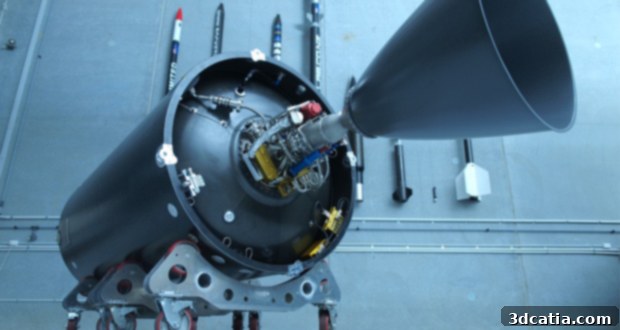
The Rutherford engine from Rocket Lab – almost completely 3D printed – represents a significant advancement.
The choice of the Mahia Peninsula on New Zealand’s east coast as Rocket Lab’s primary launch site is strategic, offering several unique advantages. Its remote location provides clear launch trajectories over the Pacific Ocean, minimizing population overflight risks and offering a wide range of orbital inclinations. Furthermore, New Zealand’s relatively clear airspace makes it an ideal location for frequent launch operations. The inaugural flight, aptly codenamed “It’s a Test,” aimed to validate the Electron rocket’s design and operational capabilities. The mission objectives were clearly defined: the rocket was tasked with carrying an inert payload, a dummy satellite designed to simulate the mass of a real payload, into an 83-degree elliptical orbit. This orbit was planned to vary between 300 and 500 kilometers in altitude, demonstrating the rocket’s ability to achieve specific orbital parameters. The team carefully monitored every aspect of the countdown and launch, understanding the immense stakes involved in this historic first attempt. This mission represented not just Rocket Lab’s ambitions, but also New Zealand’s entry onto the global space stage, a remarkable feat for a nation without prior spacefaring capabilities.
“It’s a Test”: The Inaugural Launch Mission
The monumental lift-off occurred precisely at 4:20 PM local time, marking the beginning of a new chapter in space exploration. From the moment of ignition, the nine Rutherford engines roared to life, propelling the Electron rocket skyward with immense power. Just three minutes into its flight, the vehicle successfully reached space, a testament to the efficient and powerful performance of the Rutherford engines and the overall engineering prowess of Rocket Lab. The journey was closely monitored by the ground control team, who observed critical milestones such as stage separation and second stage ignition. While the rocket and its inert payload did not ultimately achieve their target orbit, the team expressed profound satisfaction with the outcome of their maiden test launch. Rocket Lab’s founder and CEO, Peter Beck, articulated the mixed emotions of triumph and analytical focus, stating, “We had a great first stage burn, stage separation, second stage ignition and fairing separation. We didn’t quite reach orbit, and we’ll be investigating why. However, reaching space in our first test puts us in an incredibly strong position to accelerate the commercial phase of our program.” His statement underscored the significant achievements of the launch while also highlighting the company’s commitment to rigorous analysis and continuous improvement. The data gathered from this flight will be invaluable in refining the Electron’s performance for future missions.
Evaluating the Results and Looking Ahead
Despite not reaching the precise target orbit on its inaugural attempt, the success of “It’s a Test” in reaching space validated Rocket Lab’s core technologies and proved the Electron rocket’s fundamental capabilities. The data collected from every second of the flight provides critical insights, which Rocket Lab’s engineers are meticulously analyzing to understand why orbit was not fully achieved. This iterative development process is standard in aerospace and is crucial for refining complex systems. Moving forward, Rocket Lab remains firmly committed to its innovative approach, particularly its continued reliance on 3D printing for engine production. This ensures that the company can maintain its competitive edge by keeping manufacturing costs low and production cycles short, enabling more frequent and affordable launches. The ultimate goal is clear: to make space more accessible to a wider range of customers, from small businesses and research institutions to government agencies. The company plans to build and launch more rockets, significantly ramping up its operational tempo to meet the burgeoning demand for small satellite deployment.
Rocket Lab has a series of test launches still planned, with three additional missions slated before they commence providing commercial satellite opportunities to paying customers. These subsequent flights will further test and refine the Electron’s performance, ensuring maximum reliability for commercial operations. The vision extends beyond simply launching satellites; Rocket Lab aims to enable a future where the economic and scientific benefits of space are available to more organizations and countries than ever before. Until they begin their full commercial services, the company will be intensely focused on development, innovation, and, undoubtedly, a little celebratory reflection on their historic achievements. This journey is not just about building rockets; it’s about building a sustainable and accessible pathway to space for the global community. The advancements pioneered by Rocket Lab, particularly in 3D printing and electric propulsion, are setting new benchmarks for efficiency and affordability in the space industry, signaling a future where orbital access is no longer the exclusive domain of large government agencies but a service readily available to a diverse clientele.
Check out the video of the launch below, capturing the historic moment of Electron’s maiden flight:
We’d love to hear your thoughts on this remarkable innovation in 3D printing and its impact on space exploration! Please leave a comment below or join the conversation on our Facebook and Twitter pages. For all the latest 3D printing news delivered straight to your inbox, don’t forget to sign up for our weekly newsletter today!