
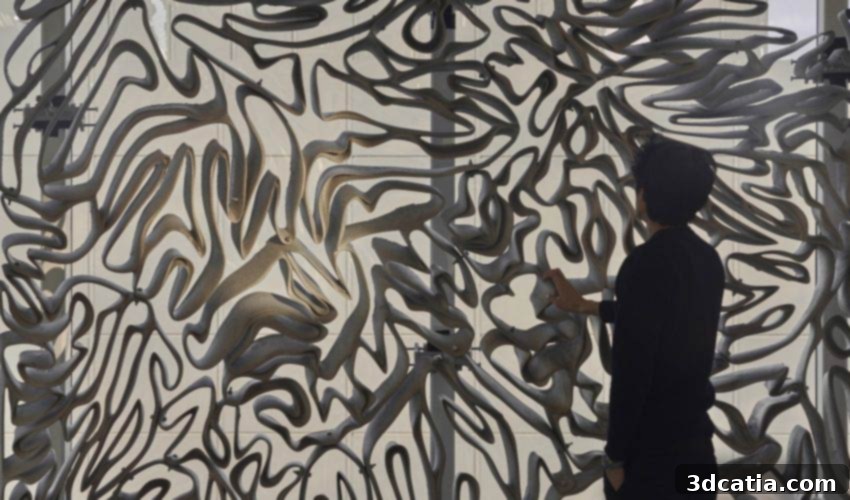
Revolutionizing Architectural Design: ETH Zurich Students Craft an Innovative 3D Printed Metal Facade
The convergence of advanced digital fabrication techniques and architectural design continues to push the boundaries of what is possible in construction. A groundbreaking example of this innovation comes from the University of Applied Sciences, ETH Zurich, where a team of visionary students has successfully created a monumental 6-meter-high and 4-meter-wide metal facade. This impressive structure, aptly named ‘Deep Facade,’ stands as a testament to the transformative power of 3D printing technology in architecture. It was meticulously crafted by assembling 26 intricately articulated metal panels, each born from a sophisticated 3D printed mold.
The Evolving Landscape of 3D Printing in Art and Architecture
In contemporary design and artistic expression, the application of 3D printing has transitioned from a niche technology to a common and indispensable tool. Artists across various disciplines have leveraged additive manufacturing to transcend traditional creative limitations, particularly in achieving unparalleled geometric freedom. These advanced 3D technologies empower designers to explore forms of immense complexity and offer unprecedented opportunities for customization, a capability that holds particular significance within the architectural sector. The ‘Deep Facade’ project by the ETH Zurich students perfectly encapsulates this paradigm shift, serving as a powerful illustration of how these technologies can redefine structural aesthetics and functionality.
Traditional manufacturing processes often impose significant constraints on design, limiting intricate details and complex geometries due to the difficulties and costs associated with mold making or intricate assembly. 3D printing, however, liberates designers from these restrictions, enabling the direct fabrication of highly complex components that would be impossible or prohibitively expensive to produce otherwise. This newfound freedom not only facilitates novel aesthetic expressions, as seen in all kinds of artistic works, but also opens doors for optimizing structural performance through advanced computational design methods.
Innovative Fabrication: 3D Printed Molds for Bespoke Metal Structures
The ‘Deep Facade’ is an aluminum structure, uniquely conceived by its creators as an intricate network of metal ribbons that organically connect, drawing inspiration from the complex folds of the human cerebral cortex. This design choice is not merely aesthetic; it reflects a deeper engagement with biomorphic principles to achieve both structural integrity and visual dynamism. The project was developed as an integral part of an advanced course in architecture and digital manufacturing, specifically designed to bridge the geometric versatility offered by 3D printing with the inherent structural properties of cast metal.
Aghaei Meibodi, a distinguished researcher at ETH Zurich and a driving force behind the project, eloquently articulates the significance of their approach: “Cast metal parts have a long tradition in architecture due to their extraordinary structural properties and possible 3D form. Today, the amount of manual labor involved, especially in the mold-making process, makes them too expensive. With our approach using a 3D-printed mold, we make it possible and affordable again to fabricate bespoke structural metal parts — parts with unseen richness of detail and geometric complexity.” This statement highlights a critical problem in modern architecture – the high cost barrier preventing the widespread use of custom cast metal components – and presents 3D printing as a viable, cost-effective solution.
The Technology Behind Deep Facade: Powder Binding and Topological Optimization
The intricate design and fabrication of the ‘Deep Facade’ were made possible through the innovative application of 3D printed molds. This manufacturing method proved to be significantly faster and more economical for the students compared to traditional mold-making techniques, which often require laborious manual carving or expensive CNC machining. For the printing process, the team utilized an ExOne 3D printer, a leading system renowned for its precision and reliability, which operates based on advanced powder binding technology.
Powder binding, also known as binder jetting, is an additive manufacturing process where a liquid binding agent is selectively deposited onto a thin layer of powder material, typically sand or ceramic, to create a solid part layer by layer. Unlike other 3D printing methods that use heat to melt or fuse materials, binder jetting forms green parts at room temperature, which can then be infiltrated with other materials or used directly as sacrificial molds for casting. For the ‘Deep Facade,’ this technology allowed the students to produce highly detailed and complex sand molds quickly and efficiently, ready to receive molten aluminum with exceptional accuracy.
By synergistically combining the capabilities of 3D printing with sophisticated topological optimization algorithms, the students achieved remarkable results. Topological optimization is a computational design method that optimizes material distribution within a given design space for a specified set of loads and boundary conditions. This technique identifies the most efficient structural form, often resulting in organic, lightweight, and incredibly strong parts that are otherwise impossible to design or manufacture through conventional means. This allowed the ETH Zurich team to create custom-made metal parts that are not only exceptionally lightweight but also possess an unprecedented level of geometric complexity and structural performance.
The student team emphasized the profound impact of this integrated approach, stating that it “can unlock an entirely new vocabulary of shapes for metal structures in architecture, previously unavailable with traditional mold-making systems.” This bold claim underscores the potential for 3D printing to revolutionize architectural aesthetics and structural engineering, paving the way for designs that are both functionally superior and visually captivating. The ability to produce bespoke structural components with such intricate details and optimized forms marks a significant leap forward in the field of digital fabrication for architecture, promising more sustainable and creatively boundless construction methods.
The metal is poured into the 3D printed mold, demonstrating the precision of additive manufacturing in complex casting processes.
Biomorphic Inspiration and Aesthetic Prowess
Beyond its technological innovation, the ‘Deep Facade’ stands out for its profound biomorphic inspiration. The structure deliberately mimics the organic development patterns observed in certain living organisms, creating a facade that feels alive and dynamic. This design philosophy not only contributes to its unique aesthetic but also often leads to inherently efficient and resilient structures, echoing nature’s own optimized forms. The intricate folds and connections within the Deep Facade evoke a sense of continuous growth and adaptation, characteristics often admired in natural systems.
The facade’s liquid appearance and inherent strength, derived from cast metal, evoke a sense of fluidity and robustness that contrasts sharply with the static, often monolithic qualities of traditional building materials such as sandstone or concrete. This comparison underscores the advanced capabilities of the ‘Deep Facade’ to embody both delicate artistry and formidable durability. The interplay of light and shadow on its articulated, cerebral-cortex-like surfaces creates an ever-changing visual spectacle, adding another layer of depth and engagement for onlookers. Such a dynamic interplay allows the facade to transform throughout the day, responding to changing environmental conditions and human perspectives.
The use of aluminum, a material known for its high strength-to-weight ratio, excellent corrosion resistance, and recyclability, further enhances the longevity and sustainability of the facade. By combining an advanced manufacturing process with a carefully selected material and a biomimetic design approach, the ETH Zurich students have not only created a visually stunning structure but also a highly functional, durable, and environmentally conscious one.
The Future of Architectural Fabrication
The ‘Deep Facade’ project from ETH Zurich is more than just an academic exercise; it represents a significant milestone in the ongoing evolution of architectural fabrication. It demonstrates the immense potential for additive manufacturing to create custom, structurally optimized, and aesthetically captivating building components. This research paves the way for a future where architectural designs are no longer constrained by conventional manufacturing limitations, allowing for unprecedented levels of complexity, customization, and material efficiency.
The implications extend beyond just facades. This methodology could be applied to various structural elements, interior features, and even entire building systems, opening up new possibilities for sustainable construction. By reducing material waste through topological optimization and enabling on-demand production of intricate parts, 3D printing in architecture contributes to more environmentally friendly building practices. Furthermore, the ability to rapidly iterate and produce bespoke designs allows architects to realize their most ambitious visions, fostering a new era of creative freedom and innovation.
Such projects from leading institutions like ETH Zurich are crucial for bridging the gap between cutting-edge research and practical application in the construction industry. They inspire new generations of architects and engineers to embrace digital tools and explore novel fabrication techniques, ultimately shaping the built environment of tomorrow. The ‘Deep Facade’ stands as a powerful symbol of this exciting future, where buildings are not just structures but dynamic, intricately designed works of art that push the boundaries of technology and creativity.
For those interested in delving deeper into the technical intricacies and design philosophy behind this remarkable achievement, the entire manufacturing process is comprehensively documented in the video below. Additionally, further details and insights can be found on the ETH Zurich official website, which provides an in-depth look at the project’s development and outcomes.
Join the Conversation
What are your thoughts on the innovative ‘Deep Facade’ structure and its potential impact on architectural design? We invite you to share your perspectives and insights! Let us know what you think in a comment below, or join the discussion on our social media channels – find us on Facebook and Twitter. Don’t miss out on the latest advancements and news in the world of 3D printing. Sign up for our free weekly Newsletter to get all the cutting-edge updates delivered straight to your inbox!