
Revolutionizing Neurotechnology: MIT’s Breakthrough in 3D Printing Soft, Flexible Brain Implants
The field of neurotechnology is poised for a significant transformation thanks to groundbreaking research at MIT. A dedicated team of researchers is pioneering the development of 3D printed neural implants that are as soft and flexible as rubber, a stark contrast to the rigid, metallic implants traditionally used in brain research and clinical applications. This innovative approach promises to dramatically improve the compatibility of brain implants with the delicate contours of our brains, thereby mitigating common issues such as inflammation and the detrimental accumulation of scar tissue. The team is currently in advanced testing phases, having already achieved remarkable success by implanting their novel 3D printed neural device, fabricated from a highly conductive polymer, into a mouse. This critical step has allowed them to obtain a precise and detailed image of the brain’s intricate activity, demonstrating the immense potential of this new technology.
More broadly, the medical sector, and particularly specialized fields like dentistry, are increasingly leveraging the power of additive manufacturing to design and produce tailor-made implants. These customized solutions offer unparalleled adaptation to each patient’s unique morphology, leading to enhanced efficacy and reduced post-operative complications. Beyond direct patient care, 3D printing plays a pivotal role throughout the research and development lifecycle, enabling scientists to visualize and understand complex biological structures, and significantly accelerating the deployment of innovative solutions. When it comes to the profound study of the brain – arguably one of the most complex and vital organs – 3D printing facilitates the design and rapid prototyping of sophisticated devices for detailed study, rigorous testing, continuous monitoring, and various therapeutic interventions. The team led by Xuanhe Zhao, a distinguished professor of mechanical engineering and civil and environmental engineering at MIT, has harnessed these advanced 3D printing technologies to develop flexible brain implants that are capable of monitoring the organ’s electrical activity over extended periods without causing aggravation or damage to the surrounding delicate neural tissue.
The Critical Need for Flexible Neural Interfaces
Traditional brain implants, typically composed of rigid metals like platinum or tungsten, have served as crucial tools for neuroscience research and clinical interventions, including deep brain stimulation for Parkinson’s disease and seizure detection in epilepsy. However, their inherent rigidity poses significant long-term challenges. The mechanical mismatch between a stiff implant and the soft, viscoelastic brain tissue leads to micro-motion and chronic irritation. This constant friction triggers the brain’s natural immune response, resulting in inflammation and the formation of a glial scar around the implant. This scar tissue not only encapsulates the device, isolating it from the neurons it’s meant to interact with, but also progressively degrades signal quality over time, limiting the implant’s functional lifespan and therapeutic effectiveness. Addressing these limitations is paramount for advancing our understanding of neurological disorders and developing more effective, long-lasting treatments.
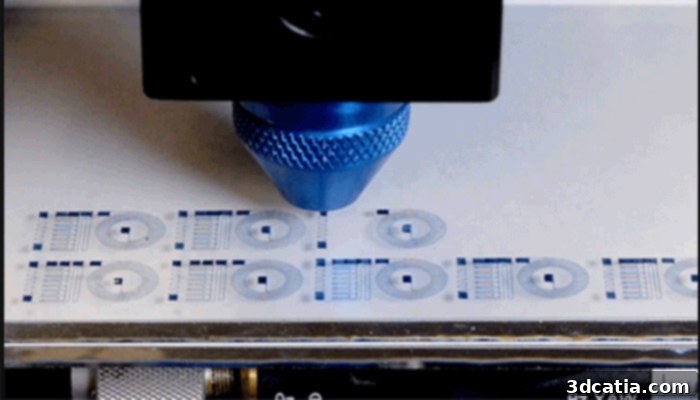
3D printing of the electrode | Credits: MIT
Innovating with Polymer 3D Printing for Enhanced Biocompatibility
Recognizing that conventional metal electrodes and implants were inherently unsuitable for long-term, stable neural interfacing, the MIT researchers pivoted their focus towards a new generation of materials: conductive polymers. These materials offer the electrical conductivity necessary for neural signal processing while providing the flexibility and softness required for seamless integration with brain tissue. Historically, most conductive polymer solutions available on the market have been utilized as antistatic coatings, primarily in liquid form. However, this liquid state presents significant challenges for additive manufacturing, particularly when attempting to create intricate, high-resolution 3D structures. Hyunwoo Yuk, a graduate student within the Zhao group at MIT, elaborated on this difficulty: “The liquid form is mostly for homogenous coatings, and it’s difficult to use this for any two-dimensional, high-resolution patterning. In 3D, it’s impossible.” This fundamental limitation necessitated a novel approach to material science, prompting the researchers to develop a new printable form – specifically, a unique hydrogel ink that could retain its conductive properties while being compatible with extrusion-based 3D printing.
The specific polymer chosen for this revolutionary application is PEDOT:PSS, a highly regarded conductive material typically supplied as a dark blue liquid ink. To transform this liquid into a printable medium suitable for their exacting requirements, the MIT team devised an ingenious process. They freeze-dried the PEDOT:PSS, a method that effectively removes the liquid component, yielding a dry matrix composed of conductive nanofibres. These delicate nanofibres, which tend to break apart on their own, were then meticulously mixed with a proprietary hydrogel – a complex mixture primarily composed of water and an organic solvent. The critical step involved carefully calibrating the concentration of nanofibres; the team discovered that adding 5-8% nanofibres resulted in a paste that exhibited a consistency strikingly similar to toothpaste. This optimal rheology was crucial, as it provided the necessary viscosity and shear-thinning properties required for precise extrusion through a 3D printer nozzle, enabling the creation of the desired micro-scale 3D printed neural devices with unprecedented accuracy and flexibility.
Crafting and Testing a Novel 3D Printed Neural Device
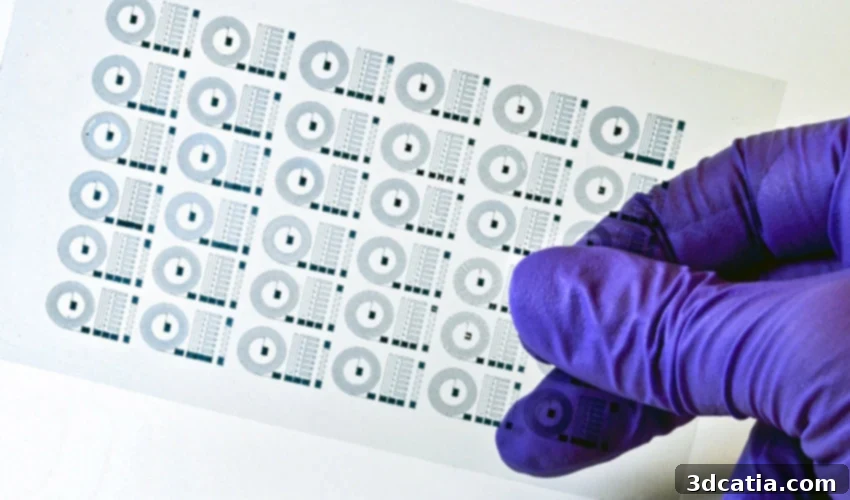
With their innovative conductive hydrogel ink developed, the MIT team proceeded to fabricate and rigorously test their material. Their initial prototype was a small, rubbery electrode, remarkably no larger than a piece of confetti. This miniature device was meticulously constructed on a foundation of a flexible, transparent polymer layer. Upon this base, the researchers precisely extruded the conductive polymer paste in thin, parallel lines. These conductive traces were designed to converge at an extremely fine point, specifically engineered to be small enough – approximately 10 microns wide – to effectively capture the electrical signals emanating from a single neuron. This level of precision is critical for high-resolution brain mapping and understanding individual neuronal activity.
The next crucial phase involved validating the functionality of this novel electrode in a biological setting. The tiny electrode was carefully implanted into the brain of a mouse. The results were profoundly encouraging: the team successfully captured signals from one of its neurons, allowing them to accurately monitor its brain activity. This achievement marks a significant leap forward in neural interface technology. Professor Zhao eloquently summarized the profound advantages of their innovation: “Traditionally, electrodes are rigid metal wires, and once vibrations occur, these metal electrodes could damage tissue. We’ve shown that you can now insert a gel probe instead of a needle. In addition, the sensitivity of this electrode is higher.” This statement highlights two key benefits: the ability to minimize tissue damage due to the implant’s inherent flexibility and the superior signal acquisition capabilities compared to conventional rigid designs.
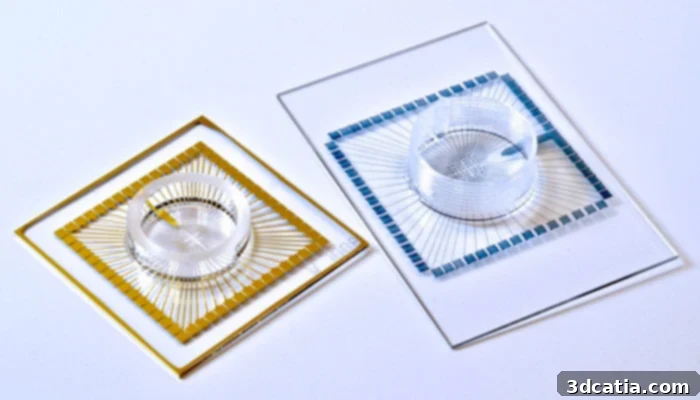
Researchers also designed a multi-electrode array | Credits: MIT
Beyond the single-neuron probe, the ingenious MIT team also engineered and fabricated a multi-electrode array. This larger device, resembling a small plastic square the size of a standard post-it note, was intricately printed with numerous very thin electrodes. The successful development and testing of both the single-neuron electrode and the multi-electrode array open up unprecedented avenues. These advanced 3D printed devices hold immense promise for tailoring highly effective, long-term brain therapies and customized implants, addressing a wide spectrum of complex neurological disorders, from epilepsy and Parkinson’s to depression and spinal cord injuries. The ability to create mechanically compliant and highly sensitive interfaces marks a paradigm shift, allowing for more stable, chronic monitoring and intervention within the brain without causing undue stress or damage. In any case, this innovative application of 3D printing represents an exceptionally promising development for the future of brain research and clinical neuroscience. Further detailed information about this pioneering research can be found HERE.
The Future Landscape: Long-Term Therapies and Deeper Brain Understanding
The implications of MIT’s breakthrough extend far beyond the laboratory. The ability to create soft, flexible, and highly sensitive neural implants unlocks new possibilities for long-term monitoring and therapeutic interventions in the brain. For patients suffering from chronic neurological conditions, such implants could offer continuous, high-fidelity data on brain activity, enabling more precise disease management and personalized treatment strategies. Imagine implants that can continuously detect early signs of an epileptic seizure and deliver targeted electrical stimulation to abort it, or devices that restore motor function by precisely reading intentions from the motor cortex. Furthermore, the reduced inflammatory response and scar tissue formation mean these implants could remain functional for significantly longer periods, minimizing the need for revision surgeries and improving patient quality of life.
This technology also holds tremendous potential for advancing fundamental neuroscience research. By providing a more benign and stable interface with neural tissue, scientists can gain deeper insights into how the brain processes information, forms memories, and generates complex behaviors. Such insights are crucial for understanding the root causes of neurological and psychiatric disorders, paving the way for truly transformative cures. While the initial successes are highly encouraging, the journey ahead involves addressing challenges related to long-term biocompatibility, manufacturing scalability, and rigorous regulatory approval processes. Nevertheless, the foundation laid by MIT’s team represents a monumental step towards a future where brain implants are not just effective but also seamlessly integrated and truly ‘brain-friendly’.
What are your thoughts on this groundbreaking research from the MIT team? We invite you to share your perspectives in a comment below or join the discussion on our Facebook and Twitter pages! Don’t forget to sign up for our free weekly Newsletter to receive all the latest news and innovations in 3D printing delivered straight to your inbox!