
Oxford University’s Breakthrough in 3D Bioprinting: Paving the Way for Advanced Regenerative Medicine and Ethical Tissue Engineering
Researchers at the esteemed University of Oxford have unveiled a groundbreaking method for 3D printing living tissue, leveraging meticulously lab-grown cells. This significant development marks a pivotal moment in the field of bioprinting. While previous advancements in 3D bioprinting have seen successes, such as the impressive work on human cartilage in Sweden, Oxford’s latest innovation stands out by offering unparalleled control and resolution, setting a new benchmark for tissue engineering. This pioneering research conducted in England is poised to revolutionize regenerative medicine, promising the creation of intricate tissues and functional cartilage constructs that could transform medical treatments and research methodologies worldwide.
The ambitious research initiative was spearheaded by Professor Hagan Bayley, a leading figure in Chemical Biology. The project benefited immensely from the collaborative spirit of an interdisciplinary team, drawing expertise from several key departments within Oxford University. Scientists from the Departments of Chemistry and Physiology, Anatomy and Genetics, alongside specialists from the Center for Molecular Medicine at Bristol, united their knowledge and skills to achieve this remarkable feat. This cross-disciplinary approach was crucial in tackling the complex challenges associated with bioprinting living, functional tissues, integrating insights from molecular biology, materials science, and engineering to develop a truly novel solution.
The innovative 3D droplet bioprinter, a marvel of precision engineering, was meticulously developed by the Bayley Research Group at Oxford, demonstrating their commitment to pushing the boundaries of scientific discovery. Photo credit: Alexander Graham
In a comprehensive paper recently published in the prestigious Scientific Reports Journal, the Oxford team meticulously detailed their innovative methodology. They successfully employed human embryonic kidney cells (HEK) and ovine mesenchymal stem cells (oMSCs) to showcase the versatility and efficacy of their bioprinting platform. This demonstration was critical in proving that a diverse range of both human and animal cells could be precisely printed into high-resolution tissue constructs. The ability to work with various cell types significantly broadens the potential applications of this technology, from developing patient-specific therapies to creating advanced models for disease research and drug discovery.
Central to their groundbreaking approach was the development of a sophisticated 3D bioprinter capable of encapsulating individual cells within protective nanoliter droplets. These microscopic droplets, each containing a single cell, were further enveloped in a specialized oil coating. This ingenious process dramatically improved the survival rate and viability of the delicate cells during and after the printing process. By enabling researchers to meticulously deposit one droplet at a time, the technique allowed for the creation of exceptionally high-resolution tissue structures, surpassing the capabilities of many existing bioprinting methods. This precision is paramount for replicating the intricate architecture of natural tissues, which is essential for their functionality in regenerative applications.
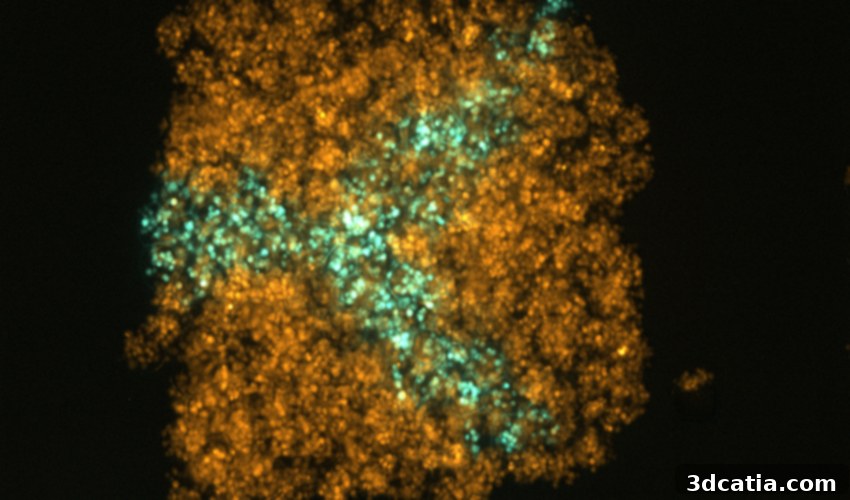
A stunning confocal micrograph illustrates an artificial tissue, meticulously fabricated and containing two distinct populations of human embryonic kidney cells, precisely printed within a cube. Photo credit: Sam Olof and Alexander Graham
Dr. Alexander Graham, the lead author of the study and a distinguished 3D Bioprinting Scientist at OxSyBio, elaborated on the team’s overarching objective: “Our primary aim was to fabricate three-dimensional living tissues that could authentically exhibit the fundamental behaviors and physiological responses characteristic of natural biological organisms.” He further emphasized the engineering aspect of their work: “We deliberately concentrated on designing a high-resolution cell printing platform, constructed from relatively inexpensive components, which could be utilized to reliably and reproducibly produce artificial tissues with appropriate complexity from a diverse array of cell types, including invaluable stem cells.” This focus on cost-effectiveness and reproducibility is crucial for the widespread adoption and scalability of this innovative technology.
The ramifications of this latest innovation are profound and far-reaching, with healthcare poised to be the primary beneficiary of these advancements. The potential applications are vast and transformative. For instance, this technology could revolutionize toxicology research by enabling the creation of accurate human tissue models, thereby drastically reducing the reliance on, and potentially leading to the complete cessation of, animal testing. Beyond toxicology, this bioprinting method holds immense promise for personalized medicine, drug screening, and the development of in vitro disease models that more closely mimic human physiology. Imagine the ability to print functional patches of heart tissue for cardiac repair, or complex neural networks for studying neurodegenerative diseases – the possibilities are truly immense.
The comprehensive study also illustrated the successful phase transfer and culture of printed constructs containing HEK-293T cells, highlighting the robustness of the bioprinted tissues. Photo credit: Scientific Reports 7, Article number: 7004 (2017)
Recognizing the immense potential, the researchers are actively pursuing avenues for commercializing this cutting-edge technology. OxSyBio, a dynamic London-based medical 3D printing company, has stepped forward to spearhead the efforts to commercialize this technique for a wide range of biomedical and industrial purposes. This strategic partnership aims to bridge the gap between academic discovery and practical application, ensuring that the benefits of this innovation can reach patients and researchers globally. The commercialization strategy focuses on developing robust bioprinting systems and protocols that can be adopted by pharmaceutical companies, research institutions, and potentially even clinical settings for therapeutic applications.
Looking ahead, the research pipeline is vibrant with future developments. Over the next several months, the team plans to trial new complementary 3D printing techniques, which will further expand the capabilities of their platform. This continuous innovation will empower researchers to experiment with an even broader spectrum of living and hybrid materials, facilitating the creation of increasingly complex and functional biological structures on an industrial scale. The scalability of bioprinting is a critical challenge, and these ongoing efforts are geared towards overcoming current limitations to enable mass production of bio-printed tissues and organs.
Dr. Adam Perriman, a key contributor from the University of Bristol’s School of Cellular and Molecular Medicine, underscored the profound impact of their findings: “The remarkable ability to 3D print with adult stem cells and observe their sustained differentiation into specialized cell types was truly astounding. This achievement unequivocally demonstrates the immense potential of this novel methodology to profoundly influence regenerative medicine globally.” The successful differentiation of stem cells post-printing is a cornerstone for creating truly functional tissues, as it ensures that the printed constructs can mature and integrate into the body effectively, paving the way for advanced therapies for injuries, chronic diseases, and organ failure.
This Oxford breakthrough not only represents a triumph in scientific endeavor but also heralds a new era for ethical research and personalized healthcare. By offering viable alternatives to animal testing and accelerating the development of human-relevant disease models, it aligns with a growing global demand for more humane and effective research practices. The ability to engineer complex living tissues with such precision and reproducibility holds the promise of fundamentally altering how we approach drug discovery, transplant medicine, and the treatment of debilitating conditions. The integration of high-resolution bioprinting with advanced cell biology expertise truly positions Oxford at the forefront of this exciting domain.
For those interested in delving deeper into the specifics of this groundbreaking research, the full report is available for review here.
What future innovations do you envision stemming from this monumental development in 3D bioprinting? We encourage you to share your thoughts and predictions in a comment below or join the discussion on our vibrant Facebook or active Twitter page! Don’t miss out on the latest updates and breakthroughs in the world of 3D printing; make sure to sign up for our free weekly Newsletter, delivering all the essential news directly to your inbox!