
North Korea’s 3D Printing Ambitions: A New Frontier in Weapons Proliferation?
3D printing, also known as additive manufacturing, has rapidly emerged as a transformative force, revolutionizing industries from healthcare to aerospace. Its potential to innovate and improve our quality of life is undeniable, offering unprecedented capabilities in rapid prototyping, customized production, and complex geometry creation. However, like any powerful technology, 3D printing possesses a dual-use nature, meaning it can be harnessed for both beneficial and destructive purposes. A recent report by the Asia Times has brought this critical concern into sharp focus, suggesting that North Korea may be leveraging these advanced technologies in its pursuit of weapons of mass destruction (WMD). Given the international community’s long-standing concerns about North Korea’s ballistic missile and nuclear programs, the potential integration of 3D printing into their illicit weapons development raises alarming questions about the future of global security and the effectiveness of current non-proliferation efforts. Could this innovative technology further enable their ambition to develop and proliferate WMDs, bypassing traditional barriers and accelerating their capabilities?
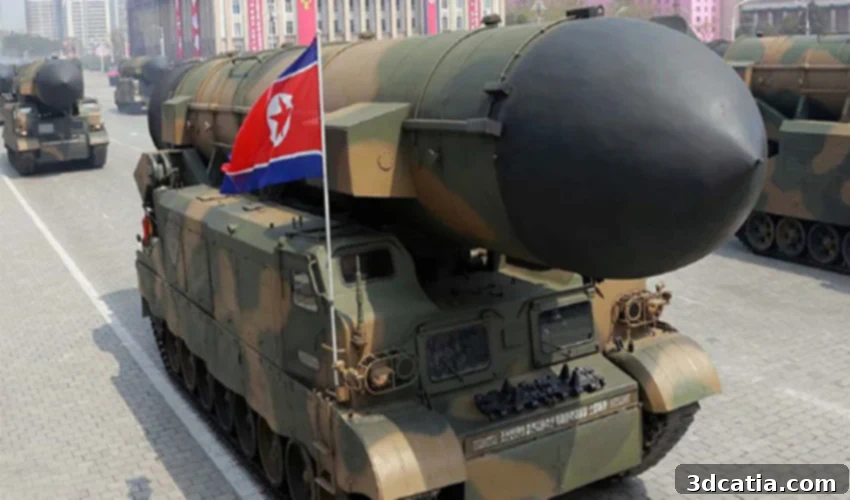
North Korea has been steadily building up their own missile capabilities.
The Strategic Appeal of Additive Manufacturing for Sanctioned States
While North Korea has not historically been recognized for its innovation in additive manufacturing, the strategic advantages offered by 3D printing technologies are acutely relevant to a state operating under severe international sanctions. For nations like North Korea, which face significant obstacles in accessing conventional supply chains and advanced industrial equipment, 3D printing presents a compelling alternative with numerous benefits:
- Reduced Development Cycles: Additive manufacturing allows for rapid prototyping and iterative design. Engineers can quickly print and test multiple versions of a component in a fraction of the time it would take with traditional manufacturing methods. This accelerates the research and development phase, enabling faster progress in complex weapon systems.
- Reduced Costs: By minimizing the need for expensive tooling, molds, and specialized machinery, 3D printing significantly lowers production costs. It also promotes material efficiency, reducing waste, which is crucial for resource-constrained economies. Furthermore, the ability to produce components on-demand can prevent the need for large, costly inventories.
- Reduced Staffing Requirements: The automation inherent in 3D printing processes can decrease the reliance on a large, highly specialized workforce. This not only streamlines production but also makes it easier to conduct clandestine operations, as fewer personnel are involved, and facilities can be smaller and less detectable.
- Bypassing Supply Chain Restrictions: Perhaps the most critical advantage for North Korea is the potential to circumvent international sanctions. Instead of importing finished components or complex machinery, they could potentially acquire raw materials (filaments, powders) and commercial 3D printers, or even reverse-engineer existing models. This enables them to produce critical parts domestically, insulating their weapons programs from external pressure.
- Customization and Complexity: 3D printing excels at creating highly complex geometries and custom parts that are difficult or impossible to achieve with traditional methods. This capability is invaluable for designing intricate components for missiles, warheads, or other advanced weapon systems, potentially enhancing their performance or enabling new designs.
North Korea’s Technological Pursuits Amid Sanctions
Despite its isolation, North Korea has demonstrated a persistent drive to acquire and adapt advanced technologies. In 2016, reports surfaced indicating the introduction of an almost exact copy of the first-generation MakerBot Replicator 3D printer into North Korea. While this model is considered rudimentary by current global standards, it was a significant indicator of the regime’s intent and interest in additive manufacturing. This event suggests that while North Korea may lag behind technologically, it is actively engaged in efforts to bridge this gap, often through illicit means, reverse engineering, and domestic replication.
The primary message North Korea consistently aims to convey to the world is its resilience and capability to defy international sanctions. The regime seeks to demonstrate that regardless of the stringent measures in place to restrict access to technological advancements, it can still acquire and utilize these technologies through various unconventional avenues. A clear precedent for this strategy can be observed in their documented use of CNC (Computer Numerical Control) machining to produce various intricate components for their missile programs. This highlights a pattern of adapting and leveraging accessible manufacturing techniques to achieve strategic objectives, underscoring the potential for 3D printing to become another tool in their arsenal for bypassing restrictions and advancing their military capabilities.
The Broader Threat: 3D Printing, WMDs, and Global Security
The potential for weapons created using 3D printing poses a significant concern.
The notion of states like North Korea, or even non-state actors, developing sophisticated weapons, including components for weapons of mass destruction, using 3D printing is no longer a far-fetched scenario. This year, Izumi Nakamitsu, the UN Under-Secretary-General for Disarmament Affairs, issued a grave warning regarding the convergence of emerging technologies. She specifically highlighted how 3D printing, combined with the proliferation of drones and the anonymity offered by the Dark Web, could empower terrorist groups and other illicit actors to manufacture their own weapons. This ominous prediction underscores a fundamental shift in the landscape of proliferation, where the barrier to entry for weapon production is significantly lowered.
The availability of digital blueprints for firearms on the Dark Web serves as a stark reminder of this evolving threat. These files, sometimes alarmingly priced as low as $12, demonstrate how easily weapon designs can be distributed globally, transcending physical borders and traditional export controls. Once these digital files are acquired, anyone with access to a relatively inexpensive 3D printer and basic materials can theoretically produce functional components or even entire firearms. This democratizes weapon manufacturing, moving it from the exclusive domain of state-sponsored industries to potentially individuals or small clandestine groups.
The implications for WMD development are even more severe. While printing an entire nuclear warhead is currently beyond the scope of readily available 3D printing technology, the ability to produce critical, complex components for missile guidance systems, warhead casings, or chemical/biological agent dispersal mechanisms could significantly aid a state like North Korea. Such capabilities could enhance the precision, reliability, or miniaturization of their weapon systems, making them more potent and harder to interdict. Furthermore, the decentralized nature of 3D printing makes monitoring and intelligence gathering exceptionally challenging, as production could occur in smaller, less conspicuous facilities, further complicating international efforts to curb proliferation.
Challenges, Access, and the Future Outlook
Despite North Korea’s restricted access to global markets and advanced international technologies, analysts, including those at Asia Times, express significant concern that the country will ultimately find a way to access industrial-grade 3D printers and the necessary specialized materials. The question is not if, but when. This access could be facilitated through several channels:
- Illicit Procurement Networks: North Korea has a well-established history of operating sophisticated illicit procurement networks to acquire banned technologies and components. These networks could be leveraged to import industrial 3D printers or critical spare parts.
- Industrial Espionage: Cyber espionage and human intelligence could be used to steal proprietary designs, manufacturing processes, or even control software for advanced 3D printing systems.
- Dual-Use Technology Imports: Some industrial 3D printers and materials may initially be marketed for legitimate civilian applications, making their export less scrutinized. North Korea could acquire these dual-use technologies and then adapt them for military purposes.
- Reverse Engineering and Domestic Development: As seen with the MakerBot copy, North Korea has demonstrated a capacity for reverse engineering foreign technologies. They could acquire commercial systems and attempt to replicate or improve upon them domestically, eventually developing their own indigenous industrial 3D printing capabilities.
If North Korea succeeds in integrating full-fledged industrial 3D printing into its weapons programs, the impact on regional and global security would be profound. It would enable faster, more clandestine development of advanced components, potentially leading to more sophisticated and diverse weapon systems. This would further complicate disarmament negotiations and increase the threat of proliferation, challenging existing non-proliferation treaties and international monitoring regimes.
The growing concern over North Korea’s potential use of 3D printing for weapons development underscores the urgent need for a robust and adaptive international response. Monitoring technological advancements, strengthening export controls on dual-use technologies, and enhancing intelligence cooperation are crucial steps to mitigate this evolving threat. Do you think North Korea will eventually possess full-fledged 3D printing technologies for sophisticated weapons creation? Share your thoughts in a comment below or join the discussion on our Facebook and Twitter pages! Don’t forget to sign up for our free weekly Newsletter to stay informed with all the latest news in 3D printing, delivered straight to your inbox!