
Revolutionizing Sports: How 3D Printing is Redefining Athletic Equipment with Wilson’s Airless Basketball
The world of sports is constantly evolving, driven by innovation that pushes the boundaries of human performance and equipment design. Among the most transformative technologies to emerge in recent years, 3D printing, also known as additive manufacturing, stands out for its immense potential. From enhancing accessibility by creating custom-designed prostheses for athletes to crafting high-performance gear that gives elite competitors a decisive edge, 3D printing is fundamentally changing how sports equipment is conceived, developed, and produced. This advanced manufacturing method allows for unparalleled customization, complex geometries, and rapid prototyping, making it an indispensable tool for athletes, coaches, and manufacturers alike.
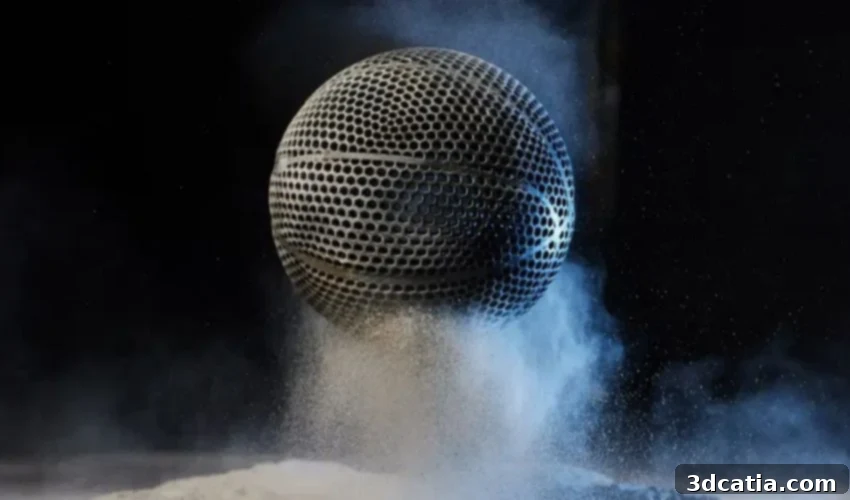
In a groundbreaking demonstration of this potential, Wilson, the renowned company responsible for supplying the official NBA basketballs, unveiled a revolutionary product: the ‘Wilson Airless Prototype’. This remarkable 3D-printed basketball eliminates the need for inflation, a fundamental shift in basketball design. Unlike traditional balls that rely on internal air pressure, this innovative creation features a unique surface characterized by an intricate lattice of hexagonal holes. This open structure allows air to pass freely through the ball, yet it maintains the necessary bounce and flight characteristics essential for the game. The concept of an “airless” basketball not only offers unparalleled convenience by removing the hassle of inflation but also promises consistent performance unaffected by pressure fluctuations or punctures, thereby offering a glimpse into the future of sports equipment.
The journey to create the Wilson Airless Prototype was a testament to collaborative innovation. Wilson partnered with General Lattice, a leading computational design company, to develop the intricate structural design. General Lattice’s expertise in generative design and advanced simulations was crucial in optimizing the hexagonal lattice pattern, ensuring the ball replicated the performance attributes of a conventional basketball while entirely eliminating the need for air. This partnership leveraged cutting-edge software to iterate through countless design possibilities, ultimately landing on a structure that provided the optimal balance of weight, bounce, and durability. The computational design phase was pivotal in translating a visionary concept into a tangible, high-performing prototype that met rigorous sporting standards.
Once the sophisticated design was finalized, Wilson turned to EOS, a global leader in industrial 3D printing, to bring the digital model to life. The team utilized EOS’s advanced additive manufacturing capabilities to transform the detailed STL file into a physical basketball. Specifically, they employed Selective Laser Sintering (SLS) technology, a powder-bed fusion process that is highly regarded for its ability to produce strong, functional parts with complex geometries. SLS works by using a high-powered laser to selectively fuse small particles of polymer powder into a solid structure, layer by layer. This process is ideal for the Wilson Airless Prototype because it allows for the creation of the ball’s intricate internal lattice structure without the need for support material, which would be difficult to remove from such a complex design. The chosen material for this prototype was a durable, high-performance polymer, selected for its resilience, consistent mechanical properties, and ability to withstand the rigorous demands of basketball play. The precision of SLS technology ensures that each hexagonal opening and structural support within the ball is accurately rendered, contributing to its consistent bounce and feel.
After the 3D printing process, the prototype underwent essential post-processing steps to achieve its final look and feel. These steps are crucial for enhancing the aesthetic appeal, mechanical performance, and durability of 3D-printed parts. The team first applied a smoothing technique, a specialized post-processing method designed to create smooth and uniform surfaces. While SLS produces parts with a slightly granular finish, smoothing refines this texture, making the ball comfortable to handle and visually appealing. Following smoothing, DyeMansion’s advanced dyeing technology was utilized. DyeMansion specializes in fully automated coloring solutions for 3D-printed polymers. Their dyeing process involves penetrating and chemically reacting with the polymeric surface of the basketball, ensuring a vibrant, consistent, and long-lasting color that stands up to wear and tear. These post-processing stages were not merely cosmetic; they played a vital role in elevating the prototype from a functional object to a high-quality product ready for real-world application, demonstrating the full capability of the additive manufacturing workflow.
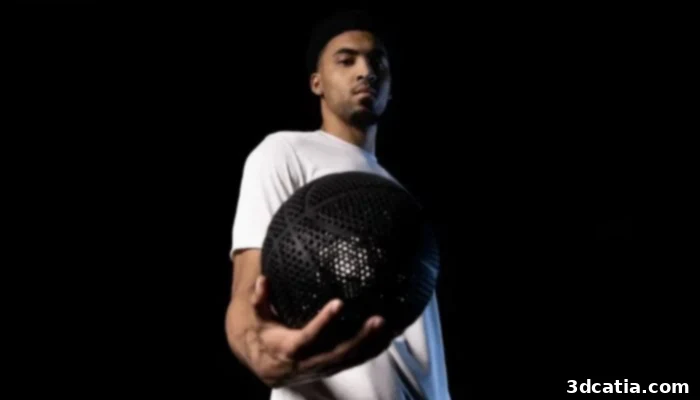
While currently a prototype, the Wilson Airless Basketball is far from a mere conceptual exercise that will never materialize beyond the drawing board. In a significant validation of its potential, this innovative ball has already made its public debut on a prominent stage. On Saturday night, February 18th, the prototype was put to the test by Houston Rockets winger KJ Martin during the first round of the AT&T Slam Dunk Contest. This annual NBA competition challenges players to execute the most spectacular slam dunks, making it a high-visibility event where equipment performance is under intense scrutiny. Martin’s use of the 3D-printed ball during such a prestigious event underscores Wilson’s confidence in its design and functionality, signaling a serious commitment to bringing this technology to market. The successful debut demonstrated that an airless, 3D-printed basketball could indeed perform at the highest levels of professional sport, capturing the attention of athletes, fans, and the broader manufacturing industry.
The philosophy guiding Wilson’s innovation efforts is deeply rooted in user experience and real-world applicability. According to Bob Thurman, Vice President of Innovation at Wilson, a core principle behind the development of the Airless Prototype was ensuring that the product would be genuinely desired and used by athletes. Thurman emphasized that if a player does not ultimately want to use the basketball in their sport, regardless of its technological sophistication, the product is essentially a wasted effort. This user-centric approach highlights Wilson’s commitment to delivering not just novelties, but truly functional and desirable sporting goods. Kevin Kryziak, Senior Director of R&D at Wilson, further elaborated on this vision, stating that the firm continually strives to integrate cutting-edge technologies to expand the realm of what is perceived as possible in sports equipment. This relentless pursuit of innovation aims to “change perceptions” of both manufacturing processes and the very nature of athletic equipment, challenging traditional design paradigms and opening doors to unprecedented advancements. Wilson’s long-standing legacy in sports is built on such principles, constantly seeking to empower athletes through superior equipment, and the Airless Prototype is a shining example of this enduring commitment.
Beyond the immediate impact of revolutionary products like the Wilson Airless Prototype, a key overarching benefit of 3D printing in sports lies in its unparalleled ability to facilitate the creation of highly customized devices and equipment. This customization capability extends from professional athletes seeking marginal gains to amateur enthusiasts looking for enhanced comfort and performance. For instance, we previously highlighted the startup Personomic, a company specializing in customized bicycle grips. These grips are meticulously optimized to fit the individual rider’s hand, offering improved comfort, control, and reduced fatigue, irrespective of whether they are a casual cyclist or a competitive racer. This level of personalized fit, often unattainable with mass-produced items, is made possible through 3D scanning and additive manufacturing, which allows for the rapid production of bespoke parts.
The advantages of 3D printing extend significantly to elite athletes, where even minute improvements can translate into substantial competitive benefits. A prime example is the support provided to the German Olympic luge, bobsled, and skeleton teams by BMW. Through its advanced 3D printing manufacturing capabilities, BMW has produced improved sports equipment, offering these athletes a crucial edge. In high-speed, precision sports like luge and bobsled, factors such as aerodynamics, weight distribution, and structural rigidity are paramount. 3D printing allows engineers to rapidly design, test, and produce lightweight components with optimized aerodynamic profiles and customized ergonomics for each athlete, ensuring maximum efficiency and comfort. This level of rapid iteration and personalization would be prohibitively expensive and time-consuming using traditional manufacturing methods. Such applications underscore how additive manufacturing is not just about novelty, but about genuinely enhancing performance and safety in demanding athletic environments, providing athletes with equipment perfectly tailored to their unique physiology and the specific demands of their sport.
Returning to the innovative Wilson basketball, while it remains a prototype in its current iteration, its successful demonstration at a major NBA event undeniably marks an exhilarating and significant application of 3D printing technology. The potential implications for the sport of basketball are profound, suggesting a future where equipment is more durable, consistent, and perhaps even more sustainable. The concept of an “airless” ball could eliminate common issues such as deflation, punctures, and the need for pumps, streamlining the player experience. To delve deeper into the specifics of this groundbreaking project and Wilson’s broader exploration of additive manufacturing, interested readers can find detailed information on Wilson’s dedicated page HERE. This raises an intriguing question for the future: perhaps one day, all basketballs, from professional leagues to schoolyards, will be 3D printed? This vision isn’t limited to basketball; the advancements seen with the Wilson Airless Prototype could pave the way for similar innovations across a myriad of sports, from soccer balls to specialized training equipment, ultimately leading to a more customized, efficient, and technologically advanced sporting landscape.
What are your thoughts on this pioneering 3D-printed basketball and its potential to reshape the future of sports equipment? We invite you to share your insights and comments below, or engage with us on our various social media platforms, including LinkedIn, Facebook, and Twitter pages. Stay informed about the latest breakthroughs in additive manufacturing by signing up for our free weekly Newsletter here, delivering the most relevant 3D printing news directly to your inbox. For visual demonstrations and further content, you can also explore all our videos on our dedicated YouTube channel, where we regularly feature exciting innovations and applications of 3D printing technology across various industries.
*All photos credit: Wilson