
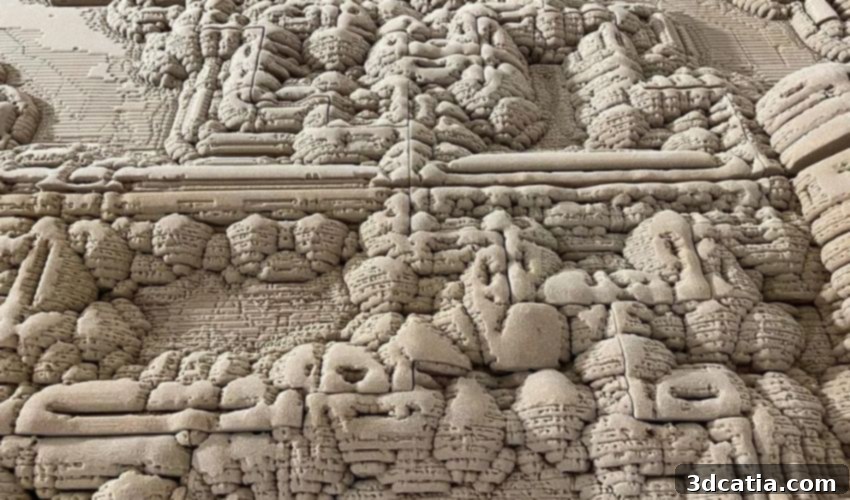
Unveiling Nadarra: Barry Wark’s Monumental 3D-Printed Sand Wall Pushes Sustainable Architecture Boundaries
While the discourse around additive manufacturing often gravitates towards advanced polymers, versatile resins, or the increasingly popular metals, the potential of more traditional, abundant materials is rapidly gaining recognition. Among these, ceramics are carving out a significant niche, but one material, often overlooked in the high-tech narrative, is sand. Indeed, 3D printing with sand is far from a nascent concept; it is already a well-established practice, particularly within the automotive industry where it’s used for intricate casting molds. Its adoption is also accelerating within the construction sector, especially for bespoke architectural elements and innovative design applications. Artists and designers worldwide are enthusiastically embracing this natural, readily available material, experimenting with its unique properties to create an astonishing array of applications that challenge conventional notions of form and function. A standout example of this innovative spirit is the work of architect and designer Barry Wark. In February 2022, Wark unveiled an awe-inspiring 3D-printed wall crafted entirely from sand at the grand opening of the temporary “Tomorrow Today” exhibition at the prestigious Museum of the Future in Dubai. This remarkable structure, named Nadarra, has since garnered immense attention, leading to its recent enlargement and permanent integration into the museum’s esteemed collection, further solidifying its status as a landmark in sustainable design and technological artistry.
Barry Wark is renowned for his collaborative approach, frequently engaging with international companies to bring his visionary projects to life across the globe. His design studio, established in 2017, marked a pivotal point in his career after years of impactful work in London. Today, Wark shares his extensive expertise and conducts cutting-edge research at the University of Pennsylvania’s Weitzman School of Design, shaping the next generation of architects and designers. A defining characteristic of all his projects is a profound ecological leitmotif; sustainability is not merely an afterthought but an omnipresent and foundational aesthetic principle. To achieve this holistic, environmentally conscious design language, Wark masterfully leverages computer-aided design (CAD) options alongside state-of-the-art, modern technological production methods. For the intricate execution of these advanced production techniques, he consistently seeks partnerships with pioneering industry leaders who push the boundaries of manufacturing. His notable collaborations include working with Rotterdam-based 3D printing innovator CONCR3DE, a partnership that yielded impressive artifacts showcased at the last Formnext exhibition. Furthermore, a highly fruitful and ongoing collaboration exists with the German company Sandhelden, which was instrumental in the construction of Nadarra and numerous other past projects. Sandhelden, a Bavarian pioneer in 3D printing with sand and its essential post-processing stages, has built a formidable reputation, particularly with its exquisitely designed 3D-printed bathroom furniture made from sand, demonstrating the material’s versatility and aesthetic appeal beyond industrial applications.
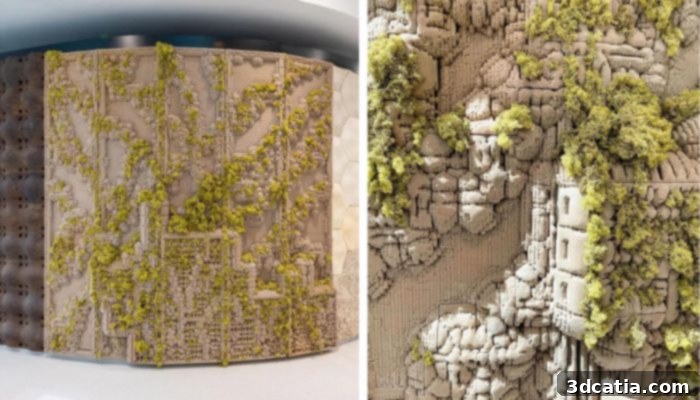
The initial exhibition featured a smaller, first version of Nadarra, which was still beautifully overgrown with moss at the time. A significantly larger version is now a permanent addition to the Museum of the Future’s collection. (Photo credits: Sandhelden)
The unparalleled expertise of Sandhelden proved absolutely indispensable for Barry Wark in realizing his ambitious vision: producing what he described as “the most complicated 3D-printed wall of all time.” Unlike its initial 2022 iteration, which featured lush greenery, the new, expanded version of Nadarra stands as a testament to pure form and scale, devoid of biological elements, yet all the more visually arresting. This monumental structure has been dramatically enlarged to an impressive 6×3 meters (approximately 20×10 feet), making it a dominant feature and a proud component of the museum’s permanent collection. The wall’s surface is a marvel of engineering and artistry, boasting an extraordinary level of intricate detailing that culminates in a truly unique and mesmerizing visual design. Achieving such complex, organic, and yet precise geometries would be virtually impossible with conventional manufacturing techniques. This is where 3D printing proved to be not just beneficial, but absolutely critical, offering the unparalleled freedom to create almost unlimited geometric shapes and elaborate patterns that defy traditional fabrication limitations. Nadarra’s intricate surfaces, therefore, are a direct outcome of leveraging advanced additive manufacturing to its fullest potential, showcasing what is achievable when visionary design meets cutting-edge technology.
While 3D printing undeniably played a pivotal role in the creation of Nadarra, it was by no means the sole technology contributing to this multidisciplinary masterpiece. Barry Wark integrated advanced AI software into his design workflow, utilizing its capabilities to meticulously sculpt and refine the wall’s intricate surface. This intelligent design approach allowed for the exploration of complex patterns and textures that might otherwise be beyond human computational capacity, pushing the boundaries of architectural aesthetics. Once the detailed digital model was successfully finalized, the physical fabrication process began. The expansive wall was meticulously printed in numerous smaller, manageable pieces, which were then skillfully assembled on-site, much like an elaborate three-dimensional puzzle. The contractor entrusted with this crucial manufacturing step was Sandhelden, a company celebrated for its proficiency in binder jetting technology and its proprietary, sophisticated post-processing methods. The core printing process involved bonding particles of SH-P14 quartz sand with a specialized binder, a task executed with precision using the advanced Voxeljet VX1000 industrial 3D printer. Binder jetting is highly advantageous for large-scale sand printing due to its ability to process a wide variety of sand and gravel types efficiently, and critically, it enables the creation of robust, functional structures through subsequent post-processing steps. These steps often include infiltration with specific resins or sealants to enhance mechanical strength, water resistance, and overall durability. According to Wark, the resulting Nadarra structure boasts remarkable resilience, capable of withstanding up to eight intensive sanding cycles without any discernible loss in its exquisite texture or aesthetic integrity. Carlos del Castillo, Head of Design at Sandhelden, proudly reiterates this technological advantage, stating, “Our 3D printing technology enables us to combine high-quality design with unlimited technical and aesthetic possibilities, opening new frontiers for architectural innovation.” This synergy of AI-driven design, advanced additive manufacturing, and expert post-processing truly defines Nadarra as a monument to future-forward construction.
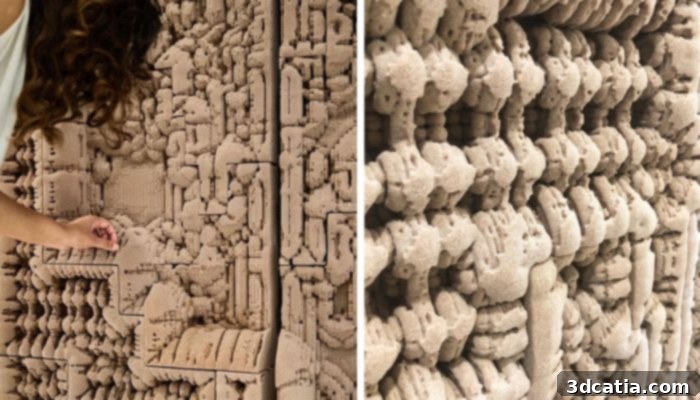
The intricate components of Nadarra were printed individually with precision and then expertly assembled on-site, much like a complex, three-dimensional puzzle. (Photo credits: Barry Wark)
The profound environmental consciousness that underpins all of Barry Wark’s work is profoundly embodied in the 3D-printed Nadarra wall, making it a powerful statement on sustainable design in the built environment. One of the primary ecological advantages of 3D printing, especially with a material like sand, is its inherent efficiency in material consumption. Unlike subtractive manufacturing methods that generate significant waste through cutting or shaping, additive manufacturing precisely deposits material only where it is functionally or aesthetically required for the end product. This “material optimization” greatly reduces raw material waste, contributing significantly to a more sustainable production cycle. Furthermore, the selection of sand as the primary material for Nadarra carries substantial environmental benefits. Sand is an exceptionally abundant natural resource, reducing the environmental impact associated with sourcing and transportation compared to many other construction materials. Beyond its efficient production, the Nadarra wall is engineered with its entire lifecycle in mind. At the culmination of its service life, the wall can be responsibly disposed of and, crucially, recycled, allowing its constituent sand to be reintroduced into new construction projects or even new 3D printing endeavors. This commitment to circularity is explicitly highlighted by Sandhelden, whose website states: “The project engages with the importance of materials and their life cycles in the built environment, employing advanced 3D printing sand technology, the parts can be fabricated, installed, and then recycled up to 8 times after use.” This remarkable claim underscores the project’s dedication not just to reducing waste, but to actively participating in a regenerative, circular economy, setting a new benchmark for environmentally responsible architectural practices.
Beyond its technological and sustainable merits, the 3D-printed Nadarra wall serves as a profound artistic and philosophical reflection on the cyclical nature of existence and the interplay between natural processes and human intervention. The wall’s surface is deliberately designed to evoke the appearance of natural erosion, a visual metaphor that resonates deeply with its environmental message. Barry Wark, through this intricate design, simultaneously alludes to the immutable laws of nature—weathering, erosion, and the slow transformation of landscapes—and to the subtle, enduring traces left by the human hand. In Nadarra, the boundaries between the organic and the man-made are artfully blurred, inviting viewers to contemplate the delicate balance and intrinsic connection between humanity and the environment. This deliberate aesthetic challenges the conventional notion of pristine, unchanging architectural surfaces, instead embracing the beauty of natural degradation and the stories it tells. Sandhelden eloquently captures this philosophical underpinning: “Motivated by the recognition that all buildings eventually erode, stain and weather, the project is designed to display its interconnectedness with its environment in other words, its ecology.” This perspective transforms the wall from a mere structure into a dynamic entity, continually interacting with and reflecting its surroundings, much like a living organism. Nadarra thus becomes more than just an architectural piece; it is a contemplative artwork, encouraging a deeper understanding of our built environment’s place within the broader natural world, and inspiring a forward-thinking approach to sustainable design that respects and integrates natural processes. Discover more fascinating details about Barry Wark and the ground-breaking Nadarra wall by visiting HERE.
What are your thoughts on the innovative Nadarra sand wall and its implications for future architecture and design? We invite you to share your insights and comments below, or engage with us on our vibrant social media platforms. Join the conversation on our Linkedin, Facebook, and Twitter pages! For the very latest updates, news, and breakthroughs in the world of 3D printing, don’t miss out on our free weekly Newsletter here, delivered straight to your inbox. You can also explore our extensive collection of videos and visual content on our official YouTube channel.
*Cover photo credits: Sandhelden GmbH & Co. KG