
Revolutionizing Additive Manufacturing: Multi-Material DLP 3D Printing for Advanced Plastic-Metal Composites
The rapid evolution of modern technology demands materials with increasingly sophisticated properties. In the realm of advanced manufacturing, the integration of distinct materials to form composites has become a cornerstone of innovation. Both plastics and metals are fundamental materials extensively utilized across numerous 3D printing processes and applications. However, combining their inherent strengths to create plastic-metal composites often presents significant challenges, particularly concerning cost-effectiveness and precision. These composites offer unique advantages, merging the lightweight, flexible, or insulating properties of plastics with the conductivity, strength, or shielding capabilities of metals, opening doors to a multitude of fields and groundbreaking product designs.
Historically, methods for fabricating such intricate plastic-metal structures have been prohibitively expensive and complex. Recognizing this critical need, a collaborative team of researchers from Waseda University in Japan and Nanyang Technological University (NTU) in Singapore has achieved a significant breakthrough. They have successfully developed an innovative, cost-efficient process for the fabrication of these sophisticated multi-material structures. This pioneering technique is known as multi-material DLP additive manufacturing, or MM-DLP3DP, and it promises to redefine what’s possible in integrated material design and production.
The Innovative MM-DLP3DP Process: A Multi-Step Approach to Material Integration
The core of this groundbreaking research lies in a meticulously designed, multi-step process that enables the precise deposition of metal onto 3D-printed polymer structures. The researchers initiated the process by preparing highly reactive “active precursors.” These chemical compounds are specifically engineered to undergo a transformation, facilitating the subsequent metal deposition. Their method involved dissolving ammonium chloride (NH4Cl) in 50 mL of deionized water, to which a precise amount of 270 mg of palladium chloride (PdCl2) was then added. This specific palladium salt is crucial as it provides the necessary palladium ions, which act as a catalytic agent for the electroless plating (ELP) process.
Once this precursor solution was thoroughly prepared and stabilized, it was carefully mixed with one of the specialized light-curable resins. These resins are the foundation of Digital Light Processing (DLP) 3D printing, solidifying upon exposure to specific wavelengths of light. The ingenious aspect of this initial step is the creation of a modified resin. When this modified resin is processed through the DLP system, the embedded palladium ions become strategically positioned within the printed plastic structure. These ions then serve as nucleation sites, allowing metal particles in a subsequent solution to be deposited precisely onto these predefined areas through the ELP process. Essentially, this first phase involved engineering a resin system that acts as a template for targeted metal integration, setting the stage for truly multi-material components.
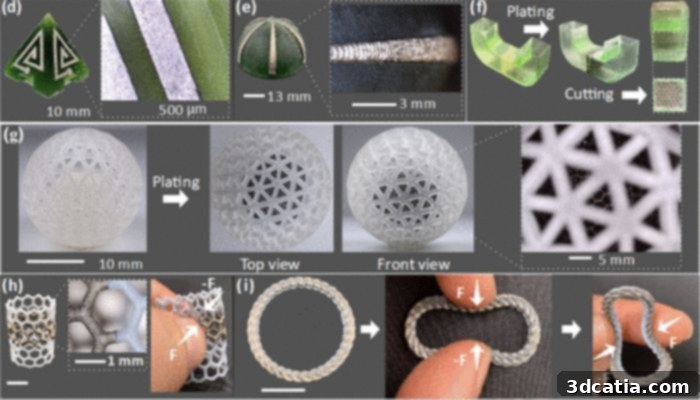
Examples of plated parts made with multi-material DLP 3D printing. (Photo credit: Waseda University)
Precision Manufacturing with MM-DLP3DP and Electroless Plating
Following the preparation of these specialized resins, the researchers moved on to the core of their fabrication method: the MM-DLP3DP process. This advanced additive manufacturing technique was employed to construct intricate micro-structures, creating nested regions where the base resin and the active precursor were precisely integrated. DLP 3D printing, renowned for its high resolution and speed, uses a projector to flash entire layers of a design onto a photosensitive resin, curing it layer by layer. By strategically switching between the base resin and the modified, active precursor resin, the team could create complex 3D polymer structures with embedded catalytic sites.
The final, crucial step involved the electroless plating (ELP) process. After the polymer micro-structures with embedded palladium ions were fabricated, they were immersed in an ELP bath. In this chemical bath, metal ions (e.g., copper or nickel) selectively deposit onto the surfaces activated by the palladium ions, forming a conductive metal pattern directly onto the 3D-printed plastic. This ingenious combination of MM-DLP3DP and ELP allows for the creation of precise, three-dimensional metal patterns seamlessly integrated within the polymer structure. This is a significant advancement over traditional methods, which often involve separate manufacturing steps for plastic and metal components, followed by complex assembly.
Demonstrating Functionality: Circuits and Sensors
To unequivocally demonstrate the utility and transformative potential of this novel technology, the research team successfully manufactured several highly functional prototypes. Among these was a sophisticated 3D circuit featuring a double-sided structure, ingeniously connected by a through-hole. This capability is vital for creating compact, multi-layer electronic devices, reducing the need for traditional printed circuit boards and offering unprecedented design freedom. Furthermore, they produced a series of advanced sensors, designed for seamless integration with the product being measured. A straightforward illustration of this capability would be a thermometer directly manufactured with an embedded temperature detector, eliminating the need for separate sensor attachment.
The efficacy of MM-DLP3DP was starkly highlighted in comparisons with conventional multi-nozzle printing methods. As the researchers emphatically pointed out, MM-DLP3DP boasts “higher resolution and thus allows the construction of microstructured surfaces with special functions.” This superior resolution is critical for the miniaturization and intricate design required for cutting-edge electronics and smart devices, where every micron counts. The ability to create functional microstructures with integrated metal patterns at such precision opens up entirely new avenues for product development, from advanced medical devices to next-generation consumer electronics.
Paving the Way for Future Technologies: Electronics, Robotics, and Wearables
The implications of this innovative MM-DLP3DP method are vast and far-reaching, with researchers expressing strong optimism for its application across numerous high-tech sectors. Key areas identified include advanced electronics, sophisticated sensors, cutting-edge robotics, and revolutionary wearable devices. The primary advantage here is the integrated manufacturing process itself, which significantly reduces the risk of errors commonly associated with multi-component assembly and post-processing steps. By embedding metal functionality directly during the 3D printing process, manufacturers can achieve greater precision, reliability, and miniaturization.
As Professor Shinjiro Umezu and Kewei Song from Waseda University, alongside Professor Hirotaka Sato from NTU Singapore, eloquently state, “Robots and IoT devices are evolving at a lightning pace. Thus, the technology to manufacture them must evolve as well.” This sentiment perfectly encapsulates the urgency and importance of such breakthroughs. The ability to create complex, functional components with integrated metal and plastic elements in a single, streamlined process is essential for meeting the escalating demands of next-generation smart technologies. From more robust and flexible sensor networks to lighter, more integrated robotic parts and discreet, high-performance wearable electronics, the potential applications are virtually limitless, promising to accelerate the pace of technological advancement.
The Novelty of Resin-Metal Composites in Additive Manufacturing
Within the dynamic field of additive manufacturing, the use of composite materials is a well-established practice, primarily aimed at enhancing the inherent properties of a base material before the final product is fabricated. Common examples include the integration of carbon fiber for increased strength and stiffness, or Kevlar for improved impact resistance in polymer parts. These composites have become indispensable for various industries, offering a balance of performance characteristics not achievable with single materials.
However, the development of a true resin-metal composite, particularly one created through an integrated 3D printing and plating process like MM-DLP3DP, represents a fairly novel and significant advancement. While metal 3D printing and polymer 3D printing exist as separate domains, seamlessly integrating conductive metal pathways or structural metal elements directly into a polymer matrix during the additive process has been a persistent challenge. This new method bridges that gap effectively.
The growing interest in such hybrid materials is evident across research institutions worldwide. For instance, in July of this year, researchers at the Department of Electrical Engineering at the University of South Florida (USF) unveiled a method to print copper directly onto fabric, enabling the creation of advanced wearable electronics. While distinct in its application, the USF project shares the spirit of integrating conductive materials with flexible substrates, underscoring the broader trend towards multi-material functionality. The potential of these innovative projects, including the MM-DLP3DP method, is abundantly clear. It is merely a matter of time before these pioneering technologies are realized on a large scale, transforming industries and products as we know them. If you would like to delve deeper into the technical specifics of this groundbreaking research, the full paper is accessible HERE.
What are your thoughts on this revolutionary multi-material DLP technology and its potential impact on future electronics and manufacturing? We encourage you to share your insights and comments below, or engage with us on our LinkedIn, Facebook, and Twitter pages! Don’t miss out on the latest advancements in additive manufacturing—be sure to sign up for our free weekly Newsletter here to receive the most current 3D printing news directly in your inbox. You can also explore all our comprehensive videos and interviews on our YouTube channel.
*Cover Photo Credits: Vogt