
Revolutionizing Pageantry: How 3D Printing Illuminated Miss Universe Singapore’s National Costume
The Miss Universe pageant, a globally anticipated event that annually draws an immense viewership of over 15 million, culminated its recent edition on January 15th. This international spectacle is a vibrant celebration of beauty, talent, and individual personality, where contestants from around the globe compete in various categories, showcasing diverse styles and elaborate ensembles. While the traditional elegance and grandeur of a beauty pageant might initially seem worlds apart from the cutting-edge innovations of 3D printing, the 2022 Miss Universe competition strikingly bridged this gap, bringing advanced additive manufacturing technology to the forefront in a truly unforgettable and dazzling display.
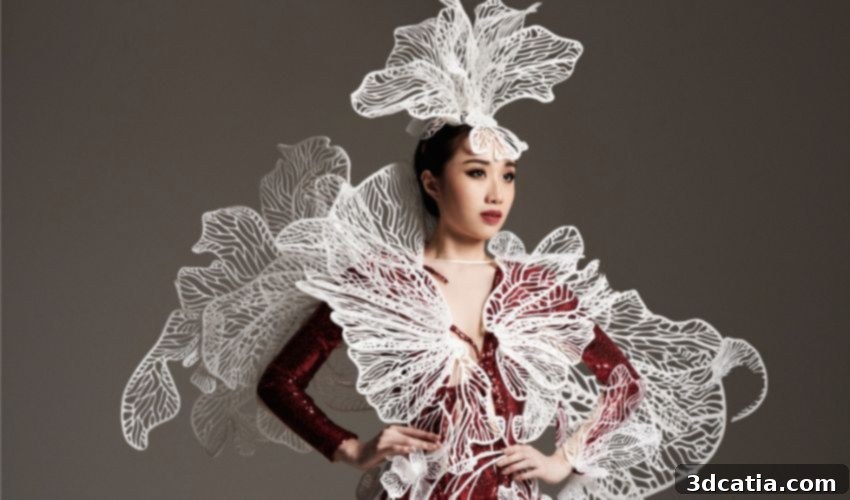
Carissa Yap, crowned Miss Singapore in October 2022, proudly stepped onto the international stage to represent her nation at this prestigious global event. For the highly symbolic National Costume segment – a crucial part of the competition where contestants showcase their country’s cultural identity and heritage through elaborate, thematic designs – Carissa chose to make a profound statement. She unveiled an extraordinary 3D printed outfit meticulously crafted to depict the iconic orchids of Singapore. Specifically, her dress was inspired by the *Papilionanthe Miss Joaquim*, formally known as *Vanda Miss Joaquim*, a resilient hybrid orchid that holds deep national significance as Singapore’s national flower. The costume was a masterful blend of artistry and technology, incorporating the nation’s emblematic red and white colors, thereby vividly representing Singapore’s spirit, resilience, and rich cultural tapestry to a worldwide audience.

Carissa Yap, the winner of Miss Universe Singapore 2022, captivating audiences in her innovative 3D printed national costume (Photo credit: David Wirawan / Miss Universe Singapore).
The Architectural Vision of Baëlf Design: Unpacking the 3D Printed Orchid
The visionary design behind this intricate and highly conceptual dress originated from Baëlf Design, a distinguished Singaporean fashion design firm. Known for its avant-garde approach and whimsical detailing, Baëlf Design consistently ventures into experimental fashion, pushing the boundaries of traditional garment construction. This project for Miss Universe Singapore perfectly encapsulated their innovative spirit, showcasing how technology can be seamlessly integrated into high fashion. According to Baëlf Design’s own social media narrative, the central idea was to envision “the islands of Singapore composed of the five-fold petals of an orchid draping the upper torso of Miss Singapore.” This poetic concept was then meticulously translated into a tangible, wearable art piece through sophisticated computational design and 3D printing technology.
The design process involved leveraging advanced computational methods to organically ‘grow’ intricate, vein-like structures, mirroring the delicate yet complex patterns found in natural orchids. These exquisitely formed petals were engineered to rise gracefully, forming a high collar that dramatically framed Carissa’s face, while simultaneously extending outwards into elegantly outstretched wings, symbolizing flight, aspiration, and the nation’s soaring ambitions. The entire 3D printed structure sensuously enveloped her body in a lightweight, white-coloured lattice, a testament to both precise engineering and artistic grace. This innovative application of 3D printing enabled an unprecedented level of complexity and organic fluidity, features that would be exceptionally difficult, if not impossible, to achieve using conventional fabric-based garment construction methods.
A significant detail of the design involved the strategic arrangement of the five dominant petals, which were carefully positioned to compose the unmistakable silhouette of Singapore’s islands. This made the costume not just a garment, but a powerful, wearable map and a heartfelt homage to the nation’s unique geography and identity. Furthermore, complementing the striking 3D printed components, the bodysuit worn underneath the orchid structure was elegantly adorned with vibrant red sequins. This critical element was the masterful work of Fredrick Lee, a highly celebrated designer of theatrical couture. Lee has garnered numerous accolades in Singapore for his flamboyant and imaginative creations, and his contribution added a luxurious shimmer and a dynamic contrast to the pristine white, technologically advanced orchid structure, completing the costume with a sophisticated touch of traditional glamour and sparkle, harmoniously echoing Singapore’s national colors.
3D Printing: A Catalyst for Innovation in Contemporary Fashion
The seamless integration of 3D printing into Carissa Yap’s national costume is far from an isolated incident; rather, it represents a significant and accelerating trend within the global fashion industry. When 3D printing technology is applied to fashion, it is most frequently utilized to craft futuristic, avant-garde, and conceptually daring pieces that fundamentally challenge the limitations of conventional textile manufacturing. This advanced fabrication method offers designers an unparalleled degree of creative freedom, enabling them to realize intricate geometries, complex textures, and impossible silhouettes that are simply unattainable through traditional sewing, draping, or weaving techniques.
Among the most prominent pioneers in this burgeoning field is Dutch fashion designer Anouk Wipprecht. Wipprecht has consistently pushed the boundaries of wearable technology, employing 3D printing to create fascinating, tech-inspired outfits that interact dynamically with both the wearer and their surrounding environment. Her groundbreaking work includes dresses embedded with sophisticated sensors that respond to various stimuli such as proximity, the wearer’s mood, or even their heart rate, often debuting at high-profile events like a recent New York gastronomy showcase. These creations transcend the definition of mere garments; they are interactive experiences, blurring the lines between fashion, robotics, and performance art. Wipprecht’s designs powerfully demonstrate 3D printing’s inherent capability to integrate electronics and smart functionalities seamlessly into clothing, thereby opening up vast new possibilities for smart textiles and responsive apparel that can adapt and evolve.
Another luminary in the realm of 3D printed haute couture is Iris van Herpen. Her collections are consistently a highlight at prestigious events such as Paris Fashion Week, where she regularly unveils breathtaking, sculptural garments that redefine the very essence of luxury fashion. This year, for instance, she presented a groundbreaking vegan haute couture dress developed in collaboration with the ice cream brand Magnum. This unlikely but impactful partnership not only showcased the immense aesthetic potential of 3D printing but also underscored its crucial role in promoting sustainability and ethical design practices within the high fashion world. Van Herpen’s designs are renowned for their elaborate, organic forms and seemingly impossible silhouettes, demonstrating how additive manufacturing can transform complex digital concepts into tangible, exquisitely wearable art that appears simultaneously alien and beautifully crafted. Her pioneering and visionary work has firmly established 3D printing as a legitimate, transformative, and indispensable tool within the upper echelons of fashion design.

Vanda Miss Joaquim, the national flower of Singapore, serving as the beautiful and symbolic inspiration for the intricate 3D printed dress (Photo credit: Singapore Botanic Gardens).
Beyond Aesthetics: The Profound Benefits of Additive Manufacturing in Fashion
The advantages of integrating 3D printing into the fashion industry extend far beyond simply generating consumer interest through novel fabrication methods. Firstly, its ability to create incredibly complex and highly customizable designs within a relatively short timeframe represents a profound benefit. Unlike traditional manufacturing, which often involves laborious processes of pattern cutting and stitching various fabric pieces, 3D printing allows designers to render highly intricate digital models directly into physical, three-dimensional objects. These objects can feature interlocking parts, sophisticated lattice structures, and organic forms that would be either impractical or entirely impossible to produce using conventional textile techniques. This combination of speed, complexity, and precision is invaluable in a dynamic and fast-paced industry like fashion, particularly for crafting bespoke pieces or developing avant-garde collections that demand unparalleled uniqueness.
Furthermore, 3D printing offers considerable advantages in terms of sustainability, an increasingly critical concern within the fashion sector. As an additive process, it builds objects layer by layer, generating significantly less material waste compared to subtractive methods, such as cutting fabric from large sheets. This inherent precision leads to far more efficient material usage. The potential for on-demand production also drastically reduces overstock inventory and eliminates the need for extensive warehousing, thereby contributing to a leaner and more sustainable supply chain. As material science continues to advance, the development of biodegradable and recycled filaments further enhances 3D printing’s eco-friendly credentials, empowering designers to create stunning, durable garments with a significantly reduced environmental footprint.
The technology also unlocks unprecedented levels of personalization and customization. Garments can be precisely tailored to an individual’s unique body shape and measurements, ensuring a perfect, comfortable fit that enhances the wearer’s experience – a crucial factor for high-performance wear, theatrical costumes, or intricate pageant outfits. This bespoke capability positions 3D printing as a powerful tool for luxury fashion houses and custom design studios looking to offer truly unique products. Moreover, the continuous exploration of new, non-traditional materials opens up vast possibilities for texture, drape, flexibility, and wearability, fundamentally pushing the boundaries of what fashion can be. From flexible plastics and lightweight resins to metal composites and even bio-based polymers, the material palette for 3D printed fashion is in a constant state of exciting expansion, promising even more revolutionary designs in the future.
While the widespread adoption of 3D printing in mainstream, ready-to-wear fashion still faces challenges, such as scalability for mass production and the current cost of advanced materials and machinery, its transformative impact on high fashion and experimental design is undeniable. Carissa Yap’s national costume for Miss Universe Singapore stands as a shining example of how this innovative technology can beautifully blend deep cultural symbolism with cutting-edge modern innovation, resulting in garments that are not just visually stunning but also rich in narrative and technological advancement. For those interested in delving deeper into Baëlf Design’s innovative creations and other works, you can find more information on their official Facebook page by clicking HERE.
Join the Conversation: Your Thoughts on the Future of 3D Printed Fashion
What are your impressions of this remarkable 3D printed outfit showcased by Miss Universe Singapore? Do you believe 3D printed fashion represents the future trajectory of the industry, or do you think it will remain primarily a niche domain for avant-garde designers and experimental art pieces? On a personal level, would you consider wearing 3D printed clothing or accessories yourself? We are eager to hear your unique perspectives and insights on the fascinating intersection of technology and haute couture.
We invite you to share your thoughts and opinions in a comment below, or connect with us across our various social media platforms! You can find us and join the discussion on LinkedIn, Facebook, and Twitter. Don’t miss out on the very latest advancements, groundbreaking innovations, and essential news from the dynamic world of additive manufacturing – be sure to sign up for our free weekly Newsletter here to receive all the crucial 3D printing updates delivered directly to your inbox! For more visual content, in-depth interviews, and comprehensive discussions, we encourage you to explore all our videos on our dedicated YouTube channel.