
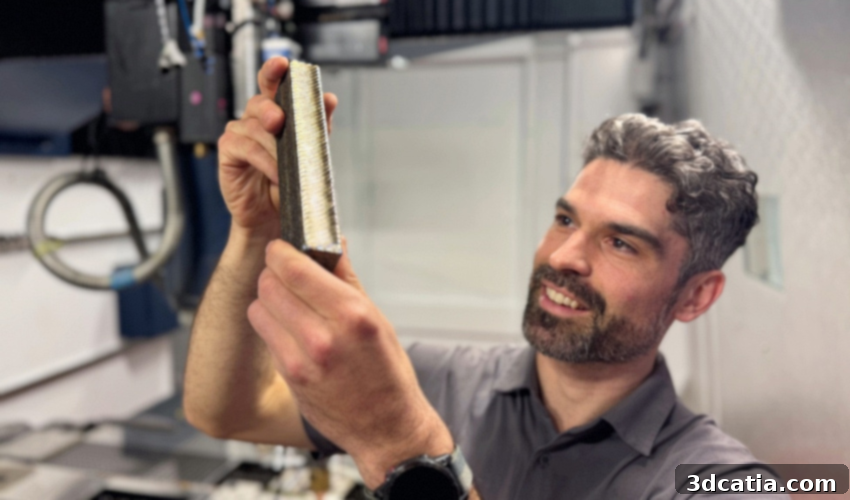
Revolutionizing 3D Printed Titanium: RMIT Unveils Stronger, Cheaper, and More Consistent Alloys for Advanced Manufacturing
Engineers at RMIT University in Melbourne, Australia, have recently achieved a significant breakthrough in additive manufacturing with the development of a novel 3D printed titanium alloy. This groundbreaking material is not only engineered to be substantially stronger than the current industry standard but also promises a dramatic reduction in production costs. Titanium alloys are indispensable across a multitude of high-stakes sectors, notably the aerospace and medical industries, primarily due to their unparalleled strength-to-weight ratio, exceptional corrosion resistance, and remarkable biocompatibility. However, the widespread adoption and cost-effectiveness of these materials have long been hampered by the expense of critical alloying elements, particularly vanadium, which is a key component in popular formulations like Ti-6Al-4V, the current workhorse of the industry.
The team at RMIT’s Centre for Additive Manufacturing (RCAM) embarked on a mission to address these limitations. Their dedicated research led to a pivotal discovery: a viable and more affordable alternative to vanadium. By meticulously exploring and combining a selection of cost-effective elements, the engineers formulated a new titanium alloy that delivers not only superior mechanical performance but also achieves an impressive 29% reduction in production cost. This innovative approach signifies a potential paradigm shift in how high-performance alloys are designed and manufactured for additive manufacturing. Doctoral researcher Ryan Brooke aptly summarized the significance of this achievement, stating, “Our new alloy is not only cheaper but performs better than what the industry currently uses.” This statement underscores the dual impact of their work, promising both economic benefits and enhanced material capabilities.
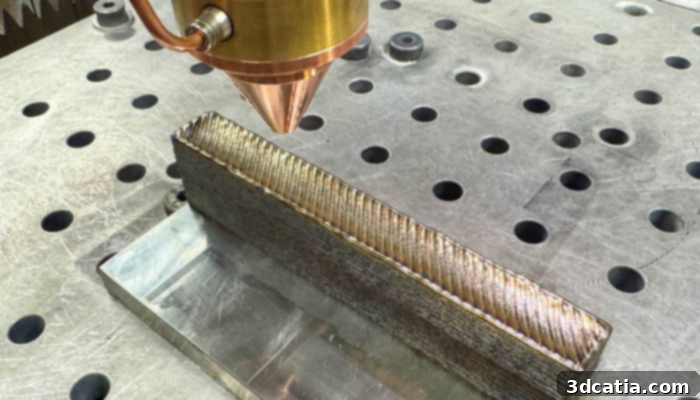
The new samples are being tested at RMIT’s Advanced Manufacturing Precinct
Overcoming Microstructural Inconsistencies: A Persistent Challenge in Metal 3D Printing
The findings of this groundbreaking research were recently published in the prestigious journal Nature Communications, drawing attention to one of the most persistent and critical challenges in metal 3D printing: microstructural consistency. Traditional titanium alloys, when processed through additive manufacturing techniques, often develop a highly anisotropic microstructure characterized by elongated, columnar grains. This undesirable formation leads to uneven mechanical properties, meaning the material performs differently depending on the direction of applied stress. Such directional dependency can severely limit the reliability and performance of components, especially in demanding applications where uniform strength and ductility are paramount.
The RMIT team’s innovative alloy design directly addresses and effectively suppresses this problematic behavior. By meticulously controlling the solidification process during 3D printing, their new formulation promotes the formation of a fine, equiaxed (uniform in all directions) microstructure. This results in a much more isotropic material, exhibiting consistent and predictable mechanical properties regardless of the stress direction. This level of microstructural control represents a monumental leap forward, eliminating a significant hurdle that has long constrained the full potential of metal 3D printing for critical parts. Ryan Brooke’s analogy vividly illustrates the current scenario in the industry: “It’s like we’ve created an airplane and are still just driving it around the streets.” He emphasizes that while 3D printing machines are incredibly advanced, the materials often lag, preventing the full utilization of the technology’s capabilities. RMIT’s new alloy, therefore, is akin to finally giving the “airplane” the right “fuel” and “wings” to truly take flight, unlocking its inherent speed, efficiency, and performance.
Paving the Way for Sustainable and Scalable Titanium Use in High-Performance Fields
This novel alloy represents more than just an incremental improvement; it opens the door to a new era of more sustainable and scalable use of titanium and its alternatives across a broad spectrum of high-performance industries. The significant reduction in material cost, coupled with enhanced performance and consistency, removes key barriers to wider adoption. For industries like aerospace, which continuously seeks lighter and stronger components to improve fuel efficiency and payload capacity, a cheaper and more reliable titanium alloy can accelerate innovation and reduce manufacturing overheads. In the medical field, where custom prosthetics, implants, and surgical tools are increasingly 3D printed, this development promises more affordable, durable, and biocompatible solutions, improving patient outcomes and accessibility to advanced medical devices.
The RMIT team is not stopping at the research stage; they are actively pursuing commercial partnerships to transition this revolutionary material from the laboratory to widespread industrial production. This push towards commercialization underscores the real-world impact and immense market potential of their innovation. This development also perfectly aligns with, and indeed leads, a crucial growing trend within the broader additive manufacturing landscape: the deliberate design of alloys specifically optimized for 3D printing processes, rather than merely adapting legacy materials originally developed for traditional manufacturing techniques like forging or casting. This forward-thinking approach allows for the intrinsic benefits of additive manufacturing, such as geometric complexity and material efficiency, to be fully realized and leveraged.
![Ryan Brooke [left] alongside Professor Mark Easton [center] and Dr Dong Qiu [right] at RMIT’s Centre for Additive Manufacturing helped design the new alternative.](https://3dcatia.com/wp-content/uploads/2025/10/img_65915_3.webp "Melbourne Lab Reveals Revolutionary 3D Printed Titanium Alternative 3")
Ryan Brooke [left] alongside Professor Mark Easton [center] and Dr Dong Qiu [right] at RMIT’s Centre for Additive Manufacturing helped design the new alternative.
The Future is in Material Science: Driving 3D Printing’s Full Potential
For too long, the narrative around additive manufacturing innovation has predominantly focused on advancements in machine capabilities – faster print speeds, larger build volumes, and multi-material printing. While these engineering feats are undoubtedly crucial, the RMIT breakthrough unequivocally demonstrates that material science, specifically the development of novel alloys and composites tailored for 3D printing, is truly the key to unlocking the full, transformative potential of industrial-scale 3D printing. By combining unparalleled cost efficiency with superior structural integrity and microstructural consistency, RMIT’s new titanium alloy signals the dawn of a new generation of 3D printed materials.
These next-generation materials are designed not just for sheer strength, which has always been a hallmark of titanium, but crucially for enhanced accessibility, broad applicability, and predictable performance across a wide variety of industries. Beyond aerospace and medical, imagine the impact on the automotive sector, where lighter, stronger components can lead to more fuel-efficient vehicles. Consider the energy sector, where robust and corrosion-resistant parts could improve the lifespan and efficiency of power generation infrastructure. Even in consumer goods, the ability to produce high-performance, complex parts more affordably could lead to entirely new product categories. RMIT’s pioneering work showcases a future where advanced materials are no longer an expensive bottleneck but an accessible enabler for innovation, driving the adoption of additive manufacturing into new markets and applications, fundamentally reshaping how we design, produce, and utilize engineered components. If you’re interested in delving deeper into this transformative research, you can learn more directly from RMIT HERE.
What are your thoughts on this exciting new advancement in 3D printed titanium alloys? We invite you to share your perspectives and predictions in a comment below or join the conversation on our LinkedIn or Facebook pages! Plus, don’t forget to sign up for our free weekly Newsletter to get the latest 3D printing news, insights, and breakthroughs delivered straight to your inbox. You can also explore all our informative and engaging videos on our dedicated YouTube channel.
*Photo Credits: RMIT University Melbourne