
Mastrex Revolutionizes Metal 3D Printing: Making LPBF Accessible and Affordable
At the highly anticipated RAPID + TCT 2026 event, Mastrex is poised to unveil groundbreaking innovations aimed at dismantling one of the most formidable barriers in advanced manufacturing: the prohibitive cost of metal additive manufacturing. For years, laser powder bed fusion (LPBF) technology has been celebrated for its ability to produce incredibly high-performance parts, utilizing robust materials such as titanium and Inconel, critical for aerospace, medical, and defense sectors. However, the substantial financial investment required to adopt these systems has historically confined their use to large corporations and specialized research institutions, leaving a vast segment of manufacturers unable to leverage this transformative technology.
Mastrex’s strategic entry into the market is specifically designed to address this challenge head-on, democratizing access to industrial-grade metal 3D printing. Their innovative product lineup, showcased at RAPID + TCT, demonstrates a commitment to making LPBF both more accessible and more cost-effective without compromising on the quality or performance that these demanding applications require. This approach promises to unlock new opportunities for small and medium-sized enterprises (SMEs), academic institutions, and even individual innovators who previously found the entry barrier insurmountable.
Addressing the Core Challenge: The Cost of High-Performance Metal 3D Printing
The high cost associated with traditional metal LPBF systems stems from several factors, including the complexity of the laser optics, the need for precise atmospheric control, high-purity metal powders, and sophisticated software. These elements contribute to expensive machinery, high operational costs, and specialized maintenance requirements. While the benefits of LPBF—such as design freedom, part consolidation, reduced material waste, and the ability to produce complex geometries impossible with traditional manufacturing—are undeniable, the economic hurdles have prevented widespread adoption. Industries across the board, from automotive and consumer goods to energy and tooling, have recognized the potential of metal additive manufacturing to innovate and streamline production, yet many have been held back by the significant initial outlay.
Mastrex understands that for metal 3D printing to achieve its full potential, it must become a viable option for a broader range of businesses. By focusing on smart engineering, optimized designs, and efficient manufacturing processes, Mastrex has developed systems that significantly lower the total cost of ownership, thereby expanding the market for metal additive manufacturing. Their solutions are not just about reducing the price tag; they are about delivering genuine value, robustness, and performance in a more attainable package, ensuring that more manufacturers can integrate metal 3D printing into their workflows and benefit from its unique advantages.
Introducing Mastrex’s Innovative LPBF Systems: The MX-100 and MX-300
Mastrex’s innovative lineup features two distinct yet complementary LPBF systems: the compact MX-100 and the production-oriented MX-300. Each system has been meticulously engineered to cater to different segments of the market while upholding Mastrex’s core commitment to accessibility and industrial capability. These machines are not merely scaled-down versions of existing technologies; they represent a fundamental rethinking of how metal LPBF can be made more efficient and user-friendly for a wider audience.
The MX-100: Desktop Precision for Every Innovator
The MX-100 stands out as a compact desktop LPBF system, a true game-changer for environments where space and budget are critical considerations. Designed with an emphasis on ease of use and a streamlined workflow, the MX-100 is ideal for small businesses, university research labs, educational institutions, and product development teams engaged in rapid prototyping. Its smaller footprint and more approachable price point make it an excellent entry point for those new to metal 3D printing or for specialized applications requiring on-demand, smaller-scale production. Despite its compact size, the MX-100 delivers impressive precision and material versatility, allowing users to experiment with and produce high-quality parts in materials like stainless steel and aluminum, which are widely used across various industries for their strength and corrosion resistance. This system empowers engineers and designers to iterate quickly, test new concepts, and bring innovative products to market faster, without the need for outsourcing or significant capital investment in large-scale industrial machinery.
The MX-300: Dual-Laser Power for Industrial Production
For manufacturers with higher production demands, the MX-300 offers a robust and scalable solution. This dual-laser production platform is engineered for industrial environments where speed, efficiency, and larger build volumes are paramount. The integration of dual lasers significantly boosts productivity, allowing for faster build times and the creation of more complex or larger parts simultaneously. The MX-300 is designed for continuous operation, offering the reliability and repeatability essential for series production and demanding industrial applications. It supports a broader range of materials, including not only stainless steel and aluminum but also specialized alloys like tool steels and certain nickel alloys, further extending its applicability in sectors requiring advanced material properties. The MX-300 ensures that high-volume production of intricate metal components can be achieved economically, positioning it as a powerful tool for industries looking to optimize their supply chains, reduce lead times, and leverage the full potential of metal additive manufacturing at scale.
Both the MX-100 and MX-300 embody Mastrex’s commitment to maintaining industrial capability. This means ensuring critical aspects such as part accuracy, mechanical properties, surface finish, and process stability meet or exceed industry standards. Mastrex has invested heavily in developing intuitive software, robust hardware, and reliable post-processing solutions to ensure that even users with less prior experience can achieve consistent, high-quality results. By making advanced metal 3D printing accessible across a spectrum of operational scales, Mastrex is paving the way for wider adoption and fostering innovation across countless industries.
Insights from Terry Cambron: The Vision Behind Mastrex’s Approach
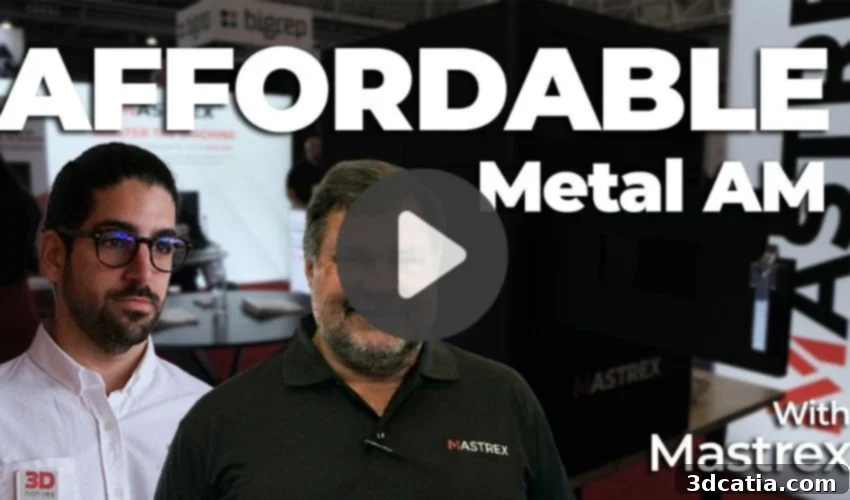
During RAPID + TCT 2026, we had the distinct pleasure of speaking with Terry Cambron, North America Sales Director for Mastrex. His insights provided a deeper understanding of the company’s unique philosophy and what truly distinguishes their approach in the competitive landscape of additive manufacturing. Cambron emphasized that Mastrex isn’t just selling machines; they are offering a comprehensive solution that empowers businesses to overcome traditional hurdles. He articulated that the company’s vision extends beyond mere technological advancement, focusing instead on user experience, operational efficiency, and a reduced total cost of ownership. This holistic strategy is what truly sets Mastrex apart, making high-performance metal 3D printing a tangible reality for a broader segment of the manufacturing industry.
Early Adopters and Expanding Horizons of Accessible LPBF
Cambron also shared compelling details about who is already embracing Mastrex’s technology and the immediate impact it is having. Early adopters span a diverse array of sectors, showcasing the versatility and broad appeal of Mastrex’s systems. For instance, in the automotive industry, manufacturers are utilizing the MX-100 for rapid prototyping of complex engine components and lightweight structural parts, significantly shortening design cycles and reducing development costs. The MX-300, with its dual-laser capabilities, is being deployed in the medical device sector to produce customized surgical instruments and patient-specific implants with unparalleled precision and speed, meeting stringent regulatory requirements and improving patient outcomes. Aerospace companies are exploring its use for creating specialized tooling and low-volume, high-performance components, benefiting from the ability to print robust parts in demanding alloys without the traditional lead times and expense.
Furthermore, the discussion with Terry Cambron highlighted how more accessible LPBF systems are not just serving existing markets but actively expanding adoption across entirely new industries. Small-scale jewelry manufacturers are exploring custom designs, while architectural firms are prototyping intricate structural models. Educational institutions are integrating these systems into their engineering curricula, training the next generation of additive manufacturing professionals on state-of-the-art, yet user-friendly, equipment. This broadened accessibility fosters innovation, enabling companies of all sizes to experiment with and ultimately integrate metal 3D printing into their core operations, driving new product development, enhancing supply chain resilience, and opening doors to bespoke manufacturing solutions that were previously economically unfeasible.
The Broader Impact: Democratizing Advanced Manufacturing
The advent of accessible metal 3D printing solutions like those offered by Mastrex has profound implications for the manufacturing landscape. By lowering the barrier to entry, Mastrex is effectively democratizing advanced manufacturing, allowing a wider range of businesses to participate in the high-growth additive manufacturing sector. This shift empowers small and medium-sized enterprises (SMEs) to compete more effectively with larger corporations, fostering a more diverse and innovative industrial ecosystem. It means that brilliant ideas are no longer constrained by access to expensive machinery, accelerating research and development cycles across the board.
Moreover, the ability to produce high-performance metal parts on-demand and locally can significantly enhance supply chain resilience, reducing reliance on complex global supply chains that are prone to disruptions. Companies can pivot more quickly to changing market demands, customize products with greater ease, and even explore more sustainable manufacturing practices by reducing material waste and optimizing resource usage. Mastrex’s vision for accessible LPBF technology is not merely a technological upgrade; it represents a strategic enablement for a future where advanced manufacturing is within reach for every innovator and every business, driving unprecedented levels of creativity, efficiency, and competitiveness across industries worldwide.
See Mastrex in Action: Watch the Full Video
To truly grasp the innovation Mastrex is bringing to the metal additive manufacturing sector, we invite you to experience it firsthand. The following video offers an exclusive look at the MX-100 and MX-300 systems in operation, demonstrating their precision, speed, and user-friendly interfaces. Hear directly from the Mastrex team about their unique philosophy and how their groundbreaking approach is reshaping the future of metal 3D printing. This visual demonstration will provide valuable insights into how Mastrex is making high-performance metal additive manufacturing more accessible and affordable for a diverse range of applications and industries.
Join the Conversation and Stay Updated
What are your thoughts on making metal 3D printing more accessible and affordable? How do you envision this technology impacting your industry or future innovations? We value your insights and encourage you to join the ongoing discussion. Please feel free to share your comments below or engage with us on our LinkedIn and Facebook pages. Your feedback and perspectives are crucial as we explore the evolving landscape of additive manufacturing. Furthermore, to ensure you never miss out on the latest advancements and news in the 3D printing world, don’t forget to sign up for our free weekly Newsletter, delivering essential updates straight to your inbox. You can also find an extensive library of our videos, tutorials, and interviews on our dedicated YouTube channel, offering a rich resource for all things 3D printing.