News
WASP completes the structure of its 3D printed eco-habitat
WASP (World’s Advanced Saving Project), an Italian 3D printing company working especially in the realm of sustainable construction, has completed the printing phase of the TECLA supporting structure, the first 3D printed eco-habitat. The TECLA project was launched in 2019…
- 3 min read
- News
- Six more stories
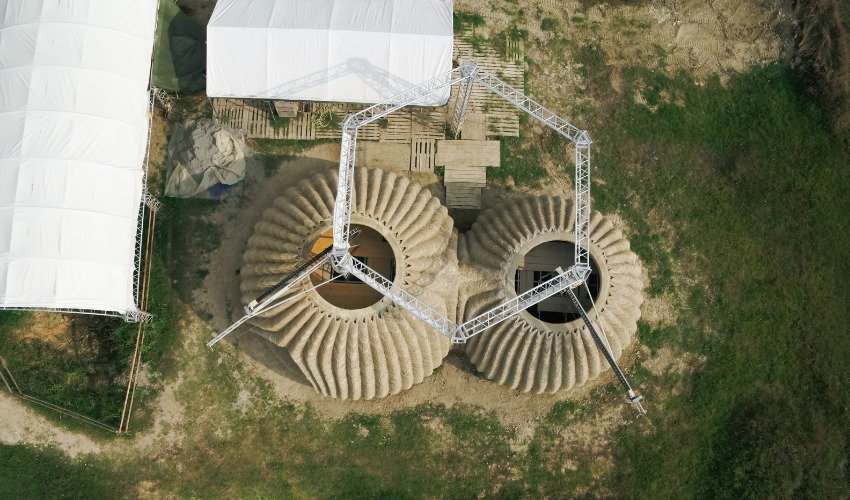
WASP (World’s Advanced Saving Project), an Italian 3D printing company working especially in the realm of sustainable construction, has completed the printing phase of the TECLA supporting structure, the first 3D printed eco-habitat. The TECLA project was launched in 2019 with Mario Cucinella Architects with the goal of creating a new circular housing model, one that was entirely reusable with recyclable materials taken from the local terrain. With the completion of their printing stage, TECLA represents a new stage of more sustainable construction, one that is hoped to provide a solution to a growing need not just for housing in a world with an ever-increasing population that is eco-friendly in order to also address the climate crisis.
TECLA (a portmanteau of technology and clay) was made in Massa Lombarda (Ravenna, Italy) using the Crane WASP (WASP’s new 3D printer for the construction sector). According to the press release, it represents a new circular model of housing entirely created with reusable and recyclable materials, sourced from local soil, carbon-neutral and adaptable to any climate and context. It was printed using multiple WASP printers at the same time, the first time that two printing arms were synchronized as part of a construction project. This enabled the team to finish the project faster while avoiding collisions. According to WASP, the TECLA can be synthesized in about 200 hours of printing, or about 8 days. However what is especially notable about this 3D printed building is its use of material, raw earth.
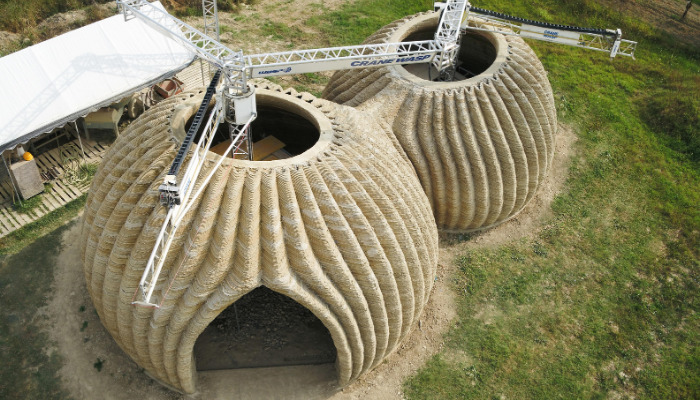
A side view of TECLA showing its distinctive shape (photo credits: WASP)
TECLA’s Contribution to Sustainability and 3D Printing Construction
Though 3D printing is not new to the construction industry, most buildings are printed using ready mix mortars though some have been completed using real concrete. Though much more stable, this poses a problem from an environmental and sustainability perspective. In general, additive manufacturing has the potential to be much more environmentally friendly than traditional manufacturing methods. This is due to its potential for local production (the reason 3D printing was a timely and effective response at the beginning of the pandemic) and because it can allow for zero-waste manufacturing, a significant departure from traditional manufacturing which results in more waste. However, concrete has a large carbon footprint, and its use in building could be considered to negate many of the other environmental benefits of using additive manufacturing.
More from the desk
Six other notes from the rest of the bench.
 PrintersIs 3D printing in an office space dangerous for your health?New studies have confirmed that particles emitted from 3D printers can negatively impact indoor air quality and have the potential to harm respiratory health. Invented 30 years ago, the unintended adverse impacts of 3D printing on human health are not…
 PrintersIEMAI Makes a Name for Itself in Large Scale and High-Performance Polymer Printing FieldsIn the Additive Manufacturing field, one of the regions where we have seen the most growth has been in China. Ranking fifth on the recent 3D printing sentiment index, the country has one of the largest installed base of printers,…
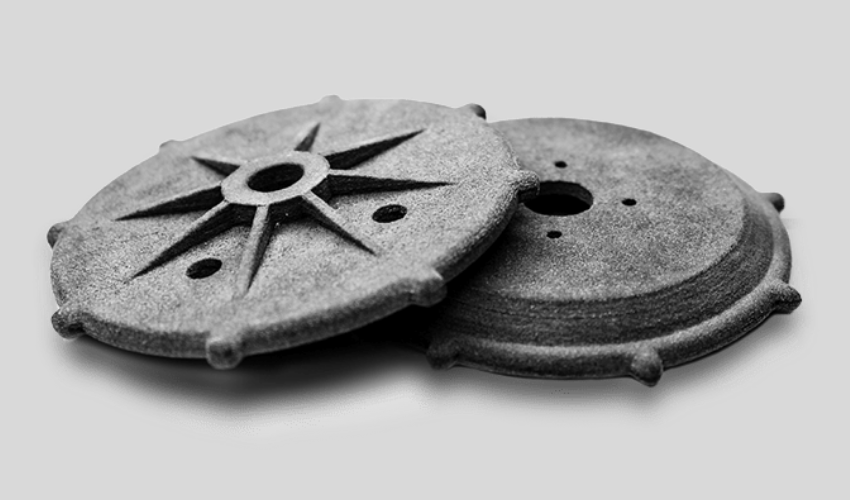 MaterialsImpossible Objects and Owens Corning Join Forces to Develop Stronger, Cheaper 3D Printing MaterialsEarlier this week, Impossible Objects announced that it would be joining a development agreement with Owens Corning targeted at developing new materials for Impossible Objects’ revolutionary composite-based additive manufacturing (CBAM) process. While Impossible Objects is both a
 NewsWhat Do We Know About the Desktop Metal Layoffs and Other Cost Optimization Measures?Desktop Metal has announced that, among other cost optimization measures, it will be reducing its global workforce by approximately 12%. These layoffs from Desktop Metal are a result of a need to cut costs after a number of acquisitions the…
 NewsBuild your own 3D printed synthesizer for 6 dollarsJohan Von Konow is a Swedish engineer with knowledge in mechanics, electronics, software and industrial design. In his spare time, he develops many projects around these subjects. One of his latest projects is called LEET Synthetizer: an open-source synthesizer to…
 NewsHow Has 3D Printing Revolutionized the Music Industry?It is becoming clear that additive manufacturing has the potential to completely revolutionze the music industry. Though it is hardly the first time that we have seen a significant impact being made by 3D printing on a sector, in this…