Applications
How Volumetric 3D Printing Became Compatible with Living Cells
A team from the Swiss Federal Institute of Technology in Lausanne (EPFL) has just published its third improvement to a volumetric 3D printing technique that began in 2017. The latest version is 70 times more efficient than previous ones and,…
- 3 min read
- Applications
- Six more stories
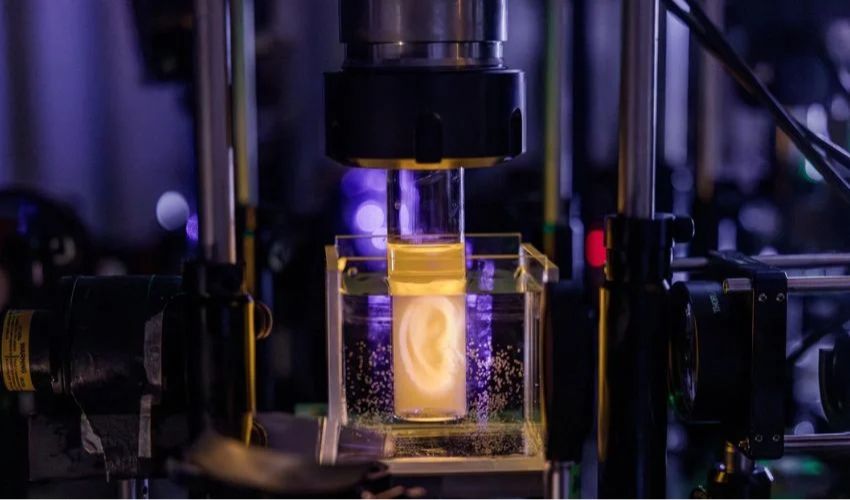
A team from the Swiss Federal Institute of Technology in Lausanne (EPFL) has just published its third improvement to a volumetric 3D printing technique that began in 2017. The latest version is 70 times more efficient than previous ones and, for the first time, allows for the printing of structures containing living cells.
The result of the new study is a life-size human ear printed in gelatin-based hydrogel. The ear contains embedded human cells that, six days after printing, were still alive and had begun to organize into networks. To understand why this matters, we need to go back nearly a decade.
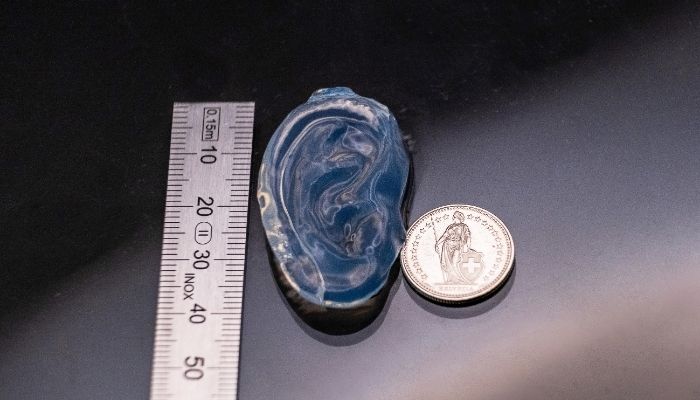
Ear printed using the TVAM process (Photo Credit: LAPD / EPFL).
What is TVAM?
The technique in question is called tomographic volumetric additive manufacturing (TVAM). Instead of building objects layer by layer like a conventional 3D printer, TVAM involves projecting a laser beam from different angles onto a rotating tank filled with photosensitive resin. Where the accumulated energy exceeds a certain threshold, the resin solidifies. The entire object is formed in a single step, in just a few seconds.
More from the desk
Six other notes from the rest of the bench.
 News#TOP5 Videos: 3D printing for animation films, shoes and more!We found the Top 5 videos of the week about 3D printing and the way additive manufacturing is shaping and changing our society. This week we touch on 3D printing for animation films, shoes and much more! If you enjoy these, you…
 NewsTop 5 Videos: A 3D Printed Vegan Steak, ADDITIV Aerospace & MoreIn this week’s selection of top 5 videos about 3D printing, we’re giving you a sneak peak of our next ADDITIV event – ADDITIV Aerospace. Next up is Marketforged’s new investor video, released after the company announced a merger with…
 NewsNanofabrica announces commercial launch of micron resolution AM technologyNanofabrica, is an Israel-based additive manufacturing company for precision engineering that has just launched its micron-level resolution industrial 3D printers, the Workshop System and Industrial System. The following systems integrate Nanofabrica’s patented process, which is
  NewsAM Ventures Launches First Venture Capital Fund Devoted to Industrial 3D PrintingToday, AM Ventures announced the launch of a 100 million euro, first-of-its-kind, venture capital fund solely devoted to industrial 3D printing. The fund’s central focus revolves around reinforcing the foundations and early growth stage of hardware, software, materials, and appli
 News#3DExpress: Prusa Research Will Manufacture 3D Printers and Filaments in the USAIt is time once again for #3DExpress, where we tell you all about some of the most interesting tidbits of news from the week. To start with, Prusa Research will be setting up in Delaware and will thus be also…
 News3D Systems and Jabil Announce ‘High Speed Fusion’ 3D Printing System3D Systems have just announced that they will soon introduce a next generation ‘High Speed Fusion’ 3D printing system. Developed in collaboration with Jabil Inc., the platform system will include new printer technology and advanced materials systems, surpassing those currently&he