Guides
Vapor Smoothing vs. Vibratory Finishing: Which Surface Finishing Process Should you Choose?
In order to achieve a polished and refined surface on 3D printed parts, engineers use a broad range of industrial finishing techniques including coating, sandblasting and hand finishing methods. Although 3D printing allows for the production of intricate and complex…
- 3 min read
- Guides
- Six more stories
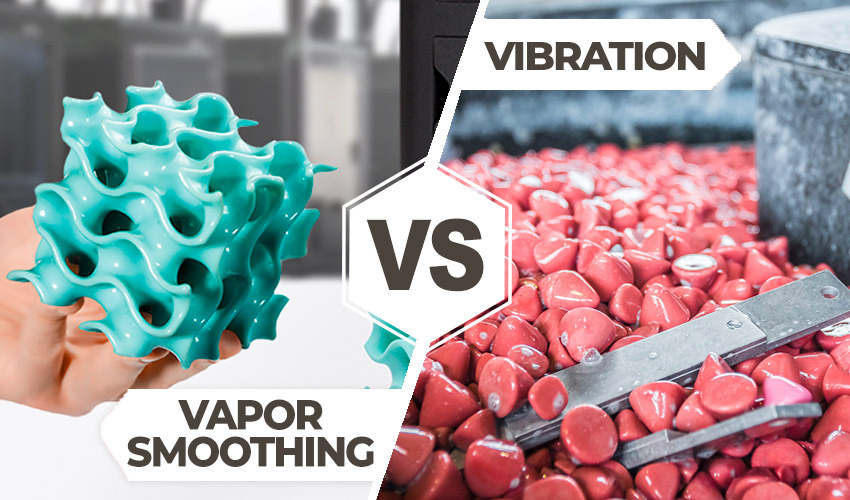
In order to achieve a polished and refined surface on 3D printed parts, engineers use a broad range of industrial finishing techniques including coating, sandblasting and hand finishing methods. Although 3D printing allows for the production of intricate and complex parts, the initial prints that come straight from additive manufacturing often exhibit rough surfaces and noticeable layer lines, particularly in parts produced using Fused Deposition Modeling (FDM). One of the final stages, post-processing, is undergone to take the rugged and unfinished surface and alter the part’s material surface by adding or removing layers of the part. In this article we will introduce you to two well-known surface finishing processes: Vapor Smoothing and Vibratory Finishing. You will learn all about the process of the methods, the advantages and disadvantages, and which method is best suited for your individual purpose.
Process
Vapor Smoothing
Vapor Smoothing, also known as Chemical Vapor Smoothing, is a technique that involves exposing the printed parts to vaporized solvent. The industrial Vapor Smoothing process requires carefully suspending single or multiple parts in a closed chamber for maximum exposure. A chemical solvent blend, such as FA 326, is injected and sprayed into the chamber, where it condenses and hardens on the part, removing surface irregularities through a controlled melt. As the chamber temperature increases, the residual solvent evaporates and is recovered. The final part becomes watertight and retains its smooth internal cavities, accurate dimensions, and original material volume. For optimal results in Vapor Smoothing, it is recommended to conduct the process in a controlled environment using industrial-grade equipment specifically designed for 3D printing Vapor Smoothing. For those interested in a DIY approach, Vapor Smoothing, or in this case called Solvent Dipping, can be achieved using acetone or ethanol as chemical solvents. However, it is essential to exercise caution and ensure proper safety measures and equipment are in place.
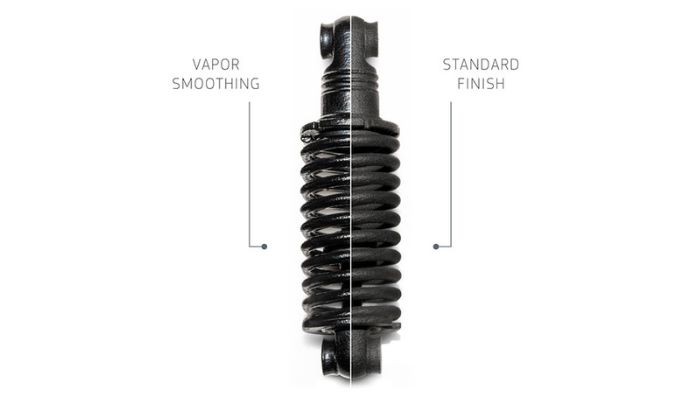
Vapor smoothed part on the left, versus standard finish on the right (Photo credits: ProtoLabs)
Vibratory Finishing
Vibratory Finishing, on the other hand, does not use chemicals for surface treatment. Instead, it relies on an abrasive medium to enhance the surface of 3D printed parts. In this process, several 3D printed parts are placed in a vibratory tub filled with a selected abrasive medium and a lubricating fluid known as the compound. When the machine is turned on, the tub begins to move, creating mechanical friction between the part and the abrasive medium. This subtractive process results in minimal and gentle removal of the outermost layer of material, improving the surface quality of the part. Vibratory Finishing requires special measures and equipment and offers two methods: the Vibration Method and the Tumbling Method. The Vibration Method is particularly suitable for larger, less detailed objects and achieves the desired result much faster. However, with the Tumbling Method, the movements are much slower and gentler, making it suitable for detailed and delicate parts.
More from the desk
Six other notes from the rest of the bench.
 ApplicationsAdditive Manufacturing Market Resumes Growth, Driven by the Defense SectorAMPOWER is an additive manufacturing consultancy dedicated to accelerating the adoption of 3D technologies worldwide. The company regularly publishes market studies and reports that shed light on the 3D printing industry. It has just unveiled its latest project, which analyzes&he
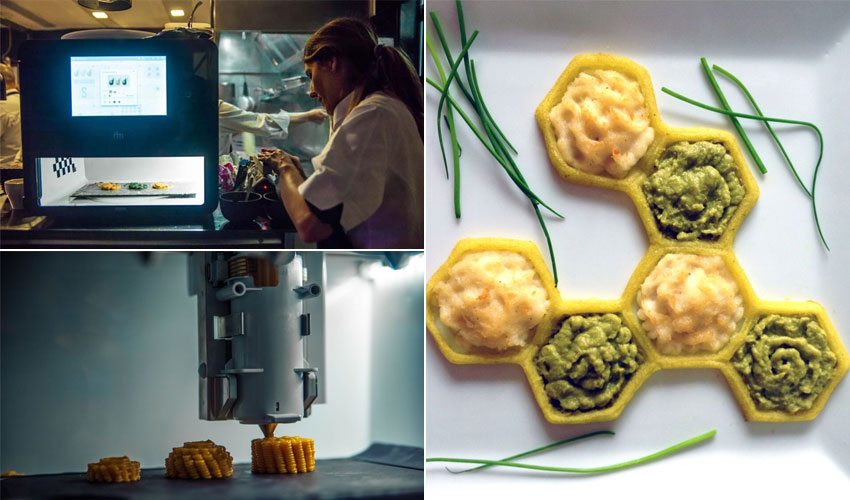 NewsA guide to 3D Printed Food – revolution in the kitchen?We all remember the Replicator, the Star Trek food manufacturer, able to turn any molecule into edible food and whole dishes. 3D food printing is able to make dishes from different pastes and materials, so it seems we are getting…
 NewsTenants of the First Ever Dutch 3D Printed Home Are Moving InOn Friday, April 30th, the owners of the first ever Dutch 3D printed home have just received its key. Situated in the Eindhoven neighborhood of Bosrijk, the house is the first of five within ‘Project Milestone’. The home is the…
 PrintersAtom 3, the first 3D printer that combines FDM and SLA into one3D printer manufacturer Layer One has just revealed its latest machine the Atom 3, which is capable of combining two 3D printing technologies, FDM, and stereolithography. In addition, check out our Top 10 resin 3D printers for some similar printers.…
 Materials3D Printing Elastomers Market Expected to Reach $1.389 Billion by 2030American research organization Report Oceans recently published a study in which it evaluated the growth of elastomers in the 3D printing market. The organization estimates that the elastomers market will reach 1.389 billion dollars within eight years, with an annual…
 NewsP-Rouette, the 3D printed ballet slippersP-Rouette is the new invention of Hadar Neeman that should interest more than one ballet dancer. He has created 3D printed ballet slippers. This young graduate of the Academy of Art and Design of Bezalel has found the solution to most…