News
The US Marines benefit from ICON’s 3D printing technology
ICON is a construction technologies company based in Austin, Texas. With the help of proprietary 3D printing robotics, software and advanced materials, ICON mainly focuses on solving problems in the construction industry, by making it more cost-effective, among other things. The&
- 3 min read
- News
- Six more stories
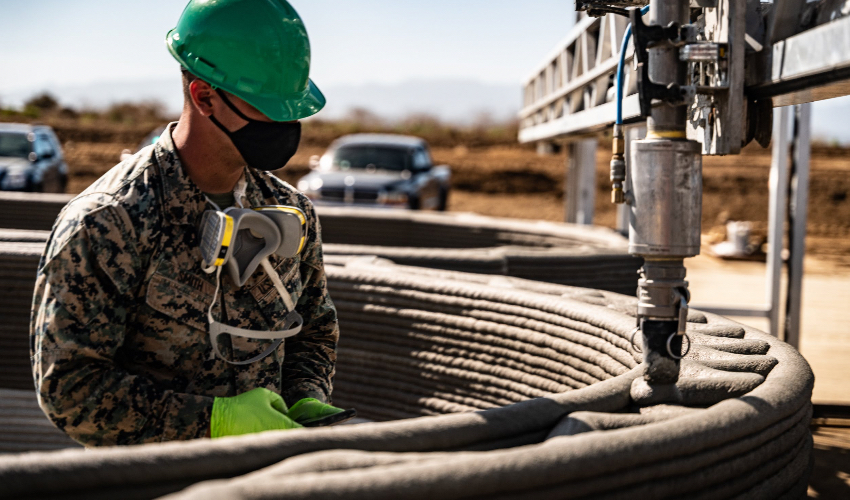
ICON is a construction technologies company based in Austin, Texas. With the help of proprietary 3D printing robotics, software and advanced materials, ICON mainly focuses on solving problems in the construction industry, by making it more cost-effective, among other things. The company has already reached a few significant milestones: ICON became the first company in America to secure a building permit for a 3D printed home and initiated the world’s first 3D printed community project. Recently, ICON announced their latest achievement – the first successful collaboration with the US Marine Corps and the Defense Innovation Unit (DIU).
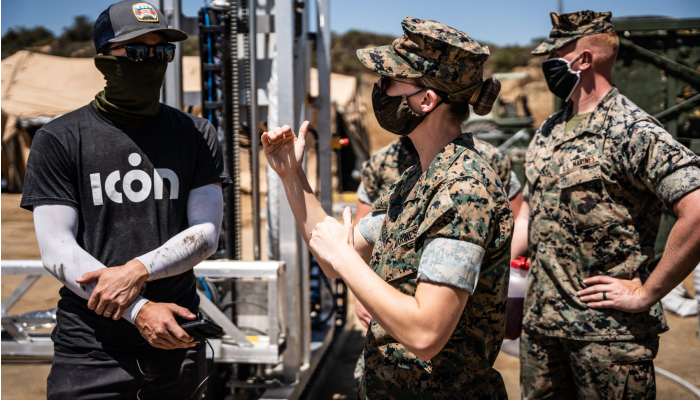
ICON partnered with the Defense Innovation Unit to help integrate 3D printing technologies into military operations. The main goal was to provide rapid construction capability to support military crisis response efforts. For this project, ICON’s 3D printing technology was used to build a vehicle hide structure for the US Marine Corps at Camp Pendleton. For this purpose, eight soldiers were trained to operate ICON’s massive Vulcan 3D printer. The aim of such training was to prepare the troops for a field demonstration, in which they would need to quickly build structures for potential army expeditions.
All image credits: ICON
ICON’s technology provides tablet-based system controls that allow even novice operators to deliver high-quality 3D printing. So, after only a few hours of field training, the soldiers learned to operate the complex equipment from start to finish – ICON’s experts remained present only to supervise. At the beginning of the project, ICON and the USMC set a realistic goal: to complete the print in 40-48 hours, with some expected loss of productivity for troubleshooting while getting the Marines up to speed. However, with a few recent automation upgrades that increased the precision of the material delivery system, the print was actually completed in 36 hours with virtually zero troubleshooting time!
More from the desk
Six other notes from the rest of the bench.
 NewsTop 5 Videos: The Importance of Training With ImplementAMOnce again, we are back this Sunday with our list of top 5 3D printing videos of the week! We start off with a video with ImplementAM to learn more about the critical role that training plays in 3D printing,…
 NewsHawaiian Students 3D Print Molds for Local Chocolate ShopAs part of a new 3D printing project, a group of students from the Department of Mechanical Engineering at the University of Hawaii recently teamed up with a local chocolate shop. The goal of the collaboration of these students and…
 NewsTOP 5 videos of the week: 3D printing in architecture and much more!We found the TOP 5 videos of the week related to 3D printing and additive manufacturing here. Share your videos and comment on the article below or on the 3Dnatives’ Facebook or Twitter account. Hope you’ll enjoy and have a…
 NewsTop 5 Videos: Utilizing the Wind With 3D PrintingHappy Sunday one and all! Welcome to another top five videos segment where we bring you the most interesting videos from this week in the world of 3D printing! This week, we look at some fascinating projects including your own…
 Applications3D printing to treat spinal cord injuriesResearchers from the University of California, San Diego, have successfully treated rats with spinal cord injuries using 3D printing. Their research offers hope for people with the same injury. 3D printing to help heal spinal cord injuries The Researchers from…
 News3D Hubs helps Fillauer Composites create carbon-fiber prosthetic feet3D Hubs, based in the Netherlands, is a leading online manufacturing platform that leverages its global network of manufacturing partners to respond to customers’ production needs. More precisely, it provides industrial 3D printing, CNC machining, injection molding and sheet meta