Applications
University of Bristol is Recycling Surgical Masks into 3D Printing Materials
The use of surgical masks is now a part of our daily lives. But, the daily use (and discarding) of them as a result of the global pandemic has caused a significant pollution problem. However, a research team from the…
- 3 min read
- Applications
- Six more stories
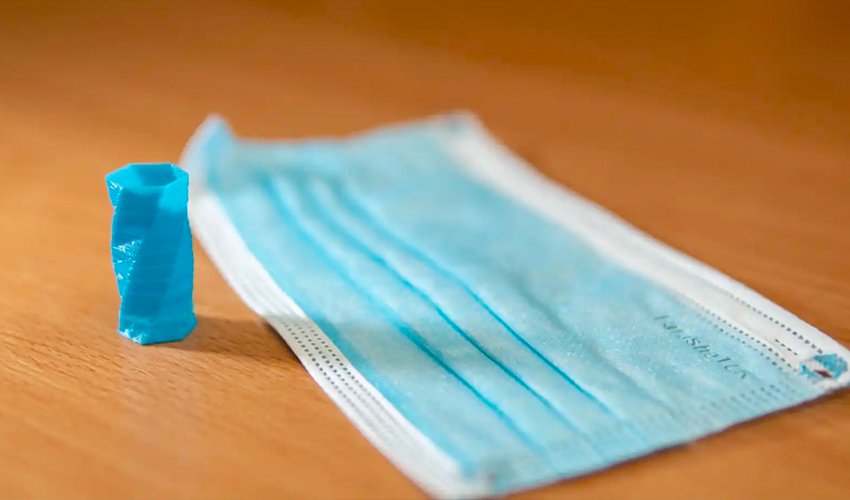
The use of surgical masks is now a part of our daily lives. But, the daily use (and discarding) of them as a result of the global pandemic has caused a significant pollution problem. However, a research team from the University of Bristol, in England, might have found the solution. The idea behind the initiative is to collect defective or unusable surgical masks before recycling them and transforming them into 3D printing material, specifically filaments. The project aims to mitigate the impact of disused PPE on the environment, while developing filaments for AM.
According to National Geographic, about 129 billion face masks are used a month or about 3.4 billion face masks or face shields that are discarded every day. This figure is shocking because the vast majority end up in the sea, on the streets or in the countryside, generating more pollution due to their plastic components. In fact, according to the Environmental Advances study, a single mask can release up to 173,000 microfibers a day into the sea. Like other everyday objects, face masks contain plastic fibers such as polypropylene that remain in the environment for decades until they finally degrade. To solve this problem, the team at the University of Bristol has studied the possibility of transforming the components of these masks into 3D printing material.
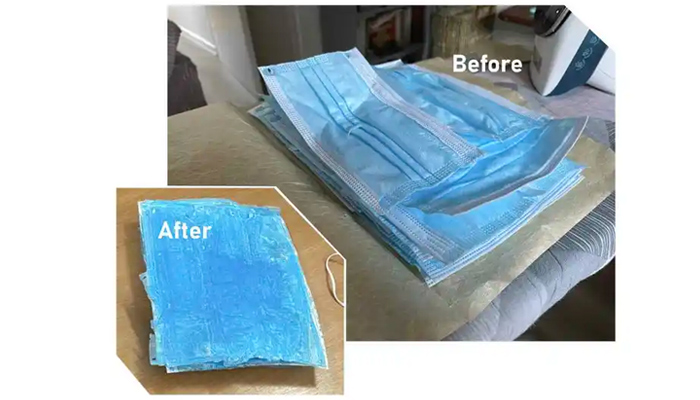
The discarded masks are transformed into sheets through a pressing process
Transforming Masks Into 3D Printing Materials
In the first tests, the team collected a number of defective masks from which they removed the ear loops and nose wire. The masks are then heated and pressed with an iron and non-stick paper to turn them into hard sheets. These in turn were then ground into fine polypropylene pellets from which the masks are made. Finally, the blue pellets are passed through a wire drawing machine that converts them into the manufacturing filament. As the initial masks had undergone a series of high-temperature processes, the researchers felt that this was sufficient to disinfect them and eliminate any possible bacteria or viruses in them.
More from the desk
Six other notes from the rest of the bench.
 GuidesElementum 3D on Materials and Expansion in Metal Additive ManufacturingOne of the many considerations in 3D printing is what materials should be used for the printing process. Though still limited, 3D printing materials have expanded in recent years. Going from traditional materials like plastics and polymers, like PEEK and…
 NewsLululemon Brings Large-Format 3D Printing to Retail Architecture3D printing continues to establish itself as a key tool in architecture and interior design. The latest example comes from Canadian brand lululemon, which has chosen large-format 3D printing to create new architectural elements for its retail stores. Specializing in…
 PrintersBambu Lab Issues Update on A1 3D Printer RecallFollowing the initial Bambu Lab announcement of a recall earlier this year, U.S. Consumer Product Safety Commission, has formalized this (5 months later), confirming that it has impacted approximately 12,800 units of A1 3D printers sold before January 30, 2024.…
 News3D Printing Quiz of 20172017 was an important year for 3D printing. In 2017, a number of big names entered the 3D printing industry such as HP and GE, and many 3D printing startups received multi-million dollar investment deals. In addition, 2017 was the…
 PrintersThe Best DIY 3D Printer KitsMost 3D printers today are sold as ‘plug-and-play’ systems—either fully assembled or semi-assembled and ready to print out of the box. However, this wasn’t always the standard. The industry’s roots can be traced back to the RepRap project, launched by&hell
 NewsEurope’s Largest 3D Printed Housing Project Welcomes Student Residents in DenmarkDenmark sets one of Europe’s tightest cost caps on subsidized housing, a limit strict enough that it has stiffled new affordable construction for years. In Holstebro, a 3D printer just circumvented this issue. 3DCP Group has completed Skovsporet (“The Forest…