Printers
The Top EBM 3D Printers on the Market in 2025
3D printing is gradually overturning traditional production methods in many industrial sectors. Among the most innovative techniques is electron beam melting, better known as EBM. This process uses a high-energy electron beam to melt metal powders such as titanium or…
- 3 min read
- Printers
- Six more stories
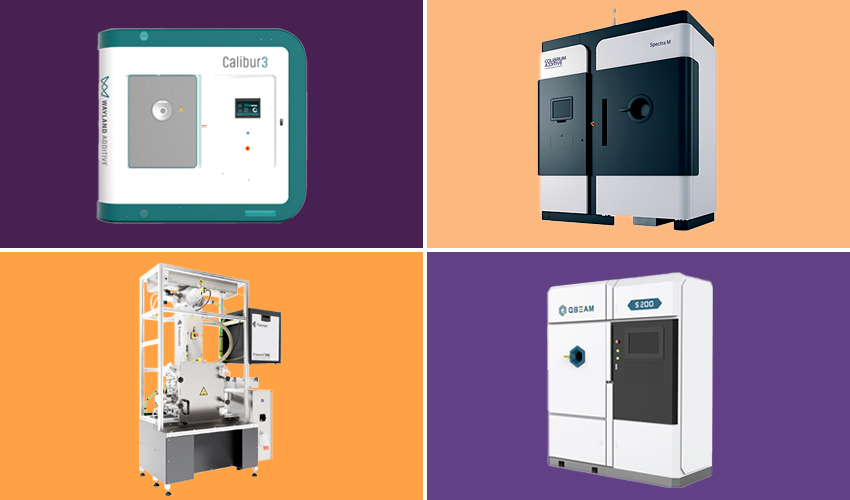
3D printing is gradually overturning traditional production methods in many industrial sectors. Among the most innovative techniques is electron beam melting, better known as EBM. This process uses a high-energy electron beam to melt metal powders such as titanium or copper, layer by layer, to produce complex, robust parts. Thanks to the density and mechanical performance of the resulting parts, EBM is particularly popular in demanding sectors such as aerospace, medical and automotive. For a long time, this technology was developed and marketed by a single Swedish company: Arcam. Today, however, the market has expanded, and other manufacturers are offering solutions based on this principle. In this article, we present an overview of the different EBM 3D printers currently available, to give you a better understanding of what is out there.
Spectra H From Colibrium Additive
Colibrium Additive’s Spectra H is an industrial EBM 3D printer. Equipped with an extended print bed of 250 x 430 mm and the ability to produce parts at temperatures above 1,000 °C, this machine enables the production of high-integrity parts quickly and on a larger scale than previous versions. Furthermore, being able to work at high temperatures is ideal for processing materials prone to cracking. Additionally, moveable heat shields improve insulation, creating an optimal environment for quality parts production. Not to mention, the self-calibrated 6-kilowatt beam enables an attractive printing speed for large-scale production. Something that is particularly noteworthy is the Point Melt technology available on Colibrium Additive’s Spectra EBM printers — a process in which metal powder is melted through small “dots” rather than lines, as is commonly done. This technology enables more precise temperature control, reducing thermal gradients, the need for sintering, and providing a better surface finish.
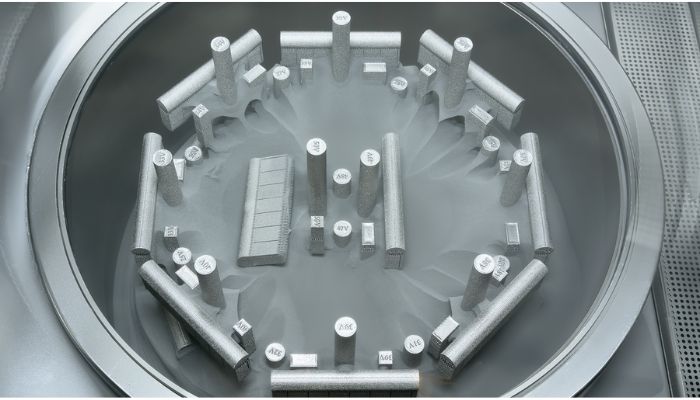
Interior of Colibrium Additive’s Spectra H machine (photo credits: Colibrium Additive)
The Calibur3 From Wayland Additive Goes Beyond Conventional Electron Beam AM
UK-based Wayland Additive, founded in 2015 by a team with a semiconductor engineering background with significant electron beam manufacturing expertise, seeks to go beyond both laser-based and electron-beam additive manufacturing. How? Its innovative NeuBeam® technology is, according to Wayland Additive, able to overcome the stability issues of traditional electron beam systems thanks to the charge neutralization step which involves the flooding of positively charged ions to neutralize negative charge in the bed. As a result, it is possible to eliminate the pre-sintering of the powder bed and results in better properties, faster build times and reduce post-processing. This technology is commercially available in the Calibur3 3D printer. The metal AM solution boasts an open system, allowing for the development of new processing parameters, and is also material agnostic. Thanks to a relatively large build volume of 300 x 300 x 450 mm, it is also possible to print either large single piece prints or print more parts per run.
More from the desk
Six other notes from the rest of the bench.
 News£1 million Grant Awarded to 3D Printing Company by UK Research and Innovation AgencyThe UK government’s Research and Innovation agency (UKRI) has announced a recent investment of £14 million into novel projects in a scheme known as the Sustainable Smart Factory Competition. Funding has been granted to those companies which promise to harness…
 ApplicationsADDITIV Aerospace 2.0, the Virtual Event Combining AM and Aerospace, is BackADDITIV Aerospace is back! After the success of the event next year, ADDITIV Aerospace 2.0 will be taking place on April 26th, 2022 at 9:00AM – 5:30PM EDT (3:00 – 11:30 PM CEST). Like last year, the conference will be…
 NewsAitiip Leads The HERON Project to Improve Energy Efficiency in AeronauticsZaragoza-based Aitiip Technology Center has taken the reins of the European HERON project. The idea came about as a result of the European commitment to the environment—more specifically, due to carbon emissions from the aeronautics industry. Thus, the primary mission…
 Applications3D Printing Is Being Used to Make a Safer Mosquito RepellentMosquitoes are transmitters of many serious diseases including malaria and dengue fever and as such are responsible for about one million deaths per year according to the WHO (World Health Organization). Not to mention how annoying the bites caused by…
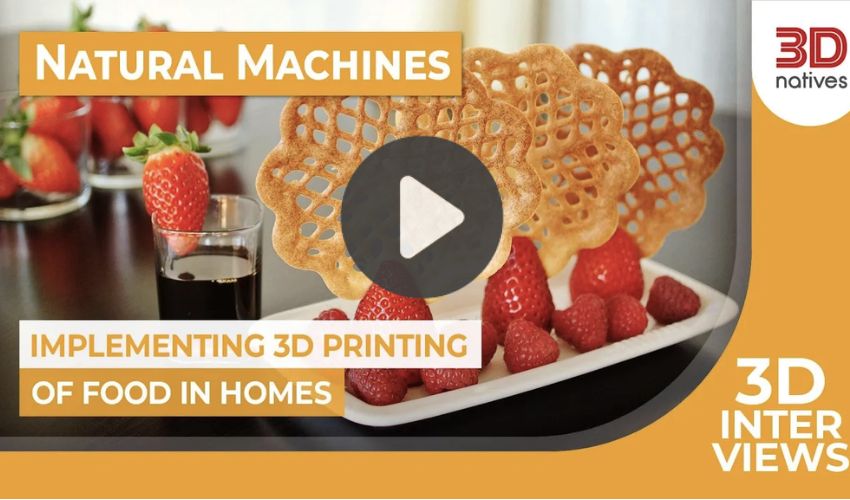 NewsTop 5 3D Printing Videos: Food 3D Printing with Natural MachinesHello everybody, and welcome to our top 5 3D printing videos of the week! Spring is in the air, and in our content too. This week, we have an exciting selection ranging from technical comparisons of different techniques, to practical…
 Guides15 Cool Things to 3D PrintYou know that we love to share STL files and ideas for you to print with your desktop 3D printer. Though many center on certain topics, like holidays or themes, this time we wanted to share with you some of…