News
Support-Free 3D Printing with 90° Overhang Angles? A New Study Reveals How Standard FDM Printers Can Do It
For a long time, standard 3-axis fused deposition modeling (FDM) printer operators have followed a general rule: if you want to print a horizontal overhang, you need to print a sacrificial support structure underneath it, otherwise the hot plastic will…
- 3 min read
- News
- Six more stories
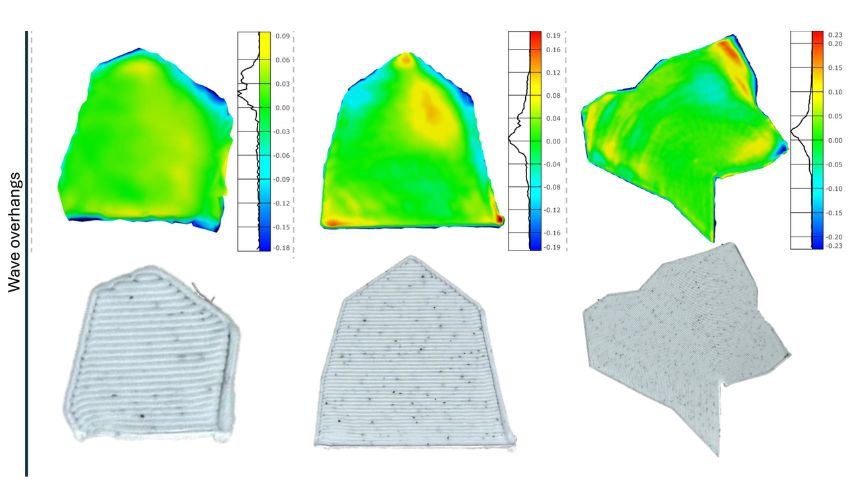
For a long time, standard 3-axis fused deposition modeling (FDM) printer operators have followed a general rule: if you want to print a horizontal overhang, you need to print a sacrificial support structure underneath it, otherwise the hot plastic will sag. But a new breakthrough is aiming to turn that assumption on its head. Researchers have developed a novel path-planning strategy that allows these printers to create cantilevered horizontal overhangs without needing any support structures. Their research, titled “Wave-inspired path-planning strategy for support-free horizontal overhangs in FDM” was published in the July volume of Additive Manufacturing Letters.
The secret to this “impossible” feat is wave propagation theory. Instead of laying down traditional, straightforward lines of plastic, the system generates continuous toolpaths that act like radiating waves. Because these paths feature a diffraction-like behavior, they can naturally bend and navigate around complex geometric shapes. When researchers put this to the test by printing standard PLA plastic on a regular, open-frame 3D printer, the new wave paths dramatically outperformed traditional arc-based toolpaths. They showed significantly less sagging, vastly improved coverage, and fewer gaps, even when the shapes got complicated. In a LinkedIn post, author Janis A. Andersons spoke to the approach’s potential, “The 45° rule was never really an inherent limitation of the FDM process. It’s a side effect of how we’ve always told printers to move. Change the slicing, and the limits move with it.”
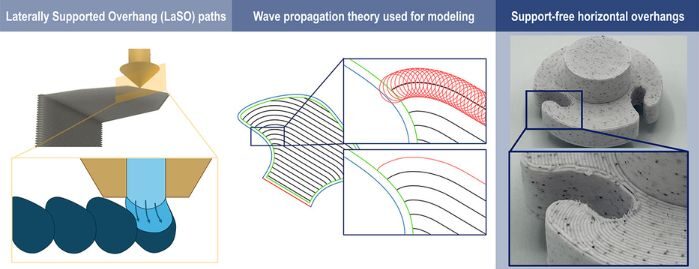
The study proposes that using wave propogation theory can help makers print overhangs without supports.
To further establish the theory, the team printed a multilayer demonstrator. They proved that once that initial, unsupported wave path base is laid down, you can reliably deposit subsequent layers right on top of it. Their measurements also showed dimensional deviations comparable to those of conventionally supported parts for the geometry tested, though some thermal warping was observed near overhang edges.
More from the desk
Six other notes from the rest of the bench.
 NewsPangaia and Zellerfeld Have Released a New 3D Printed SneakerAdditive manufacturing, also known as 3D printing, offers numerous advantages, with customization being one of its greatest. This is particularly the case for 3D printed shoes, which are quickly gaining in popularity as an alternative to ‘Fast Fashion’. Not only&helli
 NewsTop 5 Videos: The Velaskello project promotes recycling using 3D printingIn this week’s top five we will cover a universally important topic: recycling. Specifically, we will get familiar with the Velaskello project, by SuperForma, which uses 3D printing with PLA to incorporate more sustainable solutions that reduce humanity’s ecological f
 NewsTop 5 Videos: RAPID + TCT 2024 Sneak Peek!Welcome to our compilation of this week’s most compelling 3D printing highlights. We kick off this week’s edition with our very own video, providing a quick sneak peek into the exciting RAPID + TCT 2024 event, which will be held…
 SoftwareImaging Software For the Evaluation of 3D Printed Metal PartsAs 3D printing becomes more widely used, and final parts become more readily available, there is an increasing need to assess the quality of parts designed through additive manufacturing. For that reason, researchers at Nanyang Technological University Singapore (NTU Singapore)&h
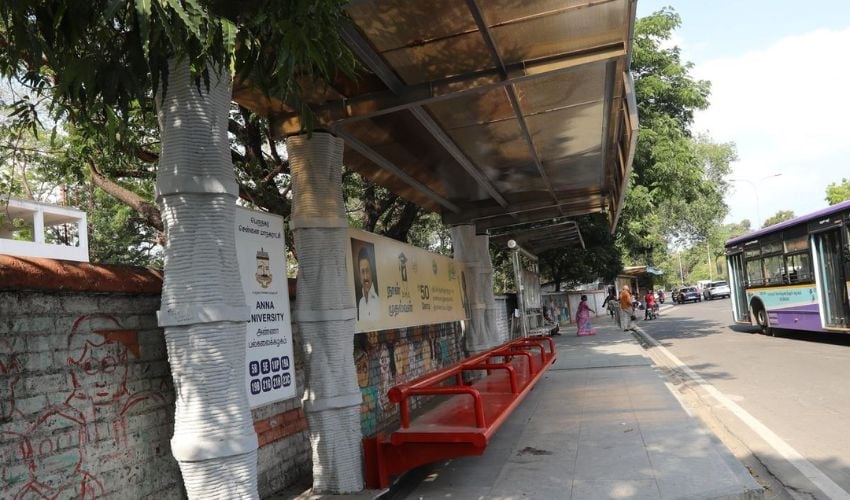 ApplicationsOver 90 3D Printed Bus Shelters Installed in the Indian City of ChennaiThe Indian city of Chennai currently has around 1,420 bus shelters. Many of them are in poor condition, and their usage is limited, if not abandoned. However, thanks to additive manufacturing, this is set to change! In the future, Chennai…
 NewsTOP 5 videos of the week: Submarines, Comics and more!A new selection of the best 3D printing videos of the week, just for you! Find our TOP 5 videos of the week below and tell us what your favorite video is in a comment or on our Facebook and Twitter page. Don’t hesitate to…