News
The State of Women in 3D Printing: study on women in the industry
A few days ago we reported on The State of 3D Printing 2020, Sculpteo’s annual report on the state of the 3D printing industry. Among other things, this report shows that 3D printing is becoming more and more common in…
- 3 min read
- News
- Six more stories

A few days ago we reported on The State of 3D Printing 2020, Sculpteo’s annual report on the state of the 3D printing industry. Among other things, this report shows that 3D printing is becoming more and more common in mass production, slowly moving away from being a prototyping only technology. In addition to Sculpteo’s study, and together with Women in 3D printing, the two groups looked at the role of women in the indstry in a new report. In the past, we have reported on influential women in the world of 3D printing, and conducted some interviews with Marie Langer, CEO of the EOS Group, Monica Smith from EOS, Nina Hoff from byFlow, Sylvia Heisel from Heisel, among others. So what is the general situation in 2020? We have compiled the most important information from the report for you.
The study found that half of the female participants surveyed (51%) have a master’s degree or higher education. Most of the women (64%) have found access to 3D printing through their jobs. According to the study, most women involved in 3D printing are in sales, marketing and research and development. The study lists research, CAD design and prototyping as the most common activities.
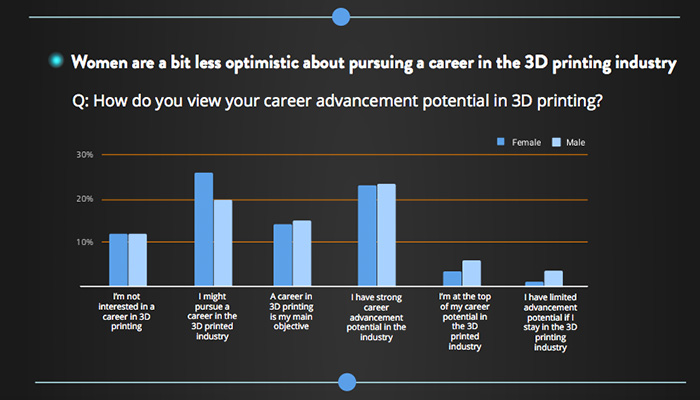
Image via The State of Women in 3D Printing
Additionally, the study asked men and women how they view their career prospects in 3D printing. It became clear that women were a little bit less optimistic than men, but not by a large margin. Nearly 12 percent of respondents, both men and women, said they were not interested in a career in 3D printing. With nearly 26 percent of women compared to 20 percent of men, a larger percentage of women are unsure whether they want to pursue a career in the industry. The survey results also show that fewer women than men are confident about career opportunities in 3D printing. And fewer female than male respondents say they feel they have already realized the full career potential of 3D printing. There is more of a stark difference between men and women when it comes to pursuing a career in the 3D printing industry, with women leading in this department.
More from the desk
Six other notes from the rest of the bench.
 MaterialsGlaciarys AR3, the New Anti-Viral Resin from Copper3DCopper3D continues its research into the development of antiviral materials and devices aimed at meeting the needs of the medical sector. After designing a 3D printed breast pump tip to fight against HIV transmission during breastfeeding, the Chilean-American company has now&hell
 SoftwareZBrush: The CAD Software for Creating 3D-Printed SculpturesAs you may know, before starting a printing process, it is first necessary to obtain a 3D digital model of a part. Perhaps the best-known modeling method is computer-aided design (CAD). It can be used to create individual models with…
 GuidesMighty Buildings, 3D printing houses on the spotBy now we know that additive manufacturing provides a multitude of advantages to the construction industry. More and more actors in the industry are interested in integrating this technology into their activities. We have already seen several projects of 3D…
 NewsA lounge chair using 3D concrete printingWhile 3D concrete printing is gaining momentum in the construction industry, it seems that technology is also widely used in the arts industry to create complex and unique structures, including furniture. This is the case of this project presented by the designer Philipp…
 PrintersXYZprinting, from desktop 3D printing to professional additive manufacturingXYZprinting, is a company of Asian origin created in 2013. In just 5 years it has managed to position itself as one of the leaders in the manufacture of desktop 3D printers. With a range of more than 20 3D printers with different…
 PrintersWhat is the outlook for 3D printer sales in 2020?The research firm CONTEXT recently published a report on 3D printer sales in 2020. Given the current health crisis, these have already decreased compared to last year, even though the last quarter of 2019 was not very conclusive. In recent…