Applications
Russian Aerospace Plant Turns to Large-Scale 3D Printing for Composite Parts
The Ural Civil Aviation Plant (UZGA), located in Yekaterinburg, Russia, has been utilizing some of Russia’s largest industrial 3D printers to support the production of new aircraft. These include the Baikal LMS-90, a small utility aircraft, the UTS-800 trainer, and…
- 3 min read
- Applications
- Six more stories

The Ural Civil Aviation Plant (UZGA), located in Yekaterinburg, Russia, has been utilizing some of Russia’s largest industrial 3D printers to support the production of new aircraft. These include the Baikal LMS-90, a small utility aircraft, the UTS-800 trainer, and the Ladoga regional plane. Since 2024, the plant has installed two printers that are capable of producing parts up to five meters in length.
These machines are being used to manufacture large-scale polymer composite tooling. According to UZGA, the technology has already drastically reduced production times. A forming tool for vacuum molding composite components, which would normally take 10 to 12 weeks to complete, can now be finished in just two to three weeks. The process also requires fewer personnel compared to other traditional methods.
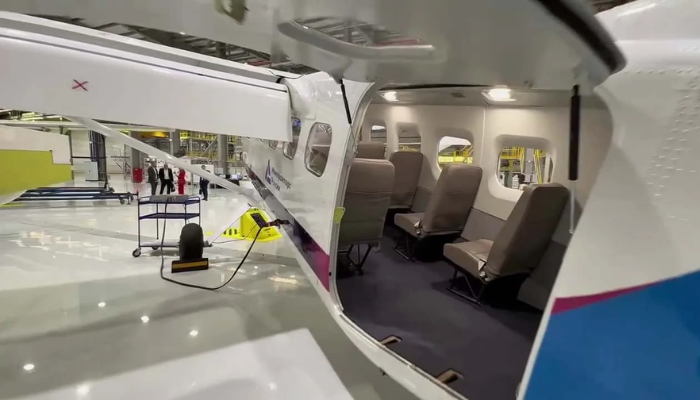
An inside view of a Baikal LMS-90 being retrofitted with 3D printed parts. (Credit: UZGA)
The plant itself relies on two types of additive technology. The first is fused filament fabrication (FFF), which extrudes melted plastic reinforced with 30% carbon fiber to create durable and large-scale structures. Tests at the facility have shown that the printed tooling maintains high accuracy during prints. The second is fused deposition modeling (FDM), which is being used for smaller structural parts for each plane.
More from the desk
Six other notes from the rest of the bench.
 NewsGanit Goldstein on her vision of 3D printing for fashionGanit Goldstein is a 3D designer working on how to merge additive manufacturing technologies with fashion to bring new possibilities to the industry. Her aim is to work with new technologies to provide custom-made items that fit the wearer perfectly.…
 Applications3D Printed Titanium Prosthesis is Attached to Dog’s Bone, Allowing Him to Walk AgainAdditive manufacturing has a number of applications in medicine, one of them being prostheses. The World Health Organization estimates that 30 million people worldwide need these devices, so manufacturing methods matter a great deal to a significant chunk of the…
 Materials3D Systems and CollPlant To Co-Develop Bioprinted Solutions for Breast Reconstruction TreatmentsIn 2020, 2.3 million women were diagnosed with breast cancer globally. Breast cancer is the most common cancer across the world, and with breast cancer survival rates at 90%, the medical industry has ramped up efforts to enhance breast reconstruction…
 Guides#3DStartup: Colossus on their large-scale yet easily transportable 3D printing systemColossus, a startup based in Genk Belgium, has created one of the world’s largest and most advanced Fused Granular Fabrication (FGF) printers. It is also the first fully integrated transportable 3D printing system. The Colossus printer is the first system…
 NewsEurope’s First 3D Printed School Opens in UkraineAdditive manufacturing, also known as 3D printing, is playing an increasingly significant role in the field of construction. The construction industry has recognized the numerous benefits offered by this technology, including the ability to create intricate designs, as well as&he
 Applications3D Printable “Skin in a Syringe” for Healing BurnsSkin is the body’s first line of defense against the outside world, and when it suffers severe burns, repairing it can be a matter of life and death. Current treatments often involve transplanting a thin layer of the epidermis, the…