News
Repairing Bridges with 3D Printing? UMASS Amherst Looks to Cold Spray AM
Bridge maintenance is a critical yet labor-intensive task, particularly due to the vulnerability of materials like steel to corrosion. According to the 2025 Report Card for America’s Infrastructure, only 49% of U.S. bridges are rated in “fair” condition, while 6.8%…
- 3 min read
- News
- Six more stories

Bridge maintenance is a critical yet labor-intensive task, particularly due to the vulnerability of materials like steel to corrosion. According to the 2025 Report Card for America’s Infrastructure, only 49% of U.S. bridges are rated in “fair” condition, while 6.8% are classified as “poor.” Restoring these aging structures is estimated to cost over $191 billion. However, the use of innovative repair techniques could significantly reduce that figure. In response, a research team from the University of Massachusetts (UMASS) Amherst, in collaboration with the Department of Mechanical Engineering at the Massachusetts Institute of Technology (MIT), is exploring cold spray additive manufacturing (CSAM) as a promising solution to this nationwide challenge.
Corrosion is one of the leading causes of steel degradation, significantly compromising the integrity of infrastructure. In rural or remote areas, this deterioration can escalate quickly, often resulting in road closures and limited access. Compounding the issue is the lack of effective methods for detecting corrosion early and accurately assessing its impact. Additionally, many regions face financial constraints that limit their ability to carry out timely repairs and routine maintenance. Simos Gerasimidis, one of the project’s leads and associate professor of civil and environmental engineering at the University of Massachusetts Amherst, has been studying bridge deterioration for about ten years. “Any time you drive, you go under or over a corroded bridge,” Gerasimidis said. “They are everywhere. It’s impossible to avoid, and their condition often shows significant deterioration. We know the numbers.”
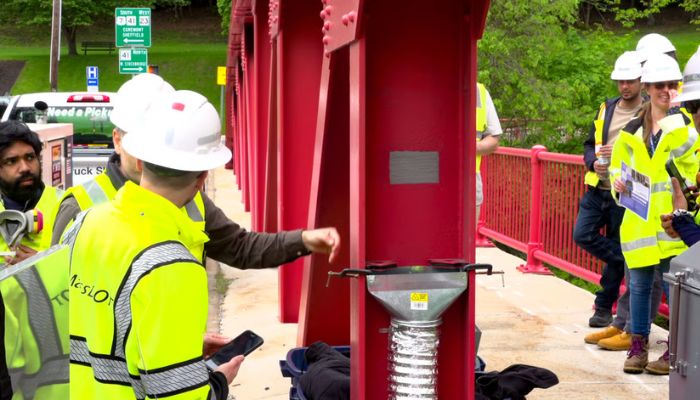
Researchers at the University of Massachusetts conduct final tests for the project (Image: University of Massachusetts)
The UMASS Amherst team is addressing this with their project “3D printing and Steel Structures: Innovation in Repairs.” The work involves testing CSAM to repair bridges, as well as developing 3D LiDAR scanning methods to replace visual assessments. Typically, visual assessments are time-consuming and subjective. With a 3D LiDAR scanning method, researchers can identify corrosion more precisely and develop a digital repair plan. This also allows them to identify where the repairs are strictly necessary, saving time and material. “By combining scanning with precise material deposition, we can be very targeted and say, ‘we’re going to print here and here and here and we’re going to give this bridge another 10 years of life,’ which is huge,” Gerasimidis added.
More from the desk
Six other notes from the rest of the bench.
 NewsPart 1: How are AM companies responding to the COVID-19 outbreak?The COVID-19 crisis has introduced a lot of uncertainty for many industries around the world. Whilst the crisis is resolving in China, where it started, in other parts of the world this is far from being the case. Governments have…
 NewsTop 5 Videos of the Week: 3D printed multifunctional robots…This week we found the top 5 videos about 3D printing and the way additive manufacturing is shaping our society. The technology has infiltrated many sectors, from medical to automotive! Check out our selection of the week to keep up with the innovations! This week we…
 NewsThe Longest 3D-Printed Bridge for Cyclists Has Been Inaugurated in the NetherlandsAlas! After several months of work, the Dutch city of Nijmegen is now home to one of the longest 3D-printed bridges for cyclists. Inaugurated on September 8, the bridge measures 29 meters long and was manufactured in the 3D printing…
 NewsTop 5 Videos: Using 3D Printing to Help Rebuild UkraineAnother week has come to an end, and that can only mean one thing: It’s time for another top five list of videos from the world of 3D printing! This week’s list starts off with a video about a Czech…
 ApplicationsFrom Switzerland, the New Customized Cancer Therapy With a 3ntr 3D PrinterFDM 3D printing as the leader among new technologies is now used to investigate personalized treatments for breast and prostate cancer. 3D printing makes it possible to make fully personalized support and immobilization tools which are very important to ensure…
 NewsMark Zuckerberg Makes 3D Printed Dresses for His DaughtersJust a few months ago, Meta, the parent company of Facebook, WhatsApp, and Instagram, announced its acquisition of Luxexcel, a Belgian-Dutch company that specializes in producing 3D-printed lenses. The company had already raised several million euros to market its eyeglass&hellip