Guides
#3Dstartup: Voltera designs printed circuit boards thanks to additive manufacturing
Less often discussed, additive manufacturing also has its place in the electronics sector, where it enables the design of smaller, finer and more precise components than conventional production methods. Known as micro 3D printing, this technique can improve the performance,&helli
- 3 min read
- Guides
- Six more stories
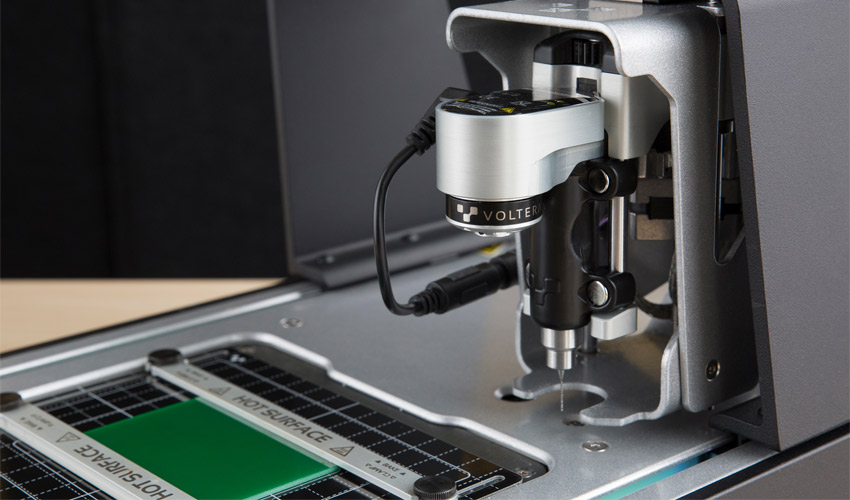
Less often discussed, additive manufacturing also has its place in the electronics sector, where it enables the design of smaller, finer and more precise components than conventional production methods. Known as micro 3D printing, this technique can improve the performance, functionality and miniaturisation of devices. It is often used in prototyping stages before the final product is manufactured. In fact, the startup we interview today, called Voltera, is interested in additive manufacturing to design printed circuits, beyond prototyping. Voltera has developed a machine to create its own circuits, hoping to revolutionise the electronics sector by making this 3D printing technology more accessible. We met with Alroy Almeida, one of the founders of the company, to learn more about the functionalities of its 3D printer and his vision of the sector!
3DN: Can you present yourself and tell us about your relationship with 3D printing?
I’m Alroy from Voltera. My background with 3D printing goes back 10 years, creating mechanical components for projects. At Voltera we do a fair amount of prototyping – originally with a filament-based printer but over the last few years we’ve moved to SLA (on our own machine and through print shops). While I still keep on top of what’s happening in the 3D printing space, since Voltera is an Additive Electronics company, I’m incredibly intrigued about the current state of the art and future developments of AE technologies.
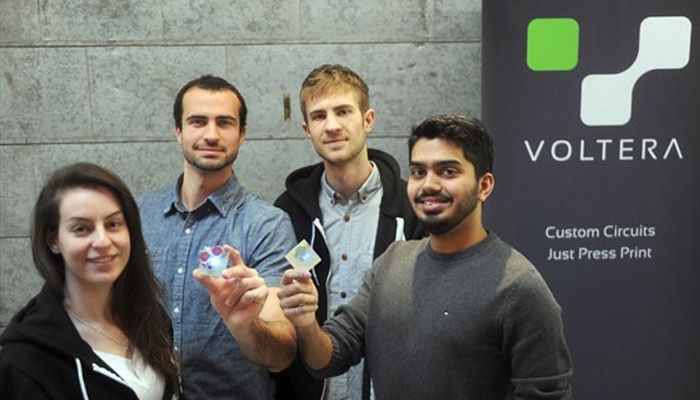
Part of the Voltera team, Alroy is at the right
3DN: Why did you decide to launch Voltera?
In 2012 we realized that 3D printers were very handy for mechanical prototyping but a circuit printer didn’t exist for electronics engineers. During the early stages of product development, it is awful to wait weeks for prototypes to arrive from factories or to pay ridiculous fees to expedite delivery. The electronics were becoming the bottlenecks at many companies. We learned this the hard way while designing electronics at various companies. Personally, my background was in industrial electronics (ruggedized communications for factories and other harsh environments) but I also did some development on medical devices. My business partners had plenty of experience in automation, EDS, and materials research.
More from the desk
Six other notes from the rest of the bench.
 ApplicationsWhat Role Does 3D Printing Play in Formula 1?Formula 1 motor racing is a demanding sport, where the quest for performance and speed is essential. But behind every sensation offered to spectators, every fraction of a second counts. Moreover, performance is not only based on the driver’s skills,…
 ApplicationsVintage Jaguar restored with HP Jet Fusion 3D printing solutionBy now it is quite well known that the automotive industry is one of the sectors that take advantage of additive manufacturing the most. From Porsche 3D printing engine pistons for its famous 911 GT2 RS model to Lamborghini Sian…
 NewsWEBINAR: How to Start and Scale a 3D Printing ServiceOn the 29th of October, 3Dnatives hosted a webinar on how to start and scale a 3D printing service. Mike Moceri, CEO of MakerOS, led this masterclass in not just how to build a 3D printing service from the ground up,…
 Applications#3DExpress: U.S. Navy and Velo3D Partner to Boost AM in DefenseYesterday, we covered the U.S. Defense Advanced Research Projects Agency’s investment of over $10 million to predict the lifespan of 3D printed parts, and today, we have another defense headline: Velo3D is partnering with the U.S. Navy. Velo3D is a…
 News3D Printing is Being Adopted in Colombia for ConstructionIn Latin America, additive manufacturing is still only in the process of being adopted. However, we are seeing gradual growth, which can at least be partly attributed to the creation in 2018 of the first Additive Manufacturing Consortium in Latin…
 NewsGerman manufacturer EOS acquires Vulcan LabsThe German manufacturer, EOS, producer of systems for the additive manufacturing of components in metal and polymers has announced the acquisition of Vulcan Labs. Vulcan Labs spun out of Stratasys last year. The spin-off from Stratasys specialises in powder bed…