News
New 3D Printed Slippery Toilet Will Help Save Water
With environmental concerns on everyone’s mind after July 2023 was the hottest month on Earth since records started being kept, more and more innovations are coming out to try and solve the climate crisis. This of course includes through efforts…
- 3 min read
- News
- Six more stories

With environmental concerns on everyone’s mind after July 2023 was the hottest month on Earth since records started being kept, more and more innovations are coming out to try and solve the climate crisis. This of course includes through efforts to conserve water as shortages loom over the horizon, including from an area you may not expect. Flushing toilets is estimated to have increased the volume of water created when humans go to the bathroom almost 20-fold, making environmental solutions to this issue paramount but unpopular due to their inefficacy. Thankfully, there may be a solution. Researchers from Huazhong University of Science and Technology have unveiled a 3D printed toilet whose surface is so slippery, nothing is able to stick to it. Potentially a huge step forward for water conservation.
As reported originally in New Scientist, this 3D printed toilet has been designed not just to be extremely slippery, but to be resistant in the face of abrasion. Slippery toilets are not a new concept, there have been many projects centered on the creation of slippery toilet coatings to prevent sticking and thus decrease flushing such as Teflon-coated toilet bowls. However, the problem with that is that this coating wears off over time, meaning either the coating or toilet will then need to be replaced. This will not be a problem for this new toilet.
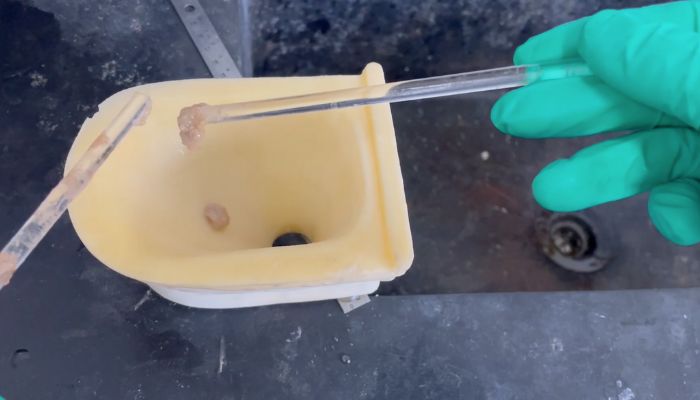
Researchers test the slippery surface of the 3D printed toilet (photo credits: Yike Li et al.)
Making a 3D Printed Slippery Toilet
To create the 3D printed toilet the researchers, led by Yike Li, turned to selective laser sintering. The aptly named abrasion-resistant super-slippery flush toilet (ARSFT) was made initially as a model that was 10 times smaller than a full-sized version. For the material, researchers developed a mixture of plastic and hydrophobic sand grains which were then fused together using a laser to create a complex structure. The self-supporting 3D complex shape was also designed to be porous, allowing the accommodation of lubricants, like silicon oil, inside it for an even more abrasion-resistant, super-slippery surface.
More from the desk
Six other notes from the rest of the bench.
 NewsWalmart Has 3D Printed Groundbreaking Concrete ExpansionAs online shopping interfaces become increasingly popular, new solutions to support this technology must be developed. That’s why Walmart built an extension to their store in Athens, Tennessee that’s dedicated to online delivery and pickup services. However, this building is&hell
 NewsADDLAB, the 3D printing laboratory at the heart of Decathlon innovationA few days ago, the French brand Decathlon inaugurated its first store concept of the future, which integrates an ADDLAB laboratory and is located in Villeneuve d’Ascq, the north of France. Called Decathlon DX, the 800 square meter store shows…
 MaterialsRENCA Makes History With World’s First Geopolymer HouseSustainability in construction has become a global imperative, urging the industry to seek innovative solutions to reduce its environmental impact. RENCA, a pioneer in sustainable geopolymer materials for 3D printing in construction, has achieved a groundbreaking milestone by usi
 NewsThe Nativity Scene Gets a 3D Printed TwistThe nativity scene is one of the most traditional symbols of Christmas across the world, and it has been reimagined this year! Italian startup Jirama has decided to innovate this most historic and religious symbol using additive manufacturing. The company…
 ApplicationsAREVO creates the first 3D printed carbon fiber unibody bike frameAREVO is the Silicon Valley company that develops technology to enable direct digital additive manufacturing of ultra-strong, lightweight composite parts for end use applications in high volume. The company announced a partnership with bike manufacturer, Franco Bicycles. Together
 MaterialsA New 3D Printing Filament Is Made from Recycled Coffee PodsAs issues related to global warming continue to arise, people around the world are constantly searching for solutions to our environmental concerns. One notable one is seeking ways to address the growing waste issue, with the World Bank estimating that…