News
In Italy, 3D printing saved the lives of COVID-19 patients
In the face of the current health crisis, solidarity is essential to combat the COVID-19 outbreak. In northern Italy, after a call for help, a few companies mobilised to 3D print valves for respiratory intensive care equipment in a hospital.…
- 3 min read
- News
- Six more stories
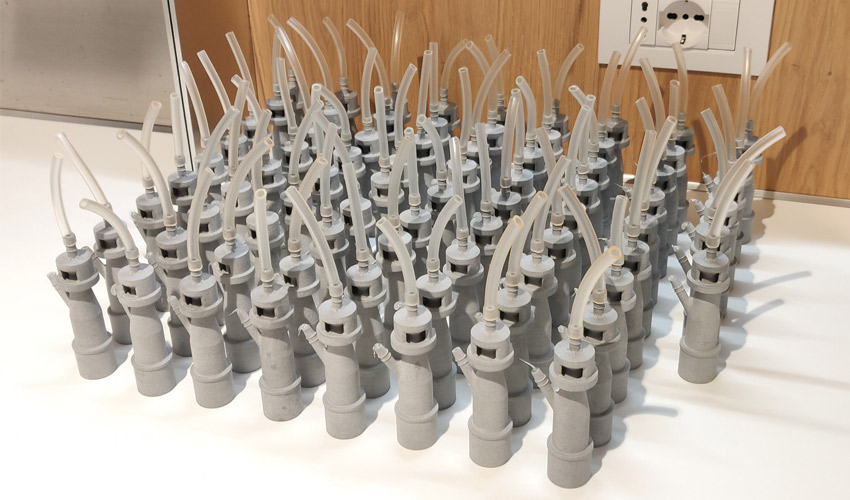
In the face of the current health crisis, solidarity is essential to combat the COVID-19 outbreak. In northern Italy, after a call for help, a few companies mobilised to 3D print valves for respiratory intensive care equipment in a hospital. About ten patients are currently being treated with a machine equipped with the 3D printed valve, a device that enabled the emergency to be dealt with in a very short amount of time and that seems to be working very well. In the midst of the crisis, 3D printing is providing an answer to frozen supply chains, and to industries that are at a standstill because of the Coronavirus.
It’s hard to say that additive manufacturing will provide long-term answers to fight the COVID-19, but it can offer some solutions to relieve the population, whether it’s through small 3D printed houses to relieve congestion in hospitals, or medical tools designed thanks to 3D printing technologies to meet a shortage. In Italy, it is thanks to the additive manufacturing community that a hospital in Brescia, one of the cities most affected by the virus in Lombardy, has been able to receive 3D printed valves and thus operate more ICUs to save lives. In the hospital, personnel was out of Intensive Care Unit (ICU) valves, and its supplier was not capable of delivering them on time.
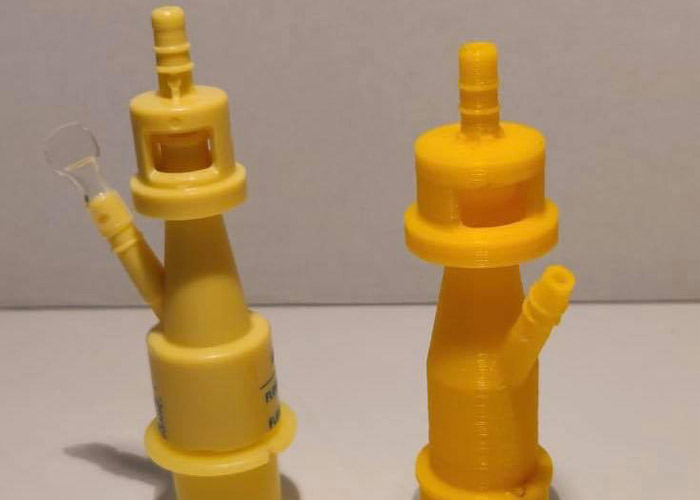
The valves were first 3D printed on an FDM machine.
It was the founder of The FabLab in Milan, Massimo Temporelli, who appealed to several Fablabs, printing services and manufacturers to print the missing valves – Massimo explains that he had earlier received a call from an editor at the Giornale di Brescia newspaper. It was the Italian design office Isinnova that answered the call: its CEO, Cristian Fracassi, expressed himself on his Facebook profile: “We received a phone call, we were told that at the hospital in Chiari, the valves for the respirators were missing and people were dying. The ordinary way, that of supplying standard parts, was not feasible for a simple reason of time. What were we to do? People’s lives were in danger, and we acted. That’s all, we did what we had to do.“
More from the desk
Six other notes from the rest of the bench.
 News#3DOpinion | What Is the State of the AM Market in the Beginning of 2024?We’ve all seen the headlines. Coming to the end of 2023 and the beginning of 2024, the 3D printing market has been inundated with thought pieces with titles claiming that 3D printing was dying, or that it failed to live…
 MaterialsHarvard researchers develop multinozzle 3D printer that can switch between 8 inksYou might be aware that most commercial extrusion-based 3D printers are only able to build objects from a single material at a time. And when they do allow for multiple materials and colors to be used, the process is slow.…
 NewsTop 5 Videos of the Week: 3D printing on Mars…This week we found the top 5 videos about 3D printing and the way additive manufacturing is shaping our society. The technology has infiltrated many sectors, from medical to space! Check out our selection of the week to keep up with…
 PrintersNano Dimension: The additive manufacturers for printed electronicsNano Dimension is an Israeli company that was founded in 2012 that specializes in nanotechnology and additive manufacturing. They have developed inkjet inks that are composed of nanoparticles, which are used in the production of printed circuit boards (PCBs) via…
 Applications#3DExpress: Agnikul Cosmos Helps India to Reach for the Stars With 3D PrintingIt’s that time once again! Now that Saturday is here, it is the moment to take a look back at some of the most pertinent news in the 3D printing news from the week. First, let’s start with Agnikul Cosmos.…
 NewsWhat are the recruiting trends in 3D printing?Behind additive manufacturing technologies lies the know-how and knowledge of qualified people on cutting-edge subjects. It is quite clear that 3D printing attracts many profiles and companies have been recruiting, but in what proportions? What are the recruiting trends in&hellip