Software
How MakerOS Combines Sales Pipelines and Production Workflows for 3D Printing Companies, and Why It’s Important to Do So
For any fabrication company, sales and engineering teams need to work together to deliver projects efficiently, yet they rarely communicate or collaborate in an efficient way. This is why MakerOS launched its collaboration platform for fabrication companies, specifically 3D print
- 3 min read
- Software
- Six more stories
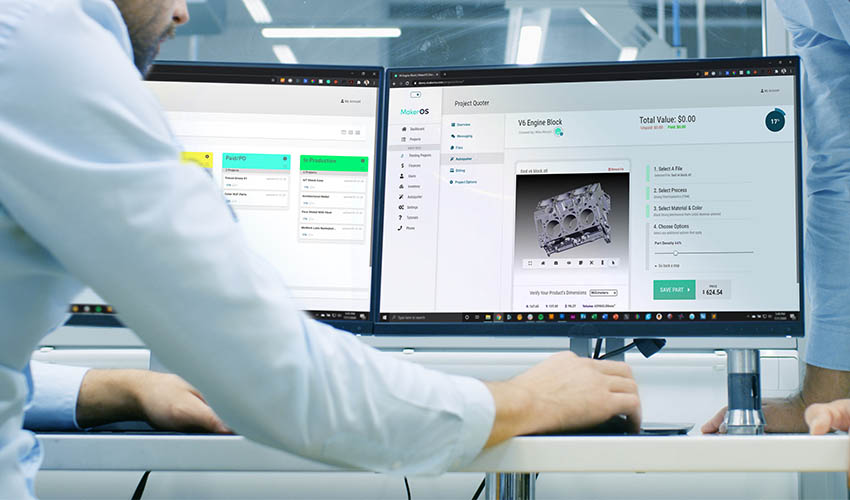
For any fabrication company, sales and engineering teams need to work together to deliver projects efficiently, yet they rarely communicate or collaborate in an efficient way. This is why MakerOS launched its collaboration platform for fabrication companies, specifically 3D printing service providers, back in 2015. Following some upgrades, it released version 2.0 of its online platform last month. As a matter of fact, there is high-demand for a solution that will help companies manage multiple projects at a time. After a threshold, it becomes nearly impossible to sync sales and engineering teams if processes are not centralized. Why is that so?
Almost all fabrication companies, especially 3D printing companies, have a process in place to receive new projects and a process to produce those projects. In the sales pipeline, a company will have a visual snapshot of where prospects are in the sales process, showing the sales team how many deals they can expect to close in a given week or month. These deals represent projects that need to be assigned to production. In most cases, the sales pipeline and production workflow are not synced, giving rise to many inefficiencies. For example, the sales team is rarely looped into the status of their clients’ projects. If they want to have some updates they will need to ask someone from the engineering team directly, which you can imagine, is not ideal.
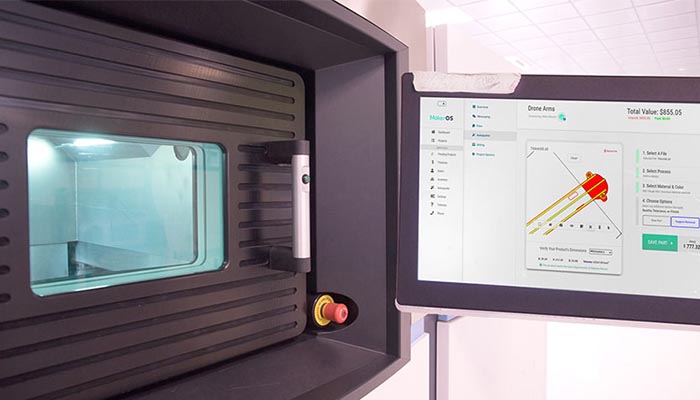
Project management solutions exist, but usually sales data is first registered on a separate software, typically a CRM tool, and then added to the PM tool. In this case scenario, the sales team is updated on the status of projects but at the price of using two software applications, one to manage the sales process and another to manage the tracking of the actual work the client had requested. Additionally, there’s invoicing, one of the most important elements of this entire process as both the sales and engineering team have to be in sync in order to send the correct invoice to the customer (the price having possibly been altered during production). Invoicing usually adds an additional, and therefore third software to this entire process. Finally, the invoicing process is rarely automated, meaning that invoices are sent manually by email once they have been generated.
More from the desk
Six other notes from the rest of the bench.
 NewsBroken shoe? This new 3D printing material repairs itselfResearchers at the University of Southern California, Viterbi School of Engineering, have developed a 3D printing material that repairs itself on its own after being fractured or punctured. These materials could be game-changing for many industries such as the shoe,…
 NewsAmerica Makes announces AM education challengeThere is no doubt that 3D printing is a technology that we will continue to see grow into the future; But when we discuss the future, it is important to remember who our future is, and that would be kids.…
 MaterialsAdvancing bioprinting technology in spaceRecently, CELLINK announced an exciting partnership with Made In Space to develop advanced bioprinting technology for space. The space company develops state-of-the-art space manufacturing technology to support exploration, national security, and sustainable space settlement. The
 GuidesThe Best STL Files for the 4th of July!Independence Day, more colloquially known as the Fourth of July, is an American federal holiday commemorating the ratification of the Declaration of Independence on July 4th, 1776. It is celebrated across the country with fireworks, barbecues and more and, of…
 ApplicationsMetShape Uses 3D Printing to Help in Fight Against VirusesThere are hardly any industries left in which additive manufacturing is not used in at least some way. In medicine in particular, 3D printing has proven itself as a manufacturing method, launching helpful applications for both patients and doctors. Whether…
 News3D Hubs raises $18M to invest in its automation capabilities3D Hubs, one of the world’s largest network of manufacturing services has just raised $18 million in series C funding. The investment round was led by the Dutch growth capital investment firm Ended Capital and will focus on developing the…