Applications
From High Fashion to Surgery Robotics, XJet’s Metal 3D Printing Is Enabling Innovation
Metal and ceramic additive manufacturing (AM) has grown exponentially in recent years. According to one report from USD Analytics, the global metal AM market size is worth an estimated $4.9B in 2023 and expected to grow at a rate of…
- 3 min read
- Applications
- Six more stories

Metal and ceramic additive manufacturing (AM) has grown exponentially in recent years. According to one report from USD Analytics, the global metal AM market size is worth an estimated $4.9B in 2023 and expected to grow at a rate of 22.85% through 2030. Ceramic 3D printing is a smaller field since the materials are more difficult to work with, but still the market is expected to be worth approximately $3.5 billion by 2030. The reason for this growth is simple. Due to the properties of the materials, 3D printing with ceramics and metal allows for heretofore unrealized applications in many fields. This is the case as well for XJet, whose 3D printing technology is making its impact especially on sectors like fashion and healthcare.
This is not the first time we have spoken to you about XJet. The Israeli company is notable for its groundbreaking material jetting technology, Nano Particle Jetting (NPJ), which is pushing boundaries in both metal and ceramic 3D printing of high-quality end-use parts, at scale. NPJ uses inks containing either metal or ceramic solid nanoparticles that are jetted onto the build tray. This process is more environmentally friendly, as it is entirely powderless and involves the use of a fully water-soluble support material. Such benefits are now being recognized in different sectors, including high fashion accessories and medical surgery tools. Applications in these verticals, and more, will be demonstrated by the company and its partners at Formnext this year.
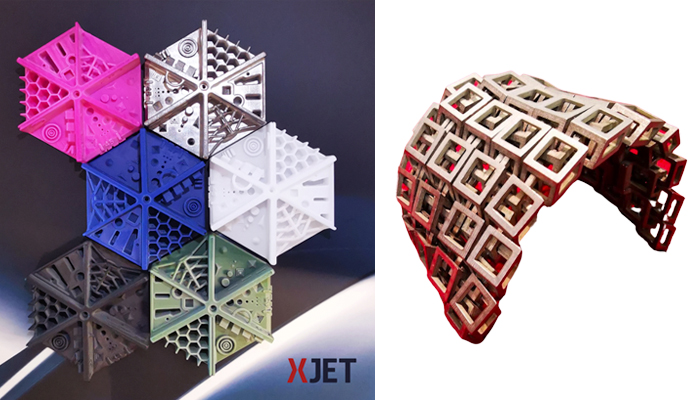
XJet is notable for its groundbreaking technology, Nano Particle Jetting (NPJ)
Reinventing High Fashion Accessories With XJet
For those of you who are familiar with high-precision, direct material jetting in general, it should come as no surprise that NPJ is so uniquely suited for high fashion as well as other wearables such as glasses, ceramic earbuds, luxury and smartwatches. Thanks to the precise nature of the technology, it can create complex and accurate parts with very high surface quality. This is especially critical when making goods that will be worn directly by users.
More from the desk
Six other notes from the rest of the bench.
 Printers3DGence releases INDUSTRY F420 3D printer for high-performance materialsFor some years now, high-performance thermoplastic materials have become more important in the additive manufacturing industry due to their strength, lightness and cost. This is why the European company, 3DGence, has decided to develop industrial 3D printers capable of producing&
 SoftwareCan Blender Be Used for 3D printing?Created in 1995, Blender is a complete 3D modeling software, very popular in the world of animation and video thanks to the many features it offers. The particularity of Blender is that it is 100% free, open source – which…
 NewsFormnext Awards: Competing to Promote Innovation in 3D PrintingThe additive manufacturing sector continues to advance thanks to the talent and motivation of the people who are driving the technology forward and, with it, the industry as a whole. It is therefore essential that all these ideas receive the…
 NewsHorizON project: 3D printed suspension lightWe have seen by now how additive manufacturing can inspire designers to create shapes and forms that were impossible to make with conventional manufacturing methods. New designs are emerging not only in fashion, but also architecture. With the ever increasing…
 NewsWEBINAR: How to get started with Additive ManufacturingOn the 26th of February, we had our first webinar of the 2020 to guide you through the steps of adopting 3D printing for your company. If you are into technology, you will have noticed that additive manufacturing has stolen…
 NewsFormnext Connect: what did the community think?Formnext Connect closed last week. After much anticipation from the community on what the physical event turned digital would look like, the event did not disappoint! The organisers stated in their press release “Formnext Connect succeeds as the digital heart…