Applications
Daimler Buses Develops Mobile 3D Printing Center in a Container
The German car manufacturer Daimler, or more precisely its subsidiary Daimler Buses, has developed a pilot project focusing on 3D printing spare parts. With its service brand Omniplus, the company has designed a mobile container measuring 36 square meters (387.501…
- 3 min read
- Applications
- Six more stories
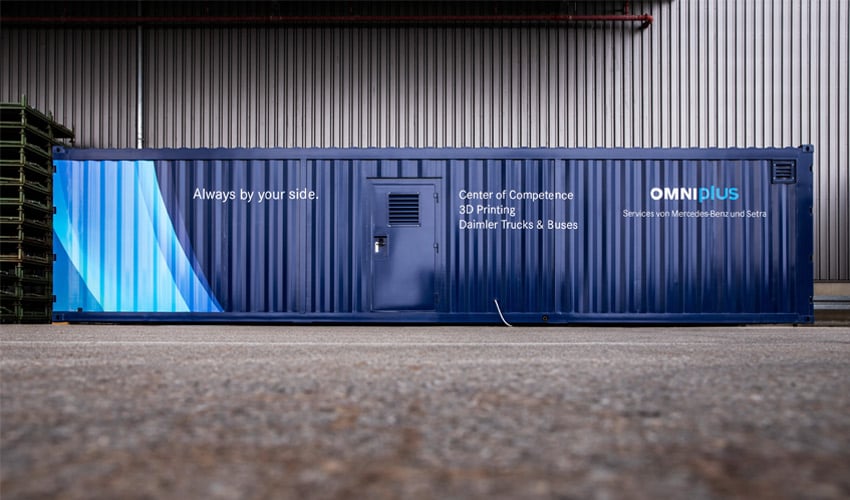
The German car manufacturer Daimler, or more precisely its subsidiary Daimler Buses, has developed a pilot project focusing on 3D printing spare parts. With its service brand Omniplus, the company has designed a mobile container measuring 36 square meters (387.501 square feet). The container integrates additive manufacturing solutions for designing components, in this case spare parts, on demand. For now, this manufacturing space will be operational at BusWorld Home (BWH) in Hamburg, Germany. The manufacturer’s goal is to increase the number of digitized and 3D printed parts, and ultimately to offer online 3D printing licenses that customers can buy and then the parts will be produced in an additive manufacturing center certified by Daimler Buses.
The German company has been using additive manufacturing for several years and has used the technology in the production of prototypes for over 30 years. Now thanks to several advancements, 3D printing is now an efficient method of creating spare parts for buses. At present, Daimler Buses claims to have 3D printed more than 40,000 spare parts . It is currently working on 7,000 more models, offering a pretty impressive library of 3D files. By developing mobile micro-factories, the company wishes to further expand its use of AM and offer a faster, more local, and more environmentally respectful manufacturing solution to its customers.
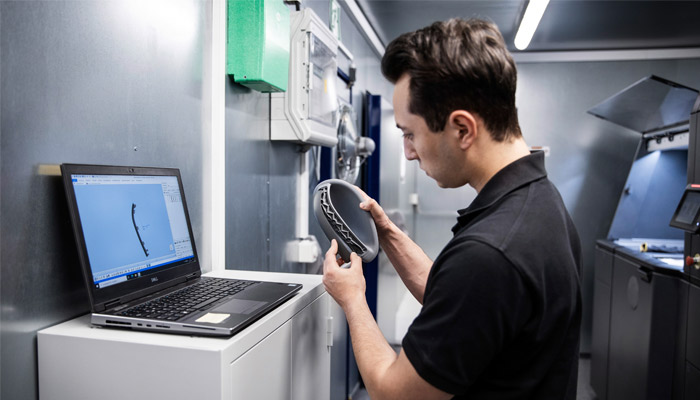
Thanks to additive manufacturing, the car manufacturer can store numerous digital spare parts and print them on demand (photo credits: Daimler Buses)
Daimler Buses and its mobile manufacturing unit
The twelve by three meter container would be easily transportable by truck and would require electricity and internet connection to operate. The first would integrate an HP Jet Fusion 4200 machine and a processing unit which ensures the mixing and loading of the material (here a polymer powder), that would also allows rapid cooling of the parts. While the second would be equipped with a powder removal solution, an air filter and an air conditioning system. The goal is to have everything in hand necessary in order to design quality components, from modeling to post-processing.
More from the desk
Six other notes from the rest of the bench.
 NewsWorld’s Largest 3D Printed Building Erected in FloridaConstruction in 3D printing just seems to continue to grow! In recent news, Printed Farms and COBOD have announced that they have completed what they claim is the largest 3D printed building in the world and located in Florida. With…
 NewsTop 5 Videos of the Week: revolution in dental 3D printing, new Guinness World Record…This week we found the top 5 videos about 3D printing and the way additive manufacturing is shaping our society. The technology has infiltrated many sectors, from medical to automotive! Check out our selection of the week to keep up with the innovations! This week we…
 MaterialsRecreus, taking 3D filament manufacturing to the next levelUntil a few years ago, FFF technology (Fused Filament Fabrication) had been associated with the maker community, and less so with the industrial sector. Following the evolution of FFF machines, and their materials, the technology began competing in the industrial…
 NewsGiant 3D printed butterfly sanctuary building in New York CityThe Brooklyn-based nonprofit architecture and urban design group, Terreform One revealed an incredible design concept for an urban ‘Monarch Butterfly’ sanctuary to be set in the Big Apple. The vertical meadow façade they imagined would be 3D printed in carbon…
 ApplicationsThe MIT Rocket Team creates 3D printed rocket using plasticWith the constant developments being made in 3D printing, it can sometimes be hard to keep up. But, there is always a piece of news that stands out from the rest, and this is one of them. Recently, an independent…
 PrintersVaporFuse Surfacing, a green solution for improved part propertiesWhen it comes to the additive manufacturing workflow, we often discuss different printing technologies and modeling software, but it seems like post-processing is not being talked about enough. Yet the subsequent treatment of prints is a crucial step as it…