Applications
Bugatti Bolide: a light and fast vehicle thanks to 3D Printing
The French carmaker Bugatti has probably imagined the lightest, fastest and most aggressive vehicle in its range. Called Bolide, this sports car is an assortment of new technologies, relying, in particular, on additive manufacturing to reduce the weight of its…
- 3 min read
- Applications
- Six more stories
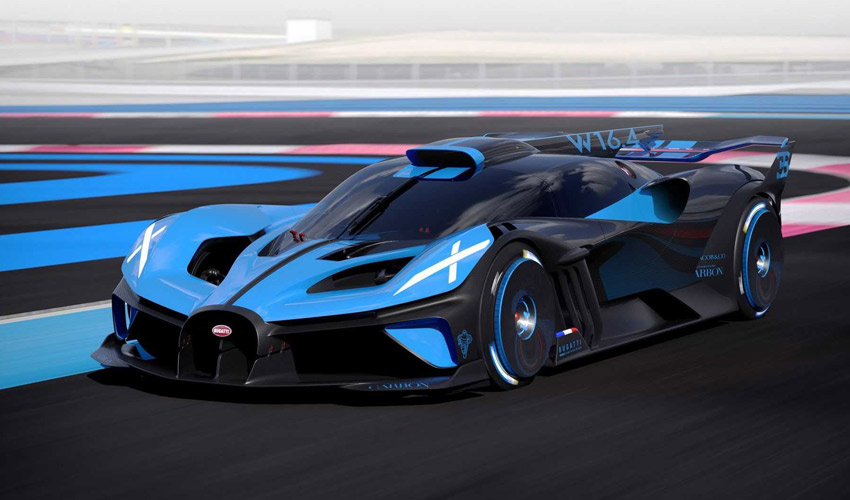
The French carmaker Bugatti has probably imagined the lightest, fastest and most aggressive vehicle in its range. Called Bolide, this sports car is an assortment of new technologies, relying, in particular, on additive manufacturing to reduce the weight of its components. It weighs about 1,240kg (2733.7lbs) compared to the 1,996kg (4400.4lbs) of its flagship Chiron model, while achieving a weight-to-power ratio of 0.67. For now, the hypercar is only an experimental study, but it could very well go beyond the project stage by demonstrating all the benefits of automotive additive manufacturing.
In January 2018, the French brand revealed a first brake caliper printed in 3D metal, more precisely titanium. This first in the automotive sector reduced the total weight of the part by 2kg (4.4lbs), a 40% reduction. One year later, Bugatti renewed its confidence in 3D printing technologies by relying on the SLM Solutions process to build not only a spoiler support but also an engine mount. Henrik Hoppe, a doctoral student at Bugatti, explains: “Through the process known as selective laser melting, commonly known as 3D printing, new, hollow, ultracomplex components that are stiffened from the inside can be produced which are very lightweight and yet extremely rigid and strong. We are using these advantages for a growing number of components in our hyper-sporty cars.”
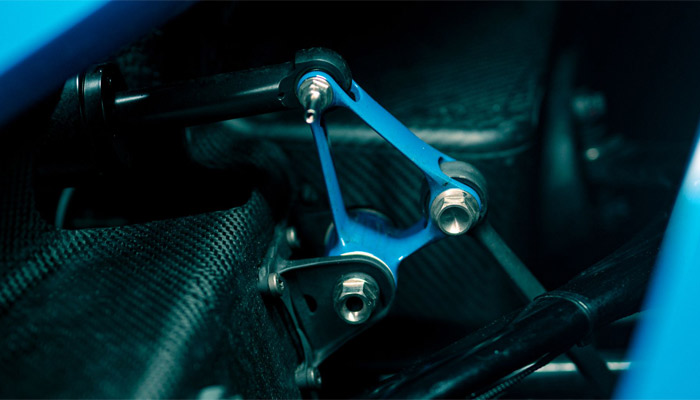
One of the 3D printed pieces on the Bugatti Bolide (photo credits: Bugatti)
Bugatti Bolide, a compilation of new technologies
Bugatti has drawn on its experience in additive manufacturing to design this new sports car, which incorporates numerous 3D printed parts, with the ultimate goal of reducing weight while maintaining high rigidity. Looking at the additively designed components, we can cite push rods weighing only 100 grams, which have an internal support arch that provides sufficient strength to support loads of up to 3.5 tons. It would appear that topology optimization methods were used in order to obtain a structure that could withstand pressures mainly concentrated in the center of the part.
More from the desk
Six other notes from the rest of the bench.
 Software3DEXPERIENCE World 2025: What Impact Will AI and Robotics Have on Humanity?3DEXPERIENCE World 2025, the event organized by Dassault Systèmes that brings together thousands of professionals, designers, engineers, makers and creatives each year, has ended. This year it was held in Houston, Texas, February 23-26. 3DEXPERIENCE World is an opportunity to&hel
 Guides3D Printing Applications in the Fight Against Breast CancerBeing a woman is the biggest risk factor for developing breast cancer. Even though men are not immune to this type of cancer and around 1% are diagnosed with it every year, breast cancer was the most common cancer in…
 PrintersSchneider Electric Harnesses the Benefits of DLP 3D Printing to Create Replacement PartsSchneider Electric is a European company founded in 1836, operating worldwide. It is engaged in the development and manufacture of air circuit breakers, among other things. They recently integrated additive manufacturing into their business to address the lack of stock…
 GuidesWe interviewed Joel Telling, AKA 3D Printing NerdWe were lucky enough to sit down and speak with Joel Telling, also known on YouTube as 3D Printing Nerd. We asked him a variety of questions, related to his experiences with 3D printing, where he sees the tech going,…
 NewsA 3D printed house to live on Mars?The winners of the contest by NASA to develop habitats in space was recently announced. One of the most prominent was the project MARSHA (Mars Habitat) created by the New York company AI Spacefactory, which developed a 3D printed house…
 NewsHow well do YOU know 3D Printing? Take Our Quiz:Do you fancy yourself as a bit of a 3D printing genius? Test yourself in our 3D printing quiz! [os-widget path=”/3dnatives/are-you-a-3d-printing-expert”] Have an opinion? Let us know in a comment below or on our Facebook and Twitter pages! Sign up for our free weekly