Applications
Better Rotator Cuff Treatment Thanks to 3D Printing
It is no secret that tendon injuries are some of the most painful and difficult to heal. Even minor ones can result in up to 12 weeks of recovery. But for the most severe, for example rotator cuff injuries, treatment…
- 3 min read
- Applications
- Six more stories

It is no secret that tendon injuries are some of the most painful and difficult to heal. Even minor ones can result in up to 12 weeks of recovery. But for the most severe, for example rotator cuff injuries, treatment is challenging and even in ideal situations take at least 6 months to recover. This is where a team of researchers at The Chinese University of Hong Kong (CUHK)’s Faculty of Medicine (CU Medicine) has come in. Knowing that more tailored and effective rotator cuff treatment was necessary, they have developed a new 3D-printable bioactive material for the repair of severe tears of the shoulder tendons.
The rotator cuff is the sheaf of tendons and ligaments that supports the arm at the shoulder joint. When torn, the injury is incredibly painful, preventing the performance of basic tasks involving arms or even sleeping, and requires surgery in almost all cases. Furthermore, with rotator cuff injuries expected to rise in the coming years due to aging populations in many countries, and with statistics showing that already at least 22% of the adult population has had one full-thickness rotator cuff tear, it has become critical to find more agile and effective solutions for treatment. This 3D-printable bioactive material could be the solution.

The team developing the materials including (starting from the left) Mr. Wang Chen-yang, Professor Elmer Ker, Dr. Zhang Xu and Dr. Li Ke (photo credits: CUHK)
Using a 3D-Printable Bioactive Material to Repair Rotator Cuffs
The key for the team at CUHK was in a polythiourethane elastomer, or PHT polymer, that when implemented in the body, could replace the torn tendons. Created using “click chemistry,” or chemical synthesis to join two molecular entities of choice, known for its ability to create almost exact copies of natural molecules, the material is able to mimic natural tendon. Indeed, testing has shown that in addition to its highly robust mechanical properties, the material can be stretched at least 10,000 times without failing.
More from the desk
Six other notes from the rest of the bench.
 NewsTop 5 Videos: First Full-Size 3D Print of a Human HeartThis week we found the top 5 videos about 3D printing and the way additive manufacturing is changing production. The technology has infiltrated many sectors, from medical to automotive: check our selection of the week to keep up with the innovations! If you enjoy these, you&helli
 NewsAdditec Revealed Desktop Metal 3D Printer: μPrinterAdditec, founded in 2015 is a company based in Las Vegas (USA) and Bremen (Germany). It initiative aims to innovate how large metal structures are manufactured by changing system reliability and cost. They have revealed their new desktop metal 3D printer,…
 MaterialsValueBioMat Talks 3D Printing Biosourced CompositesToday, more and more companies are developing composite materials for additive manufacturing, enabling the design of lighter and stronger parts. However, these materials can have a negative impact on the environment as they are often made from a plastic matrix.…
 ApplicationsStratasys and AM Craft Partner to Advance 3D Printed Aviation PartsStratasys, a leader in advanced 3D printing technologies across diverse industries, has joined forces with AM Craft, an aviation manufacturing innovator from Latvia. This strategic partnership, built on the combined expertise of both companies, is set to significantly boost the&h
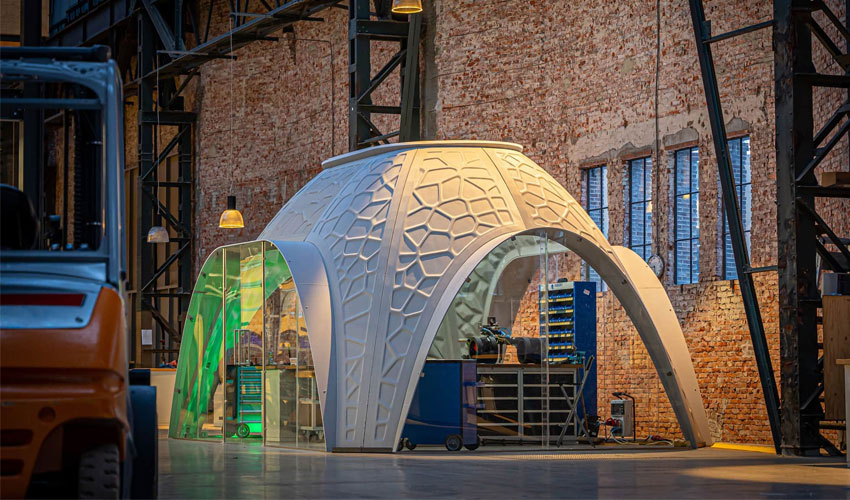 NewsThis 3D Printed Pavilion was Made from Recycled PETIn the Netherlands, additive manufacturing has once again proven its worth in the construction sector: the Royal3D printing service has created a sort of shelter for a modular 3D printed workspace. And this time, it is not traditional concrete that was…
 NewsGE’s education program invests AM into educationAs part of GE’s Additive Education Program, GE Additive will offer 3D printers to more than 400 schools, reaching more than 180,000 students across the world. An initiative that will help streamline the use this technology in education. General Electric…