News
Additive Manufacturing vs. Injection Molding: Which Manufacturing Process to Choose?
In modern manufacturing, a variety of production technologies cater to different requirements. And two of the most popular are undoubtedly injection molding and additive manufacturing. Both processes offer unique advantages and can complement each other. To gain a deeper understa
- 3 min read
- News
- Six more stories
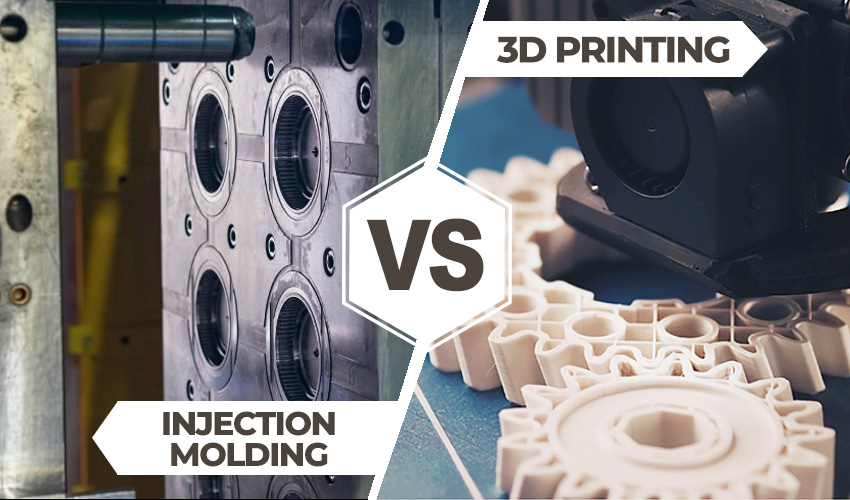
In modern manufacturing, a variety of production technologies cater to different requirements. And two of the most popular are undoubtedly injection molding and additive manufacturing. Both processes offer unique advantages and can complement each other. To gain a deeper understanding, we decided to take a closer look at the two different technologies to compare and contrast them, focusing on fundamental principles, distinguishing features, applications, manufacturers, and costs.
Before delving into each of these technologies, it is useful to trace their historical origins. Injection molding dates back to the 1860s when John Wesley Hyatt invented celluloid, an early plastic material. Hyatt and his brother Isaiah later patented the first injection molding system, which used a piston to force molten celluloid into a mold. Throughout the 20th century, the technology advanced significantly, notably with James Watson Hendry’s invention of the rotary screw injection molding machine in 1946, which remains the standard in injection molding today.
Additive manufacturing has its origins in the 1980s. The first 3D printing systems were based on the stereolithography technique, developed by Chuck Hull and commercially patented in 1986. In the decades that followed, additive manufacturing grew with the development of new processes that have allowed for expanded material options, thus offering solutions for different practices. Now, additive manufacturing has gained ground and has become extremely attractive for different industries.
More from the desk
Six other notes from the rest of the bench.
 ApplicationsAI, ROI, and the OR: ADDITIV Medical 2026 Unites Global Experts to Bridge 3D Printing GapsA surgeon in Barcelona rehearses a cardiac repair on a model printed from the patient’s own scan. A children’s hospital in Nebraska turns around a custom cranial guide in days instead of weeks. The faster that knowledge moves between the…
 Applications3DPRINTUK 3D Prints Car Parts For Team Bath Racing3D printing is now indispensable to the automotive industry. Most major companies, such as Nissan and Audi, have already turned to the technology to streamline their production, thanks in part to the time savings and cost reductions that additive manufacturing…
 MaterialsORNL and IperionX Are Developing Low-Cost Titanium Alloys for AMIperionX has announced that it is collaborating with Oak Ridge National Laboratory in order to further develop low-cost titanium alloys for additive manufacturing. As part of a U.S. Department of Energy (DOE) approved user agreement, the two will be working…
 NewsSavorEat Makes History on the Tel-Aviv Stock ExchangeThe Israeli food-tech company SavorEat produces 3D-printed plant-based meat alternatives. After going public earlier this year, SavorEat made history. It was the first company of its kind to be listed on the Tel Aviv Stock Exchange (TASE) and raised NIS…
 NewsTOP 5 videos of the week: Airbus, Fidget Spinners and more!A new selection of the best 3D printing videos of the week, just for you! Find our TOP 5 videos of the week below and tell us what your favorite video is in a comment or on our Facebook and Twitter page.…
 News3D Factory Incubator Has Already Supported 55 3D Printing ProjectsIn early March of this year, the 3D Factory Incubator completed its second year in operation. It is the first European high-tech 3D printing incubator, housing the most promising initiatives and projects committed to disruptive technologies as the basis of…