Applications
A New Heart Patch Was Made From a 3D Printer at ETH Zurich
An interdisciplinary research team led by Professor Robert Katzschmann (ETH Zurich) and Professor Omer Dzemali (University Hospital Zurich) has introduced a promising innovation in medical technology known as the “RCPatch,” a three-dimensional, tissue-integrating heart patch that
- 3 min read
- Applications
- Six more stories
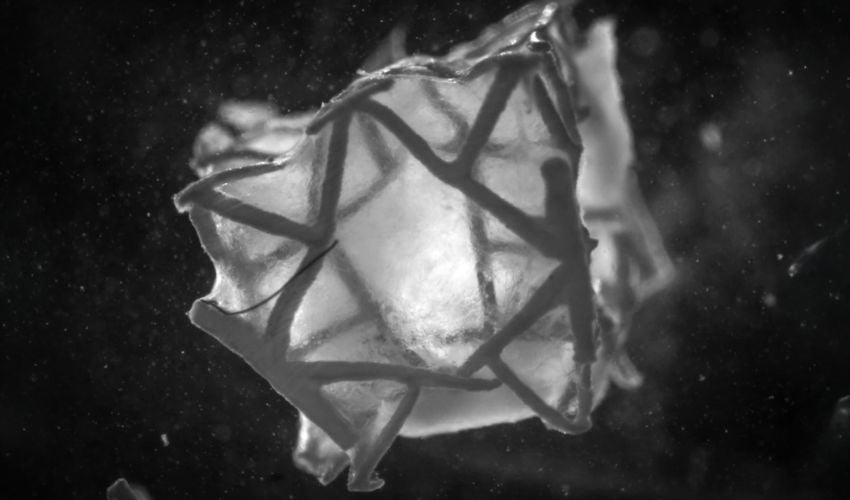
An interdisciplinary research team led by Professor Robert Katzschmann (ETH Zurich) and Professor Omer Dzemali (University Hospital Zurich) has introduced a promising innovation in medical technology known as the “RCPatch,” a three-dimensional, tissue-integrating heart patch that not only seals defective areas of the heart chamber but also actively contributes to their regeneration.
In current medical practice, heart defects following a heart attack are treated with bovine pericardium patches (BPPs). While these are stable and easy to implant, they are biologically inactive and remain permanently in the heart as foreign bodies. They carry risks such as calcification, thrombosis, or inflammation. The research team at ETH Zurich set out to develop a biologically active patch that fully integrates into heart tissue.
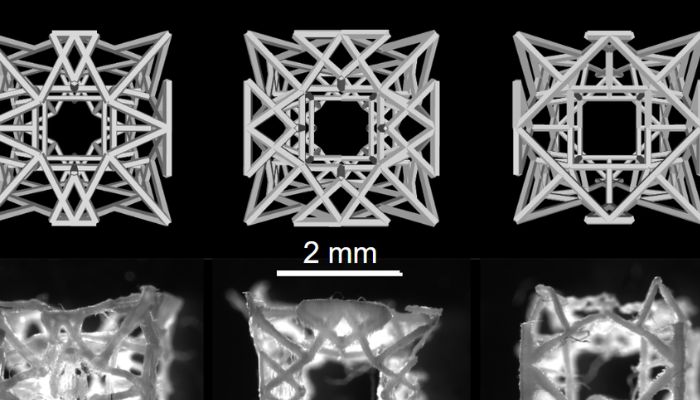
The lattice structure of the ‘patch’ from three perspectives
One Patch With Three Components
The RCPatch is composed of three coordinated components: a fine-mesh sealing net that lies directly over the defect, a 3D-printed support scaffold consisting of a lattice structure made of biodegradable polymers, and a hydrogel designed to promote tissue growth, which is populated with living heart cells. The lattice structure is produced using 3D printing and filled with hydrogel, which is also applied to the net. Once the patch is implanted in the heart, it fuses with the surrounding tissue. The support scaffolding then fully dissolves over time, leaving no foreign material behind.
More from the desk
Six other notes from the rest of the bench.
 NewsWhat Can You Expect at 3D Print Paris 2022?Trade shows are still an excellent for additive manufacturing users to meet and learn about personalized solutions. 3D Print Paris, a key event for the 3D printing industry, is now back for its second edition, taking place on October 19th…
 News3DEXPERIENCE World 2020: shaping the world of designToday, 3DEXPERIENCE World 2020, organized by Dassault Systèmes, is coming to a close. Previously known as SOLIDWORKS World, the event was renamed to mirror the ecosystem formed by the whole family of solutions from Dassault Systèmes. Taking place in Nashville,…
 GuidesEndurance Lasers: Easy to install on your 3D printerThe Russian-American startup, Endurance Lasers, specialises in creating easy to install and use lasers and cutters. A tool to add something extra to your 3D printing by combining a 3D printer, cutter and laser engraver all into one machine. We have…
 NewsA 3D Printed Air Cooler Could Be an Environmentally Friendly Alternative to Air ConditioningAccording to scientists worldwide, 2023 has been the hottest summer in history. Understandably, this has drawn ever more people not only indoors but to air-conditioned areas to find relief. However, unfortunately, AC units is not the most environmentally friendly. Not…
 NewsTop 5 Videos: Aerogel microstructures using 3D printingThis week we found the top 5 videos about 3D printing and the way additive manufacturing is changing production. The technology has infiltrated many sectors, from medical to automotive – check our selection of the week to keep up with the innovations! If you enjoy these, you&hell
 ApplicationsMaking a facial prosthesis on photogrammetry softwareDenise Vicentin, 53 was diagnosed with a facial tumor 30 years ago. After having it removed twice, it came back 20 years later in a malignant form. Luckily, she was able to benefit from research conducted by scientists at Paulista…