Guides
#3DStartup: Readily3D and its Volumetric Printing Technology Based on Tomography
Readily3D is a young Swiss startup that has developed a volumetric 3D printing method to create complex organic shapes in just a few seconds. The company used tomography to design its first 3D printer, which is capable of solidifying an…
- 3 min read
- Guides
- Six more stories
Readily3D is a young Swiss startup that has developed a volumetric 3D printing method to create complex organic shapes in just a few seconds. The company used tomography to design its first 3D printer, which is capable of solidifying an entire object at once instead of taking the layer-by-layer approach typically used in additive manufacturing. This method could make it possible to manufacture human tissue, organs or even medical models for our surgeons, all very quickly and reliably. Recently, Readily3D presented its preliminary work on the pancreas: as part of the European project ENLIGHT, the startup 3D printed organic tissues of the organ. This is a very interesting development in the fight against diabetes. We met Damien Loterie, co-founder of Readily3D, to learn more about volumetric bioprinting and the company’s future projects.
3DN: Can you introduce yourself and Readily3D?
With my colleagues Paul Delrot and Christophe Moser, I co-founded Readily3D SA, a spin-off of the Swiss Federal Institute of Technology in Lausanne. Our company commercializes a so-called “volumetric” 3D printing technology based on tomography. The development of this technology dates back to 2017 and is a continuation of the research that Paul and I had been doing up to that point while doing our PhDs in Christophe’s lab.
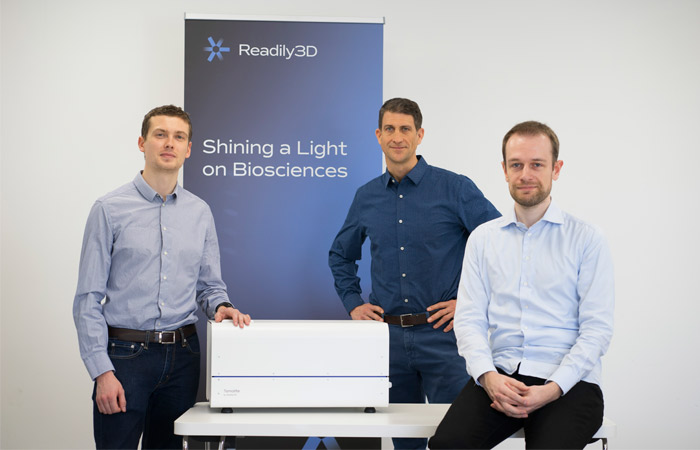
From left to right: Paul Delrot, Christophe Moser, Damien Loterie, the founders of Readily3D
3DN: How was the ENLIGHT project born?
This project is the result of a long-standing collaboration between our team and that of Prof. Riccardo Levato at UMC Utrecht in the Netherlands. After successful trials on other cell types, Prof. Levato had the idea to apply our tomographic printing technology to pancreatic cells. The goal was to obtain more representative models of the pancreas than conventional cell cultures, relying on the speed of our printers and their ability to create vascular networks within the printed objects. The pancreas plays an important role in diabetes. Being able to obtain realistic simulations of this organ by bioprinting will greatly facilitate the search for new therapies.
More from the desk
Six other notes from the rest of the bench.
 NewsHow to Make Your Own 3D-Printed Squid Game MaskNetflix’s Squid Game series has taken over the public consciousness and every corner of the internet. The Korean drama tells the story of a group of financially indebted people who risk their lives in a survival competition for the chance…
 NewsBiohybrid Jellyfish to Push Boundaries of Deep-Sea ExplorationExploring the mysteries of the ocean depths has long been an irresistible challenge for scientists. Like the vastness of space, the ocean remains largely uncharted territory, with its depths holding valuable information that could provide important insights into our planet’
 NewsThe Complete Guide to Binder Jetting in 3D PrintingThere are numerous additive manufacturing technologies on the market today, each associated with different materials and very specific applications. In this guide, we’ll be talking about binder jetting, which is compatible with a variety of materials, including ceramics and
 NewsDyeMansion raises $14M to accelerate AM mass productionDyeMansion, manufacturer of additive manufacturing finishing systems, is developing technology to turn 3D printed raw parts into high value products. It all started in 2015 when the company released the first industrial coloring solution for powder bed fusion (PBF) parts.…
 NewsELASTIUM-1, the World’s First Fully 3D Printed Foam ShoeFootwear made with additive manufacturing is a relatively recent revelation. Though the concept of 3D printing first entered the scene in the late 1970’s, it was only incorporated into the footwear industry three decades later in 2014, with adidas’s Futurecraft&hellip
 NewsMX3D’s 3D Printed Metal Bridge Has Officially Been Installed in the Center of AmsterdamOn July 15, the Queen of the Netherlands, Máxima Zorreguieta Cerruti, inaugurated the 3D-printed metal bridge installed in the city center of Amsterdam, right in the Red Light District. It took 6 years for the Dutch company MX3D to allow…