Guides
#3DStartup: LEAM Improves the Layer Density of 3D Printed XXL Parts
From science to 3D printing to business: this has been LEAM’s journey so far. The spin-off from the Technical University of Munich developed the foundation of the technology now marketed from within the university. With its DEMEX system, LEAM is…
- 3 min read
- Guides
- Six more stories
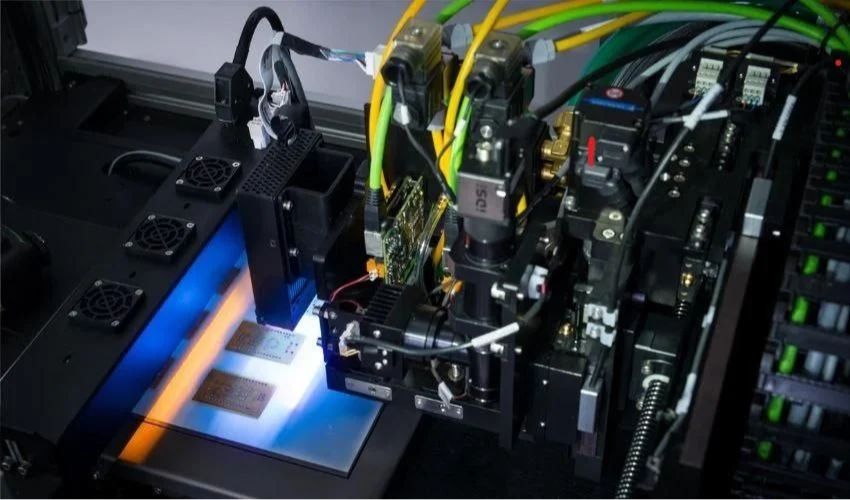
From science to 3D printing to business: this has been LEAM’s journey so far. The spin-off from the Technical University of Munich developed the foundation of the technology now marketed from within the university. With its DEMEX system, LEAM is breaking new ground in additive manufacturing. Instead of using a laser to melt material, they use a continuous light spectrum, heating the material just before the nozzle, ensuring better adhesion between layers. The DEMEX system developed by LEAM is available as an add-on module for large-format 3D printers. The young company has already attracted its first customers. We spoke to the LEAM team to learn more about the milestones they have reached, its technology and its plans for the future.
3DN: Could you introduce yourself and tell us how you discovered 3D printing?
The three of us founders (Patrick Consul, Ting Wang and Benno Böckl) have been interested in 3D printing ever since we studied mechanical engineering or started working as collaborating scientists at the Chair of Carbon Composites (LCC) at the Technical University of Munich, where we first met. Patrick had already tried his hand at 3D printing PEEK cores for aerospace structures during his Master’s thesis. But this was not possible at the time because the necessary strengths were not achievable. From 2017 onwards, however, he pursued this theme as a scientific collaborator at the Carbon Composites Chair. In the following years, he applied for and handled several research projects in which he continued to explore the subject.
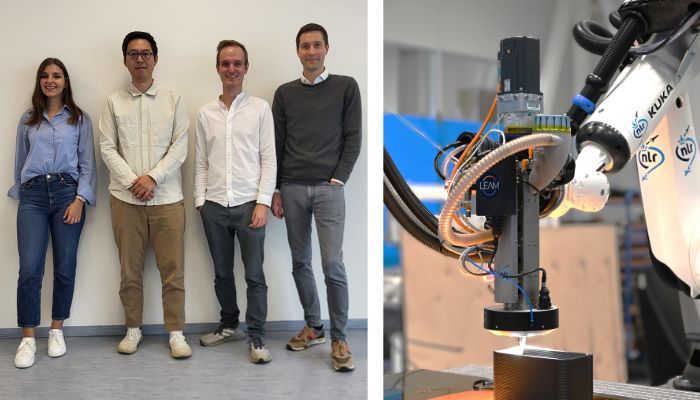
On the left, the LEAM team; on the right, the DEMEX system
Ting has been working on a research project to investigate the targeted heating of the substrate to achieve better bonding with the next layer. As a research associate, Ting carried out the first concrete preparatory work on which subsequent developments of the DEMEX system were based. Benno also worked for several years as a research associate at the Chair of Carbon Composites, where he became interested in the automated fiber placement process for carbon components manufacturing, a process with certain similarities to 3D printing. So, we came to 3D printing through science, which gave us a good understanding of its associated challenges. This has enabled us to develop solutions that open new possibilities for 3D printing in parts manufacturing.
More from the desk
Six other notes from the rest of the bench.
 PrintersA new 3D printer aboard the International Space Station?The European Space Agency (ESA) is currently testing a 3D printer capable of operating in zero gravity, designed by various international partners; it will be designed to print technical polymers with high mechanical and thermal properties. Although it is still…
 GuidesVelettrica Uses 3D Printing for More Sustainable Maritime TransportAdditive manufacturing can create parts with advanced materials that guarantee effective and cost-efficient solutions even in the most extreme environments, from the sky to space and the depths of the ocean. A prime example of this technological revolution is Velettrica,…
 GuidesThe Top Thanksgiving STL FilesThanksgiving is a time for celebration, spending time with family and friends, and of course, enjoying good food. For many, it is one of the year’s biggest gatherings where reconnecting with your loved ones is part of looking back on…
 NewsAMBUSH 3D Prints a Shoe That is Wearable in the MetaverseShoe brand AMBUSH is launching a new project that is quite unique in the fashion world: Aapair of 3D printed shoes that can be worn both in the metaverse and in everyday life. The shoes which are called 100S were…
 Applications#3DExpress: Partnership Seeks to Further Silicone 3D PrintingIn this week’s 3DExpress, start off with a new French partnership between Lynxter and 3Deus that could help advance silicone additive manufacturing in the industrial and healthcare sectors. Then learn about Creality’s latest launch and how the combination of chocolate
 NewsGermany Cuts Funding for 3D Printing: Formnext and Experts RespondThe German government’s decision to cut funding for additive manufacturing has met with resistance. After the government initially announced support for the technology, recent budget proposals made no mention of it. Criticism from the additive manufacturing industry has come from