News
How the NASA-Backed Project µBites is 3D Printing Plastic-Derived Cookies for Space Missions
Researchers at Southern Illinois University (SIU) Carbondale are using biotechnology and 3D printing to explore whether plastic and agricultural waste can be turned into food for the µBites project. The team presented the project on August 24th at ACS Fall…
- 3 min read
- News
- Six more stories
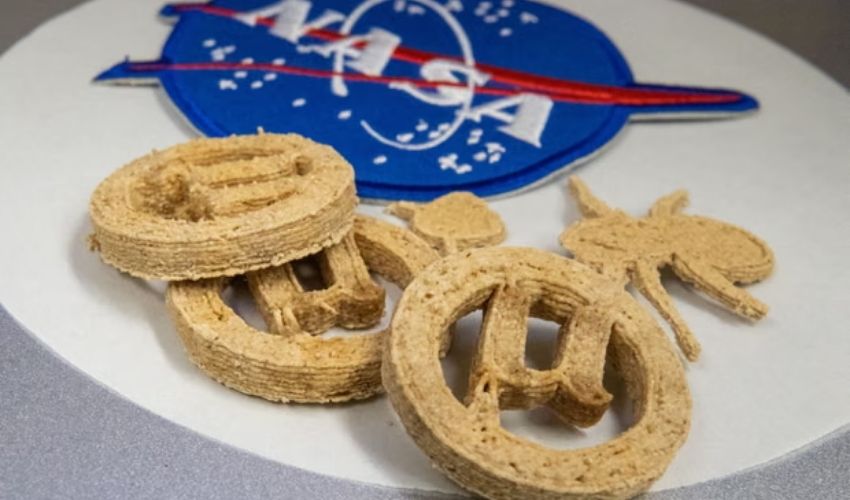
Researchers at Southern Illinois University (SIU) Carbondale are using biotechnology and 3D printing to explore whether plastic and agricultural waste can be turned into food for the µBites project. The team presented the project on August 24th at ACS Fall 2026, a meeting of the American Chemical Society. The research is linked to the NASA Deep Space Food Challenge, which aims to develop ways to produce food with limited resources. That need is especially important for long-duration space missions, like a round trip to Mars that would take three years.
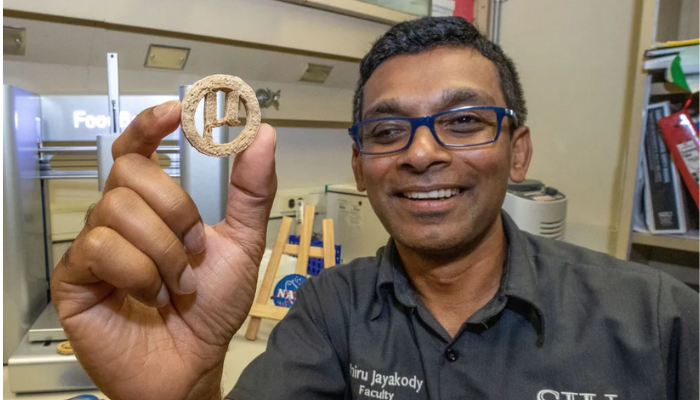
Dr. Lahiru Jayakody, who led the µBites project (Credit: SIU Carbondale Communications via ACS)
The Process, Step by Step
The process starts with PET and plant-based waste. The researchers use oxidative hydrothermal dissolution, a method that combines water, oxygen, high temperatures and pressure to break these materials into smaller molecules.
Several yeast strains then convert these compounds into protein-rich biomass and other ingredients. The team has also developed microorganisms that can produce substances to improve the food’s properties. One yeast strain can produce vanillin, which provides vanilla’s flavor and aroma. Another can use ethylene glycol derived from PET to produce beta-carotene, a precursor of vitamin A.
More from the desk
Six other notes from the rest of the bench.
 MaterialsNonOilen, a 100 % Biodegradable Filament From FillamentumOn World Recycling Day, we told you about Bluesint PA12. A polymer developed by Materialise, which allows printing with a 100% recycled powder. And today, it is the turn of the Czech manufacturer Fillamentum to unveil its new ecological 3D…
 NewsPorsche Consulting and Sakuu to Create 3D Printed Batteries TogetherOne of the first industries to use 3D printing was the automotive sector. Initially, the main application was prototyping, as the technology allows parts to be manufactured quickly, while the design can be easily changed. Though as we know that…
 NewsDyeMansion raises $14M to accelerate AM mass productionDyeMansion, manufacturer of additive manufacturing finishing systems, is developing technology to turn 3D printed raw parts into high value products. It all started in 2015 when the company released the first industrial coloring solution for powder bed fusion (PBF) parts.…
 ApplicationsRoBoat 3D printed autonomous boats in AmsterdamA team of researchers at MIT’s Computer Science and Artificial Intelligence Laboratory (CSAIL) are working with the Institute of Advanced Metropolitan Solutions in Amsterdam on a project called RoBoat. The goal is to create a system of autonomous boats that…
 PrintersUniversity of Maine creates the world’s largest 3D printed boatA team of researchers from the University of Maine revealed the largest 3D printed part in the world. It is a boat, the 3Dirigo, designed on a large-format polymer 3D printer developed by the UMaine Advanced Structures and Composites Center.…
 GuidesAddmio, an online platform to learn 3D printingWhile 3D printing is gradually taking hold in our businesses and industries, it is still a technology that is difficult to grasp. Specific skills are required to enter this market, whether in terms of materials, equipment or design. A number…