News
A house 3D printed in a single block in Belgium
In Belgium, a two-storey house has just been erected thanks to additive manufacturing: using the concrete 3D printer BOD2, developed by COBOD, the Kamp C company was able to construct a 90 square meter structure in only three weeks, and…
- 3 min read
- News
- Six more stories
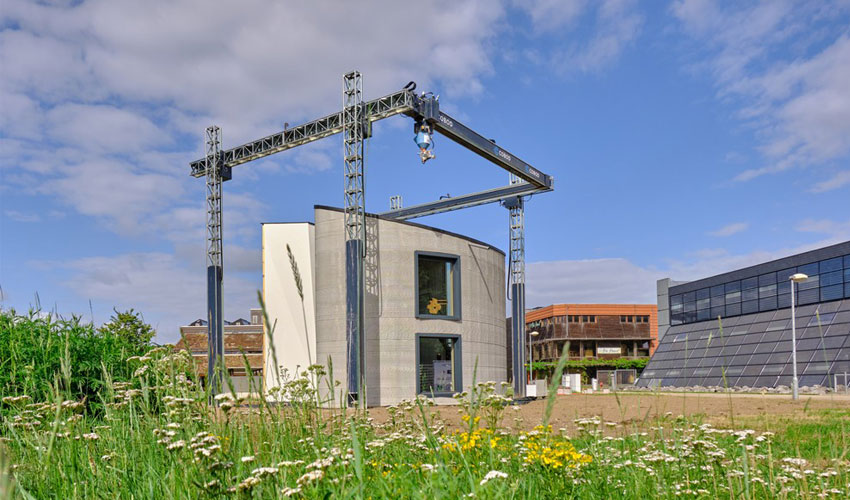
In Belgium, a two-storey house has just been erected thanks to additive manufacturing: using the concrete 3D printer BOD2, developed by COBOD, the Kamp C company was able to construct a 90 square meter structure in only three weeks, and in one single block! The company claims that this freed them from the on-site assembly steps. The project is actually a model house – for the moment, there are no plans to inhabit it as its purpose is to demonstrate the full potential of additive manufacturing in the construction industry.
The construction industry today faces many challenges, including the excessive consumption of polluting materials and energy, the reduction of CO2 emissions, but also the high demand for affordable and at the same time quality housing. The sector has to juggle all these constraints, which can sometimes hinder certain projects and create frustration. This is where additive manufacturing steps in. According to Kathleen Helsen, MPP for Housing and President of Kamp C, “New technologies, such as 3D printing of concrete, can help provide an answer. 3D printing in construction is growing worldwide. A number of possibilities, including the printing of temporary dwellings and even complete apartments, are already being implemented, but this technology is still very new in Flanders“. That is why Kamp C has designed this 3D printed house, which for the time being is only intended as a model to show the possibilities offered by the additive manufacturing technology.
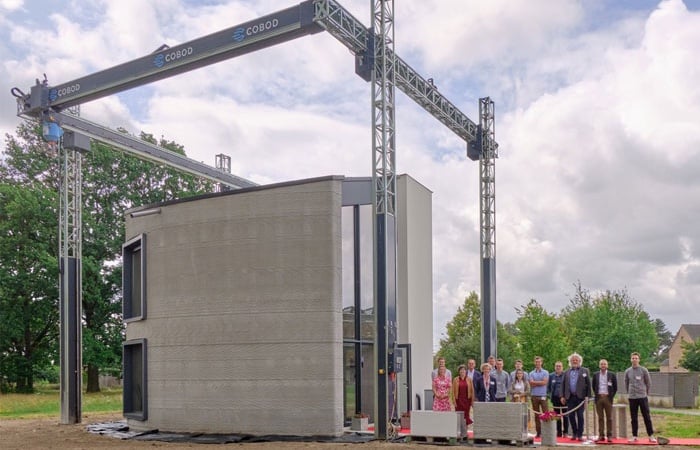
The 3D printed house and the COBOD 3D printer (Photo credits: Kamp C)
Indeed, the Kamp C team explains that they hadn’t defined the usefulness of the 3D printed structure at all – it could be used as a home as well as an office. In any case, 3D printing saved 70% in terms of material, costs and time. It took three weeks to erect the structure, a time that the team hopes to reduce to just a few days. On the material side, carbon fibers were added to the concrete to reinforce the final result. Marijke Aerts, project manager at Kamp C, adds: “The compressive strength of the material is three times higher than that of conventional building bricks.” The house would therefore be three times stronger than a house built using traditional methods. The technologies also made it possible to create different and atypical shapes. The team opted for a “greener” construction with low energy consumption, solar panels and floor and ceiling heating.
More from the desk
Six other notes from the rest of the bench.
 News3D Printing Can Be Used to Fight Against BacteriaDue to the continuing COVID-19 pandemic, more than ever we are aware of how harmful and easily transmissible bacteria and other microbes are on surfaces. The mats that adhere there, some of which are slimy, are called biofilms and are…
 Guides#3DStartup: Mantle on its Unique Paste-Based Metal Additive Manufacturing ProcessMantle, a young, American startup, made headlines back in February 2021 with the launch of its TrueShape technology. The proprietary AM process distinguishes itself from other metal 3D printing processes on the market by using paste as the printing material…
 ApplicationsRomanian Engineer 3D prints first ever airplane engine prototypeThe aerospace industry has been making gains left and right thanks to additive manufacturing technology. Between investments made by large corporations that are helping to create 3D printed parts for the interior of planes, to the creation of a giant 3D…
 NewsGE Patents Blockchain Technology for Additive ManufacturingUS giant General Electric, one of the largest 3D printer vendors with its subsidiary GE Additive, recently filed a patent to use Blockchain technology to validate and verify 3D printed parts in its supply chain. This technology makes it possible…
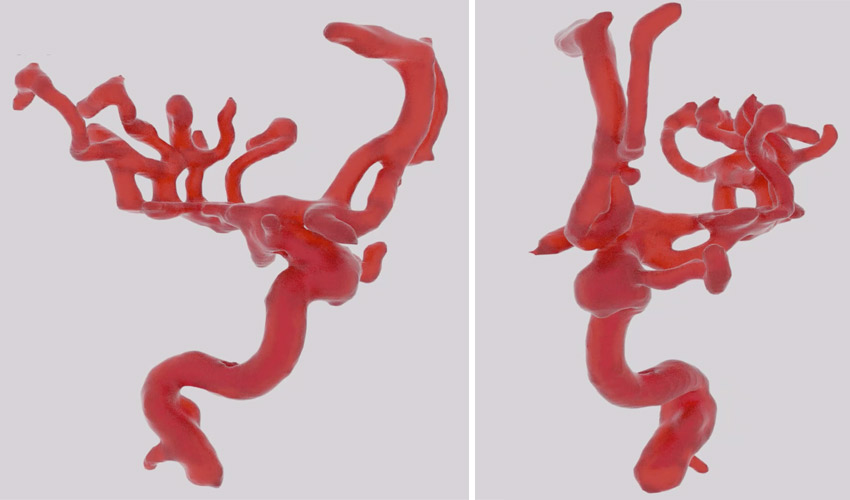 ApplicationsSilicone 3D Printing Allows for More Accurate Models of Blood Vessels in the BrainAt the University of Florida, a team of researchers is attempting to reproduce precise blood vessels in the brain using silicone 3D printing. To do this, they have developed a process called AMULIT, or additive manufacturing at ultra-low interfacial tension:…
 MaterialsShanghai Electric Adopts High-Performance 3D Printing Solution From IEMAI and VictrexHigh-performance plastics for additive manufacturing are seeing significant demand at the industrial level. Many companies are already taking advantage of 3D technologies and advances in materials to produce parts with higher mechanical properties. One such company is Shanghai El