News
COVID-19: new 3D printed device could address shortage of ventilators
The Belgian company Materialise has developed a new solution to cope with COVID-19, and that solution is the Materialise NIP Connector. It converts standard equipment available in most hospitals into a non-invasive PEEP mask (NIP) that can be connected to…
- 3 min read
- News
- Six more stories
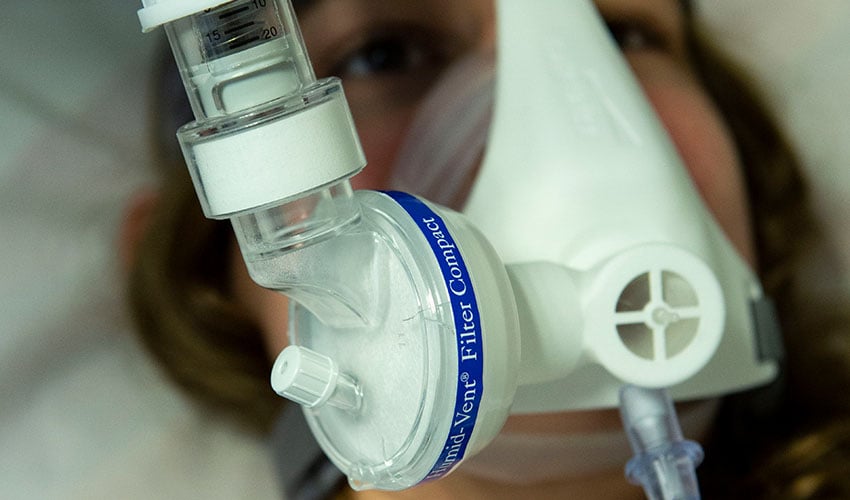
The Belgian company Materialise has developed a new solution to cope with COVID-19, and that solution is the Materialise NIP Connector. It converts standard equipment available in most hospitals into a non-invasive PEEP mask (NIP) that can be connected to an oxygen supply. Ventilators are one of the pieces of medical equipment in shortage in many hospitals around the world. Nevertheless, they are crucial in keeping COVID-19 patients breathing. The 3D printed connector developed by Materialise can keep together a non-invasive ventilation (NIV) mask, a filter and a PEEP valve to facilitate breathing for patients. The solution is simple and familiar to use for medical professionals who will be able to easily assemble their non-invasive ventilation solution by themselves.
Today, additive manufacturing players are looking for alternatives to the mechanical ventilators that help critically ill patients breathe. The lack of devices is being severely felt in the medical sector. This is why Materialise has developed its 3D printed connector. A small device that can provide oxygen while creating positive pressure in the lungs. With this new solution, mechanical ventilators could be attributed to those in extremely critical condition. The Belgian company hopes to supply this connector to hospitals by mid-April.
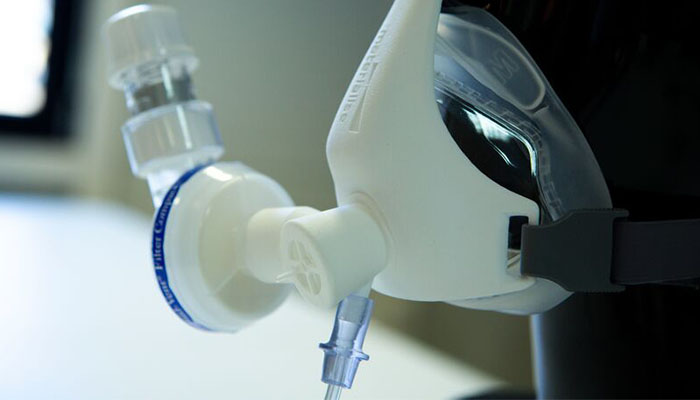
The 3D printed connector from Materialise connects a NIV mask, a PEEP valve and a filter together to facilitate breathing for COVID-19 patients | Image via Materialise
A 3D printed oxygen mask thanks to a connector
Materialise explains that its priority is to ensure everyone’s safety, whether it be that of the nursing staff or the patient. This is why many tests have been carried out with the help of pulmonologists and specialists. Professor Wilfried de Baker, an expert in pneumology, explains that one of the positive points of the connector is that there are no gaps through which the virus could spread in its environment. It also provides the positive expiratory pressure that pushes fluids into the lungs and thus facilitates the absorption of oxygen. The Materialise NIP Connector is 3D printed on Selective Laser Sintering (SLS) machines and production will take place at the company’s ISO 13485 certified facilities in Belgium and Plymouth.
More from the desk
Six other notes from the rest of the bench.
 GuidesKumovis on Decentralizing Production of Plastic Medical Devices and ImplantsThose who have been following our news for a while will certainly be familiar with the startup Kumovis. Because in 2018, only one year after its founding, Kumovis was already among the winners of the Formnext Startup Challenge. A year…
 ApplicationsNikon to Implement Space Strategy Fund at Japan Aerospace Exploration AgencyNikon Corporation (Nikon), known for its digital manufacturing and advanced selective laser melting (SLM) solutions, announced last week that it was selected as one of the organizations to implement the Space Strategy Fund (SSF) by the Japan Aerospace Exploration Agency…
 MaterialsA Closer Look at 3D Printing Materials: CompositesIn recent years, composite 3D printing has become increasingly popular. One of the youngest branches of 3D printing, this technology is now used by many players in additive manufacturing, such as Impossible Objects, a company specializing in the field. In…
 News$27 million investment for an AM labThe University of Waterloo in Ontario, Canada is leading the way for educational institutions with their latest investment in 3D printing technology. On Wednesday May 24, the Federal Economic Development Agency for Southern Ontario (FedDev) announced their investment of $8.9 mill
 NewsU.S. Navy to Use 3D Printed Components in New Nuclear SubsThe U.S. Navy stretches around the world as one of the farthest-reaching branches of the North American superpower. It demands the most cutting-edge technology to enhance its operational effectiveness as it patrols the oceans of the world. To fill that…
 SoftwareTOP 25 of the most widely used software in 3D printingWhether you are designing, modifying, or repairing a 3D file yourself, there are always days when a happy owner of a 3D printer wonders what 3D software to use. Because it is difficult to choose among the many existing programs,…