Applications
How Chitin from Crustacean Shells Could Power 3D Printed Wound Care
Chronic wounds are defined by being unable to fully heal naturally, persisting at an inflammatory stage due to imbalances in the wound microenvironment. These wounds, including diabetic ulcers and pressure sores, can linger for months or even years. Wound dressings…
- 3 min read
- Applications
- Six more stories
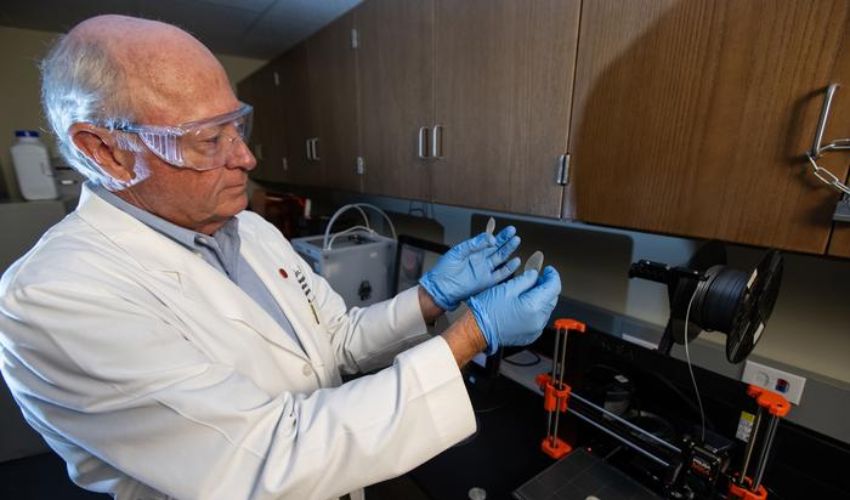
Chronic wounds are defined by being unable to fully heal naturally, persisting at an inflammatory stage due to imbalances in the wound microenvironment. These wounds, including diabetic ulcers and pressure sores, can linger for months or even years. Wound dressings function to provide a protective barrier over the injured region, facilitating new tissue and vascular structure growth. However, conventional dressings sometimes have insufficient moisture balance, limited bioactivity, poor mechanical strength, and difficulty in sustaining the release of therapeutic agents. That’s why researchers at the University of Mississippi School of Pharmacy are 3D printing medicated patches to treat persistent sores and ulcers. This mission of this research was to optimize scaffold composition for printability and mechanical performance, evaluate in vitro drug release, and assess antibacterial efficacy.
The wound scaffold developed by the University of Mississippi team offers natural, biodegradable antibacterials over time to encourage healing. This isn’t the first time wound dressings have been 3D printed. For instance, in 2023 researchers from the Queen’s University Belfast published a study in which they 3D printed scaffolds for ulcers. However, the difference is in the production methods and the novel materials used, which you might find surprising.
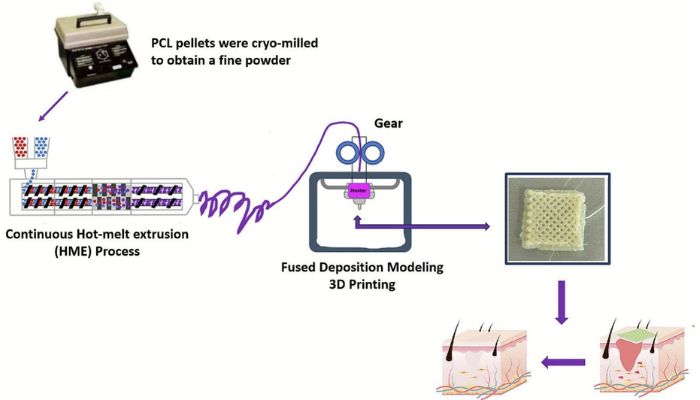
Graphical abstract of the study. (Image credit: Alshammari et al.)
What Materials Are in the Scaffolds?
The base material of the scaffolds is chitosan (CS), a biopolymer derived from chitin, which is naturally present in the exoskeletons of crustaceans and insects. This biopolymer has attracted attention for wound healing due to its distinct combination of biocompatibility, biodegradability, and antibacterial characteristics. The researchers combined this biopolymer with Para-Coumaric acid (P-CA), a naturally occurring phenolic compound that is abundant in plants, especially fruits, cereals, tea, and wine. Additionally, they incorporated polycaprolactone (PCL) for mechanical stability, and polyethylene oxide (PEO) for improving hydrophilicity and processability. PCL and PEO reinforced the CS-based scaffolds, to maintain structural integrity during healing.
More from the desk
Six other notes from the rest of the bench.
 Applications3D Printed Femur Facilitates Orthopedic SurgeryAdvances in 3D printing for medicine are booming, and researchers at the University of Texas at Dallas have just successfully designed a 3D-printed femur model. This project could provide doctors with a new tool to better prepare bone reconstruction surgeries…
 NewsThe 3D printing innovations at RAPID + TCT 2019With new technologies, machines, and materials constantly emerging in the market, additive manufacturing is evolving quicker than ever before. This is why RAPID + TCT 2019 is such an important event for the industry. It is an opportunity to meet…
 NewsMicrolight3D Shatter Limitations of Microfabrication 3D PrintingMicrolight3D have 3D printed the world’s smallest replica of the statue of liberty to commemorate inauguration day in the USA (the swearing in of the President of the United States took place on January 20th) and show off their new…
 NewsWork Begins On World’s First 3D Printed Mosque3D printing is an emerging technology in the field of construction and building, offering a more efficient workflow and the ability to construct on command. We’ve seen houses, offices, resorts, but soon will see another first: the world’s only 3D…
 SoftwareOctoPrint, the application to control your 3D printerOctoPrint is a controller application for 3D printers: open-source and free, it allows you to manage all your prints remotely and to control your machines with peace of mind. It works directly on your web interface, you just need to…
 NewsEurope’s First 3D Printed School Opens in UkraineAdditive manufacturing, also known as 3D printing, is playing an increasingly significant role in the field of construction. The construction industry has recognized the numerous benefits offered by this technology, including the ability to create intricate designs, as well as&he