
Unlocking Olympic Gold: How 3D Scanning Revolutionized Italian Cycling Team’s Aerodynamics
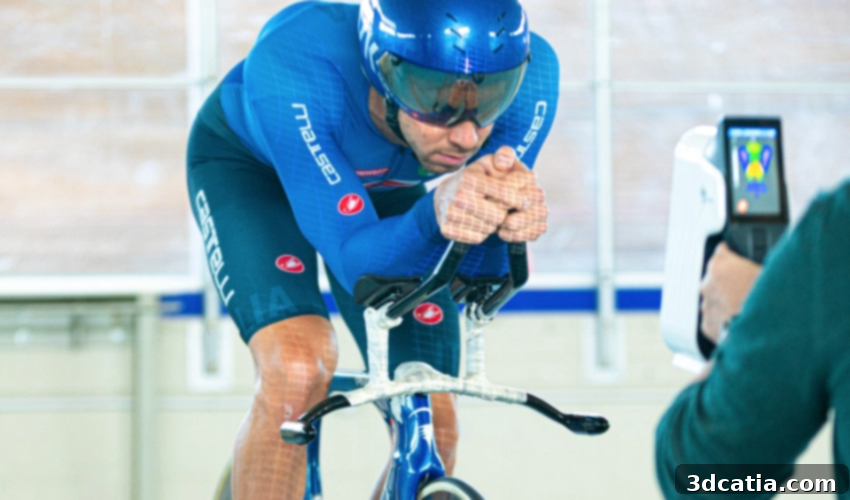
In the intensely competitive arena of elite sports, every fraction of a second and every marginal gain can signify the crucial difference between triumph and defeat. For the Italian National Cycling team, as they embarked on their rigorous preparation for the Tokyo 2021 Olympic Games, the quest for perfection led them to embrace an innovative technological solution: advanced 3D scanning. Their overarching objective was crystal clear – to substantially reduce aerodynamic drag, a pivotal factor that directly influences a cyclist’s efficiency, velocity, and ultimately, their prospects of clinching Olympic Gold.
To actualize this ambitious goal, the team strategically partnered with 3DiTALY, an Italy-based specialist and partner of the renowned Russian manufacturer Thor3D. Central to this groundbreaking project was Thor3D’s state-of-the-art Calibry scanner. Celebrated for its exceptional precision and ability to meticulously scan historically challenging objects, the Calibry proved to be the quintessential instrument for capturing the intricate geometries of both the athletes and their high-performance Pinarello bicycles. This sophisticated 3D technology empowered the creation of highly precise and bespoke analyses for each individual cyclist, furnishing invaluable data crucial for minimizing air resistance and optimizing their performance to an unprecedented degree.
The collaborative spirit extended deeply throughout the project. Pinarello, a globally recognized leader in bicycle manufacturing, and Hardskin, an innovator in sports apparel, equipped the Italian team with all the necessary cutting-edge gear engineered for attaining maximum speeds. It was Hardskin that proactively initiated the critical request to digitally capture each athlete and their Pinarello bicycles with painstaking detail. This comprehensive digitalization effort underscored a shared conviction that leveraging 3D technology would provide an unparalleled level of precise, individualized analysis, ultimately enabling the cyclists to achieve peak aerodynamic efficiency and secure a decisive competitive advantage.
The Indispensable Role of Aerodynamics in Elite Cycling
In the demanding discipline of track cycling, where races are frequently determined by mere hundredths of a second, the influence of aerodynamic drag is absolutely paramount. Air resistance stands as the primary external force opposing a cyclist’s forward momentum, and at the blistering speeds achieved in Olympic-level competition, it can account for an astonishing 80% of the total resistance encountered. This stark reality means that while raw physical strength, unwavering endurance, and astute race strategy are foundational elements, the meticulous reduction of drag through superior equipment design and optimized body positioning becomes an absolutely critical determinant of ultimate success.
Optimizing aerodynamics transcends simply going faster; it is fundamentally about conserving precious energy. When a cyclist adopts a more aerodynamic profile, less power is expended to maintain a given speed, thereby allowing them to either sustain higher velocities for extended periods or unleash powerful bursts of acceleration more effectively at critical junctures of the race. Even a seemingly minuscule reduction of a few watts of drag can translate into several meters gained over the duration of a race, potentially elevating a contender to a gold medalist status. This ceaseless pursuit of ‘marginal gains’ has firmly established itself as a cornerstone of contemporary elite sports science, with 3D scanning emerging as a powerful and indispensable tool in this ongoing quest for perfection.
A Groundbreaking Initiative at Italy’s Premier Indoor Velodrome
This ambitious project, representing a significant investment in cutting-edge sports innovation, was brought to fruition with vital financing from the Municipality of Montichiari. The strategically chosen location for this crucial data collection phase was equally significant: the Velodrome of Montichiari, nestled in the province of Brescia. This facility boasts a unique and esteemed distinction as the inaugural and only indoor facility in Italy exclusively dedicated to track cycling. Its meticulously controlled environment provided the perfect, consistent setting for accurate and repeatable data acquisition, critically free from extraneous variables such as fluctuating wind conditions or temperature variations that could otherwise compromise the precision and integrity of the aerodynamic studies.
Within this state-of-the-art facility, the Thor3D Calibry scanner was skillfully deployed to meticulously collect comprehensive 3D data from each cyclist and their respective bicycles. The raw, high-resolution scan data was subsequently transferred and rigorously post-processed using the sophisticated Calibry Nest software. This crucial stage involved meticulously cleaning the scan data, deftly filling any minuscule gaps, and transforming it into high-fidelity, actionable 3D models. These refined digital models were then dispatched to Pinarello’s team of expert engineers, who embarked on in-depth aerodynamic studies. Their primary task was to scrutinize every curve, every angle, and every minute detail to precisely identify potential areas for drag reduction. Optimizing both a rider’s equipment and their specific body positioning is absolutely paramount for attaining top speeds, unequivocally underscoring the principle that in the realm of Olympic-level performance, every single fraction of a second – no matter how small the unit of data – contributes profoundly to the ultimate outcome.
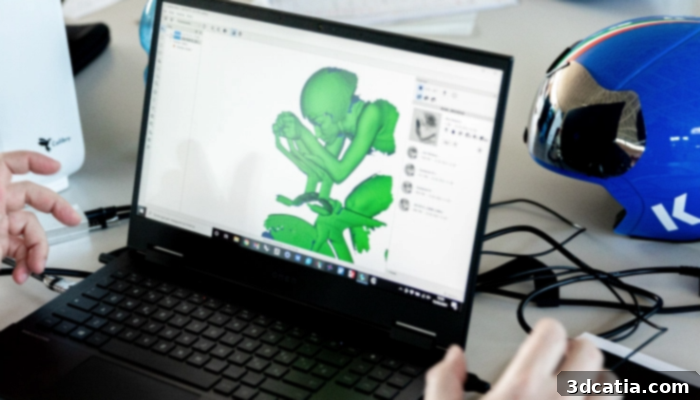
A highly detailed 3D scan of a cyclist, highlighting the precision and intricacy captured. (Photo Credit: Thor3D)
Simulating Race Day with Unprecedented Accuracy and Speed
The methodology employed for the 3D scanning of each cyclist was meticulously designed to replicate an actual race day scenario as closely as possible, ensuring that the collected data was maximally relevant, accurate, and actionable. The process commenced with a comprehensive warm-up routine for the athlete, physically preparing their body for the sustained effort required, followed by the meticulous preparation of the mechanical medium – the bicycle and its critical components. The subsequent and crucial step involved initiating an imitation of the race itself, during which the athlete was guided to assume and then steadfastly maintain an optimal aerodynamic position.
Throughout the entirety of the 3D scanning procedure, the cyclist was instructed to hold their exact race position without deviation. Critically, they were clad in their full competition attire, including their specialized aerodynamic bodysuit and helmet, to flawlessly simulate the real-world conditions and air interaction they would encounter on race day. This unwavering commitment to detail guaranteed that the resulting digital model precisely mirrored the athlete’s true aerodynamic profile. Dynamic adjustments to the cyclist’s position were made based on the athlete’s extensive experience and immediate feedback, allowing for a refined tuning process that intelligently combined objective scientific data with subjective physical feel. Thanks to the remarkable speed and efficiency of the Calibry 3D scanner, the entire scanning procedure for each athlete was completed in an astonishingly brief duration of merely two minutes. This rapid data capture minimized athlete fatigue, facilitated multiple scans or adjustments without significant time investment, and ultimately enhanced the project’s overall efficiency and accuracy in profiling peak performance.
From Digital Models to Bespoke Engineering: Crafting Tailor-Made Equipment
With all the high-resolution data meticulously captured and precisely processed into detailed 3D digital models, the intensive engineering phase commenced. Every single piece of information derived from the comprehensive scans was rigorously analyzed and fed into the design process for critical bicycle components. The most prominent and impactful example of this bespoke engineering approach was the development of tailor-made handlebars. Pinarello, leveraging decades of unparalleled expertise in crafting high-performance cycling equipment, manufactured these handlebars as unique, individualized pieces, custom-fitted to each athlete’s precise arm length, hand grip, and overall body dimensions. This individualized approach ensured the establishment of a perfect and harmonious rider-bicycle relationship, optimizing both ergonomic comfort and, most crucially, aerodynamic efficiency.
Conventional ‘off-the-shelf’ handlebars, even those marketed as high-performance, inherently cannot account for the subtle yet significant differences in each elite athlete’s unique physiology and nuanced riding style. In stark contrast, a custom-designed handlebar minimizes the frontal area presented to the oncoming wind, substantially reduces turbulent airflow, and enables the rider to maintain an aggressively aerodynamic yet sustainable tuck position for extended periods. This level of highly personalized equipment not only contributes directly and significantly to drag reduction but also inherently enhances the cyclist’s control and stability, allowing them to exert maximum power with unparalleled efficiency. This unparalleled degree of customization, made possible by the precision of 3D scanning, unequivocally represents the pinnacle of performance engineering in the demanding world of competitive cycling.
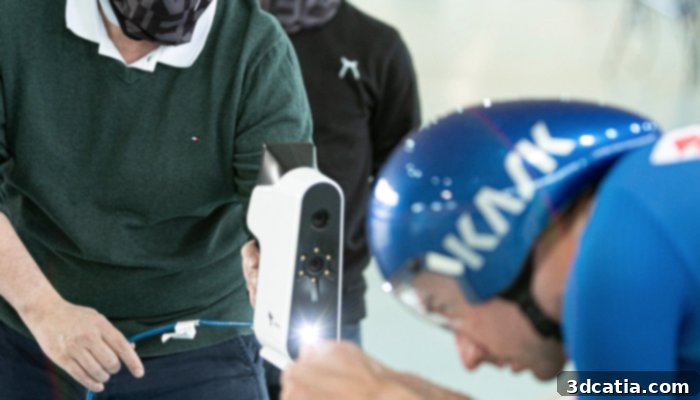
The Calibry 3D scanner meticulously capturing precise data from a cyclist in their race-day posture. (Photo Credit: Thor3D)
Impact and Future Implications for Advanced Sports Performance Optimization
The Italian National Cycling team’s proactive and pioneering adoption of 3D scanning technology for aerodynamic optimization established a new and rigorous benchmark in Olympic preparation. By meticulously analyzing and refining every conceivable aspect of the integrated rider-bicycle system, they achieved a significant enhancement of their competitive advantage. This sophisticated data-driven approach transcends subjective assessments, providing concrete, quantifiable, and measurable improvements that are absolutely vital when the margins for victory are razor-thin. The resounding success of this initiative powerfully highlights the transformative potential of advanced manufacturing and digital technologies in shaping the future of elite sports performance.
This project serves as an exceptionally compelling case study for how 3D scanning and custom manufacturing are fundamentally revolutionizing athletic performance across a diverse spectrum of disciplines. Beyond the specific application in cycling, similar methodologies possess immense potential to be applied to other sports that demand precise equipment fits, optimal body mechanics, or highly specialized gear designed to interact harmoniously with environmental forces. From the development of custom-fitted footwear and advanced prosthetics to optimized athletic apparel and highly personalized training aids, the ability to rapidly and accurately digitize physical forms unlocks an entirely new realm of possibilities for performance enhancement, injury prevention, and expedited rehabilitation. The future trajectory of sports optimization undoubtedly lies in these highly personalized, technologically advanced solutions, ensuring that athletes are not merely equipped to compete, but are truly empowered to achieve unprecedented levels of excellence.
What are your thoughts on the Italian National Cycling team’s innovative and pioneering use of 3D scanning technology in their rigorous preparation for the Olympics? Do you foresee such advanced methods becoming a standard and indispensable practice across all elite sports in the near future? We warmly invite you to share your valuable insights and comments below, or join the ongoing discussion on our Facebook and Twitter pages. And for all the very latest news, groundbreaking developments, and insightful analyses in the dynamic world of 3D printing and additive manufacturing, don’t forget to sign up for our completely free weekly newsletter, delivered directly to your inbox!
Cover Photo Credit: Thor3D