

Unveiling the Complexities: New Discoveries in 3D Printed Drug Formulation Challenges
The pharmaceutical industry stands on the cusp of a revolutionary transformation, largely driven by advancements in additive manufacturing, more commonly known as 3D printing. This innovative technology promises to usher in an era of personalized medicine, offering tailor-made dosages and intricate drug delivery systems designed for individual patient needs. However, as with any pioneering scientific endeavor, the path to innovation is often punctuated by unforeseen challenges and critical discoveries. Researchers at University College London (UCL), closely associated with the ambitious startup FabRx, have recently unveiled a significant limitation concerning 3D printed drugs, specifically when employing the stereolithography (SLA) process to create multi-drug polypills. This groundbreaking finding highlights the intricate chemical interactions that can occur during the 3D printing process, demanding a more meticulous approach to material and drug substance selection in the development of future pharmaceuticals.
FabRx, a dynamic spin-off from UCL, has been at the forefront of this pharmaceutical revolution. Their core mission is to leverage additive manufacturing to design bespoke drugs, moving away from the traditional “one-size-fits-all” approach to medication. The vision is clear: to offer personalized dosages and unique shapes, precisely adapted to each patient’s physiological and therapeutic requirements, and to do so with unprecedented speed and efficiency. Since its inception, FabRx has diligently explored and tested various 3D printing technologies to achieve its ambitious goals. Among these, Fused Deposition Modeling (FDM) has been utilized, notably in the design of drugs for children suffering from conditions like Maple Syrup Urine Disease (MSUD), where precise and individualized dosages are paramount for effective treatment and patient safety. FDM allows for the creation of medications with specific release profiles and forms that are easier for pediatric patients to administer.
Beyond FDM, FabRx researchers have also extensively investigated stereolithography (SLA), a process that has consistently demonstrated superior efficiency and precision compared to extrusion-based methods in certain applications. SLA’s ability to achieve high resolution and create complex geometries made it particularly appealing for developing advanced drug formulations. Crucially, SLA showed immense promise in enabling the creation of a single pill containing multiple different drug substances – known as a “polypill.” Polypills are designed to improve patient adherence by consolidating several medications into one, simplifying complex treatment regimens, especially for chronic conditions. Early research efforts had largely yielded positive results, showcasing the significant potential of additive manufacturing to fundamentally reshape the pharmaceutical landscape and offer novel solutions for drug development and delivery.

The FabRx team is using FDM and SLA technologies
However, science progresses through both successes and unexpected hurdles. In a recent development, Professor Simon Gaisford and his dedicated team at UCL encountered a significant and unforeseen difficulty. While attempting to 3D print certain substances using SLA, they observed that although the pill itself formed correctly and appeared structurally sound, some critical drug components were not being released as expected. This discovery marked a pivotal moment, shifting the focus from simply creating the physical form of the pill to ensuring the integrity and functionality of the active pharmaceutical ingredients (APIs) within it.
The team’s particular experiment involved designing a polypill intended for the treatment of high blood pressure, a common chronic condition that often requires patients to manage multiple medications simultaneously. This specific polypill was formulated to contain a combination of four crucial substances: amlodipine, atenolol, irbesartan, and hydrochlorothiazide. Amlodipine is widely used to prevent angina attacks and manage hypertension; atenolol is a beta-blocker also used for high blood pressure and heart conditions; irbesartan is an angiotensin receptor blocker (ARB) primarily for hypertension; and hydrochlorothiazide is a diuretic that helps reduce fluid retention, further aiding in blood pressure control. The formulation of such a polypill was a testament to the advanced capabilities that 3D printing promised, offering a simplified regimen for patients managing complex cardiovascular health needs.
Upon the completion of the 3D printing process and subsequent analysis, a critical issue emerged: one of the crucial drugs, amlodipine, was undetectable within the finished polypill. This finding was alarming, suggesting that despite the visual success of the printing, the therapeutic efficacy of the amlodipine component was compromised. Further investigation by the researchers revealed that amlodipine had remained inextricably trapped within the polymer matrix of the 3D printed structure, preventing its release and rendering it therapeutically inert. This meant that patients consuming such a pill would not receive the intended dose of amlodipine, posing a significant challenge to the reliability and safety of SLA-printed medications.
The underlying cause of this trapping was identified as a specific chemical reaction between the drug substance, amlodipine, and the photoreactive monomers present in the resin used for stereolithography. The researchers posited that a “Michael reaction” had occurred. In simple terms, a Michael reaction is a type of organic reaction involving the formation of new carbon-carbon bonds, often occurring between a nucleophile and an alpha, beta-unsaturated carbonyl compound. In this context, amlodipine, likely acting as a nucleophile, reacted irreversibly with components of the photo-curable resin during the UV light curing process. This unexpected chemical incompatibility resulted in the amlodipine molecules becoming chemically bonded to or encapsulated within the polymer network, preventing their dissolution and release when the pill was meant to be ingested. This critical finding fundamentally alters the understanding of drug compatibility with resin-based 3D printing, underscoring that not all active pharmaceutical ingredients are suitable for this particular additive manufacturing method without careful formulation considerations.
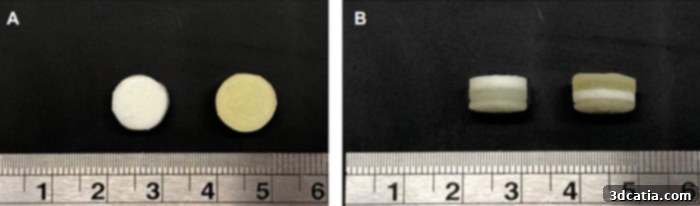
The 3D printed pill | Credits: UCL
The implications of this discovery are profound and far-reaching for the burgeoning field of pharmaceutical 3D printing. The UCL researchers’ conclusion serves as a vital warning and a guide for future research: “This research demonstrates the importance of careful selection of photo-curable resins for the manufacture of drug-laden oral pills using SLA 3D printing technology. It also highlights the potential safety challenges to the successful adoption of the SLA process for the development of drug delivery platforms in the pharmaceutical field”. This statement underscores that while SLA offers incredible precision and flexibility in fabricating complex geometries, its chemical environment during printing must be thoroughly understood and controlled. It’s not enough for a pill to look right; its chemical composition and drug release profile must be impeccably preserved.
This pivotal discovery will undoubtedly propel researchers to advance their work with even greater rigor and meticulousness. It mandates a deeper dive into the chemical compatibility between various active pharmaceutical ingredients and the wide array of photo-curable polymers and monomers available for SLA. Future research will need to focus on identifying or developing new, inert resin systems that do not react with sensitive drug substances. Furthermore, it emphasizes the necessity of conducting comprehensive release studies and stability analyses during the early stages of drug development using additive manufacturing. This ensures not only the physical integrity of the printed dosage form but also the chemical stability and therapeutic efficacy of the encapsulated drugs.
The journey toward widespread adoption of 3D printed drugs is a multi-faceted one, involving not just technological innovation but also rigorous safety assessments, regulatory considerations, and a profound understanding of material science. This recent finding, while identifying a limitation, is not a setback but rather a crucial step forward. It provides invaluable data that will allow scientists to refine their processes, develop more robust formulations, and ensure the safety and effectiveness of personalized medicines created through additive manufacturing. By understanding these chemical barriers, the pharmaceutical industry can develop more sophisticated strategies, potentially leading to the design of advanced materials or alternative printing methodologies that are compatible with an even broader spectrum of drug molecules. The goal remains to harness the full potential of 3D printing to deliver truly transformative healthcare solutions, making medication more precise, personalized, and accessible for patients worldwide.
Given these exciting and rapidly evolving developments, we invite your perspective: Would you take a 3D printed drug? Share your thoughts and insights in a comment below or join the conversation on our Facebook and Twitter pages! Don’t miss out on the latest advancements and breaking news in the world of 3D printing. Sign up for our free weekly Newsletter to have all the essential updates delivered straight to your inbox, keeping you at the forefront of this innovative field!
Moreover, mark your calendars! We are hosting an insightful webinar on the 26th of February, dedicated to guiding you on how to effectively adopt additive manufacturing for your projects. This is a unique opportunity to learn from experts and understand the practical applications and benefits of integrating 3D printing into various industries. You can sign up for free as of today HERE. Don’t miss this chance to deepen your understanding and explore the immense potential of additive manufacturing.