
Revolutionizing Electronics Manufacturing: Unveiling ioTech’s CLAD Multi-Material 3D Printing Technology
The landscape of manufacturing has been fundamentally transformed by the advent of 3D printing, a technology that traces its roots back to stereolithography. Patented in 1984 by Charles Hull, SLA laid the groundwork for an industry that has since exploded with innovation. From its initial focus on polymer prototypes, additive manufacturing has evolved to encompass a diverse array of processes. Today, technologies such as binder jetting, material jetting, and direct metal laser sintering are not only widespread but are continuously pushing the boundaries of what’s possible, enabling the creation of complex geometries and functional parts in various materials. Amidst this rapid evolution, new companies are constantly emerging to address specific industry needs with groundbreaking solutions. Founded in 2016, the innovative startup ioTech has dedicated the past five years to developing one such pioneering solution: Continuous Laser Assisted Deposition, or CLAD. This cutting-edge technology stands out as a unique multi-material 3D printing technique specifically engineered to meet the demanding requirements of electronic applications.
The vision behind ioTech’s CLAD process is nothing short of revolutionary: to fundamentally change manufacturing methods within the global electronics industry. Based in the UK, ioTech is poised to introduce a CLAD-based 3D printer that promises unparalleled capabilities. This forthcoming system will possess the ability to process almost any industry-certified material with exceptional precision and speed, a critical differentiator in a sector that demands both high performance and rapid iteration. Dr. Michael Zenou, co-founder and CTO of ioTech, articulates the company’s excitement: “We are thrilled to bring our unique C.L.A.D. technology to both the electronics industry and the broader additive manufacturing landscape. Its unmatched capability to precisely deposit any flowable industrial material across such a wide spectrum of applications is truly unprecedented. We firmly believe this will significantly enhance production efficiency and ignite a new wave of innovation for countless companies striving to push the limits of electronic design and functionality.” This statement underscores the profound impact ioTech anticipates, positioning CLAD as a key enabler for future electronic device development.
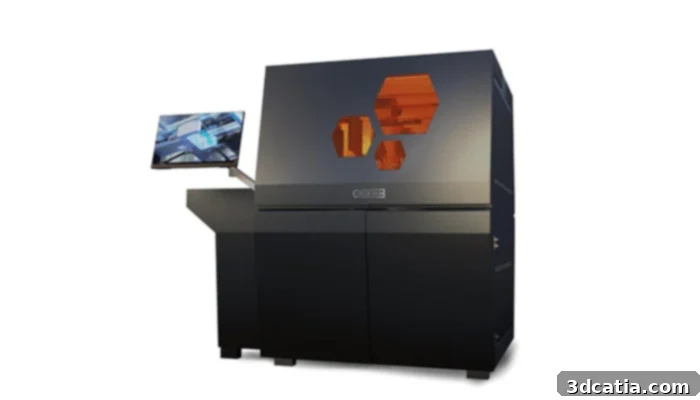
ioTech’s future 3D printer (photo credits: ioTech)
Understanding the CLAD Process: Precision and Integration
The Distinctive Characteristics of CLAD Technology
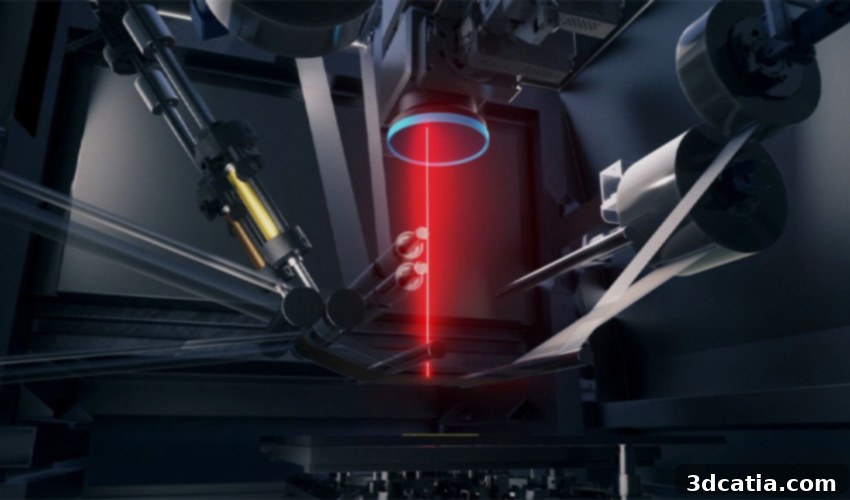
At the core of ioTech’s innovation is the CLAD process itself, designed for simplicity and efficiency despite its sophisticated underlying mechanisms. According to the manufacturer, the CLAD-based 3D printer fabricates parts by printing all materials in a meticulously controlled three-step sequence. This streamlined approach ensures consistency, precision, and high-quality output for intricate electronic components. The integration of these steps into a continuous workflow is what truly sets CLAD apart, offering a seamless path from raw material to final, functional product.
Step 1: Micro-Material Coating
The process commences with a precise coating of the micro-material onto a sheet. This initial stage is crucial for ensuring uniform material distribution, which directly impacts the final part’s integrity and performance. The ability to precisely control the thickness and consistency of this coating layer allows for unparalleled accuracy in material deposition in subsequent steps. This foundation ensures that even the most minute electronic features can be reliably reproduced, setting a high standard for print quality from the very beginning of the fabrication cycle.
Step 2: Fast, Micron-Precise Laser Projection
Following the coating, the system moves to the heart of the CLAD technology: the fast, micron-precise laser projection phase. During this critical stage, a laser selectively projects the material onto a designated substrate. The “Continuous Laser Assisted Deposition” aspect implies that the laser dynamically cures or solidifies the material as it’s being deposited, allowing for the creation of complex 3D structures with exceptional resolution. The laser’s precision, reaching resolutions of up to 20 microns, is vital for the miniaturization and intricate designs characteristic of modern electronics. This optical precision, combined with sophisticated motion control, ensures that each layer is built with exactitude, leading to highly functional and reliable electronic components.
Step 3: Integrated Post-Processing for End-Use Parts
Finally, once the 3D printing is complete, the part undergoes an integrated post-processing regimen to prepare it for its ultimate application. Unlike many additive manufacturing processes that require separate, often manual, post-processing steps, the CLAD process incorporates a comprehensive post-processing system directly within the printer. This advanced system includes capabilities such as UV and thermal curing, sintering, and laser ablation. The ability to perform all these crucial finishing steps in a single, automated workflow significantly accelerates production timelines, reduces handling, and minimizes the risk of errors. This integrated approach is designed to quickly produce high-quality, end-use parts, ready for immediate application, without the need for extensive additional equipment or labor.
Unleashing Potential: Multi-Material Capabilities and Applications
One of the most compelling advantages of the CLAD system is its inherent multi-material functionality. This allows users to leverage an expansive array of materials, which is paramount for creating truly integrated and functional electronic devices. The system is compatible with materials such as acrylate, epoxy, silicone, and various metal pastes. Each of these material categories plays a distinct role in electronics: acrylates and epoxies can serve as dielectric or insulating layers, providing structural integrity and protection; silicones offer flexibility and thermal management properties, crucial for flexible electronics or heat-sensitive components; and metal pastes are essential for creating conductive traces, interconnects, and other electrically functional elements.
As previously highlighted, this versatile process is specifically tailored for advanced electronic applications. Its capabilities are expected to enable the high-precision 3D printing of complex components such as Printed Circuit Boards (PCBs) and advanced semiconductor packaging. Beyond these core applications, CLAD technology opens doors for a broader range of innovations, including custom sensors, integrated antennas, flexible hybrid electronics, and even micro-electromechanical systems (MEMS) components. The ability to deposit multiple materials with such fine resolution allows for the creation of intricate, multi-layered electronic devices that were previously impossible or prohibitively expensive to manufacture using traditional methods.
With CLAD technology, and indeed with additive manufacturing in a broader sense, electronics manufacturers are no longer confined by the limitations of conventional subtractive or two-dimensional fabrication techniques. Engineers and designers gain unprecedented design freedom, enabling the creation of highly complex geometries, embedded functionalities, and optimized material properties within a single manufacturing step. This paradigm shift means faster prototyping cycles, reduced material waste, and the potential for mass customization of electronic devices. The implications for industries ranging from consumer electronics to aerospace, medical devices, and automotive are profound, promising accelerated product development and novel functionalities.
The Future of Electronics Manufacturing with CLAD
ioTech’s CLAD technology represents a significant leap forward in additive manufacturing, particularly for the electronics sector. By combining high-precision laser deposition with integrated multi-material capabilities and comprehensive post-processing, CLAD addresses many of the critical challenges faced by modern electronics manufacturing, including miniaturization, complexity, and the need for rapid innovation. The commitment to processing industry-certified materials further solidifies its position as a serious contender for industrial adoption, moving beyond mere prototyping to actual production of high-performance components.
The potential for CLAD to increase production efficiency and foster innovation, as Dr. Zenou noted, is not merely speculative. It offers a tangible pathway for companies to reduce time-to-market for new products, lower manufacturing costs for complex parts, and explore entirely new product categories that are simply unachievable with current methods. As the demand for more compact, powerful, and integrated electronic devices continues to grow, technologies like CLAD will be instrumental in meeting these evolving needs. ioTech is not just introducing a new printer; it’s ushering in a new era of possibilities for electronic design and manufacturing.
For those interested in delving deeper into this innovative technology, you can find more detailed information and a visual demonstration in the video below or by visiting ioTech’s official website HERE. We encourage you to explore how CLAD is poised to redefine the boundaries of what’s achievable in 3D printed electronics.