
Revolutionizing Ocean Conservation: 3D Printing for Resilient Coral Reef Restoration
Our planet’s marine ecosystems, the vibrant lungs and nurseries of the Earth, have endured unprecedented assaults in recent decades. The escalating twin crises of global warming and rapid, often unregulated, urbanization along coastal frontiers have pushed countless underwater species and habitats to the precipice of irreversible decline. Among the most alarming casualties are the world’s magnificent coral reefs, often dubbed the “rainforests of the sea.” These intricate underwater cities, teeming with life, are vanishing at an alarming rate, threatening not only biodiversity but also coastal protection and the livelihoods of millions. However, a glimmer of hope has emerged from an innovative collaboration in Israel, where researchers from four of the nation’s leading universities have unveiled a groundbreaking 3D printing methodology. This pioneering approach is specifically designed to aid in the preservation and ambitious restoration of these devastated underwater ecosystems, marking a significant leap forward in the fight for ocean health.
Coral reefs are far more than just beautiful underwater structures; they are indispensable pillars of marine biodiversity, supporting an estimated 25% of all known marine species, despite occupying less than 1% of the ocean floor. They act as critical breeding grounds, feeding areas, and shelter for countless fish, invertebrates, and other marine organisms. Beyond their ecological value, healthy coral reefs provide essential services to human communities, protecting coastlines from storms and erosion, supporting lucrative tourism and fishing industries, and even holding potential for new medicinal discoveries. The rapid decline witnessed globally – driven by ocean acidification, rising sea temperatures causing mass bleaching events, pollution from land-based activities, and physical damage from human interaction – underscores an urgent need for effective, scalable restoration solutions. Traditional restoration techniques, often involving the transplantation of coral fragments, are labor-intensive, slow, and sometimes limited in their ability to recreate the complex three-dimensional structures vital for ecosystem recovery. This is where advanced technologies, such as additive manufacturing, offer a transformative pathway.
Pioneering a New Era of Reef Restoration with 3D Printing
The innovative project initiated by Israeli researchers represents a sophisticated fusion of marine biology, advanced materials science, and cutting-edge 3D printing technology. The initial model for their restoration efforts was meticulously based on the natural structure of coral reefs found off the southern coastal Israeli city of Eilat, a region renowned for its unique and resilient Red Sea corals. While rooted in this specific environment, the researchers have ingeniously engineered the methodology to be highly adaptable and applicable to a wide array of marine environments worldwide. Their ultimate aspiration is for this innovative technique to significantly revive troubled coral reefs across the globe, offering a robust and scalable solution where traditional methods often fall short. Natalie Levy, a Ph.D. student at Bar-Ilan University and a key member of the research team, articulates the driving force behind their work: “The rapid decline of coral reefs has increased the need for exploring interdisciplinary methods for reef restoration. Examining how to conserve the biodiversity of coral reefs is a key issue, but there is also an urgent need to invest in technology that can improve the coral ecosystem and our understanding of the reef environment.” Her statement highlights the critical recognition that saving coral reefs demands not only ecological insight but also a profound commitment to technological innovation and a holistic, collaborative approach.

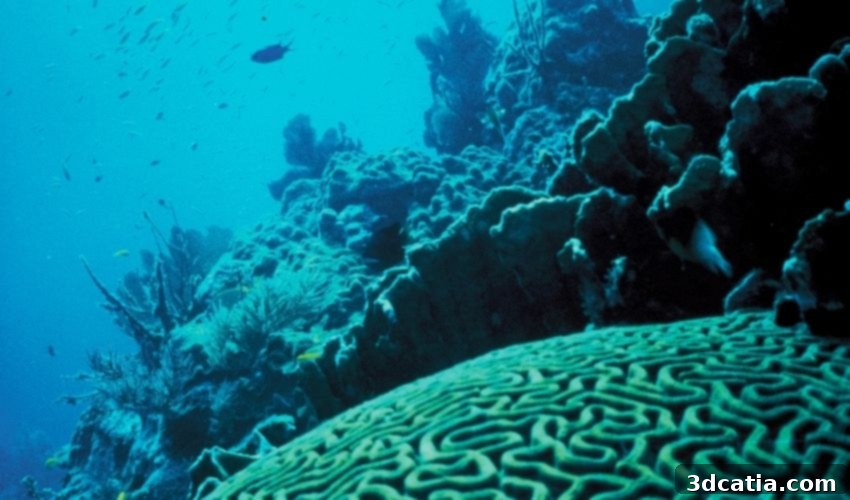
Coral reefs from the Gulf of Eilat (photo credits: Daviddarom)
The Advanced Process of Reforming the Reefs
3D printing, or additive manufacturing, has increasingly emerged as a versatile and potent tool to address complex environmental challenges across various sectors. For coral reef restoration, this technology offers unparalleled advantages. It allows for the creation of intricate, biomimetic structures using diverse materials that can be optimized for specific marine conditions. This approach makes it possible to generate geometrically complex shapes, mirroring the natural architecture of healthy reefs, at a potentially lower cost and with greater speed and precision than manual construction. The process developed by the Israeli team is multi-faceted and highly sophisticated, beginning with an exhaustive digital mapping of existing natural reefs.
The first crucial step involves the comprehensive 3D scanning of healthy coral reef sections. This isn’t a superficial scan; it captures the reef from myriad angles, employing advanced photogrammetry techniques where thousands of high-resolution images are meticulously photographed. These images are then stitched together using specialized software to construct an incredibly detailed and accurate three-dimensional digital model. This digital “twin” of the natural reef serves as the blueprint, allowing researchers to understand the nuanced structures that provide shelter and surface area for marine organisms. This precision ensures that the artificial structures are not generic, but rather customized to mimic the natural complexities vital for ecological function, thereby maximizing the chances of successful colonization and integration into the existing ecosystem.
However, digital replication of physical structure is only one part of this holistic approach. To ensure the created reefs are biologically intelligent and optimally suited for their environment, the researchers integrate a cutting-edge molecular method: the collection of environmental genetic information, commonly known as environmental DNA or eDNA. This involves taking water samples from the reef area to extract DNA fragments shed by various organisms, from bacteria and algae to fish and corals themselves. Analyzing this eDNA provides a comprehensive and accurate dataset of the species present, their genetic health, and the overall biodiversity of the specific marine environment. This rich biological data is then meticulously integrated with other crucial environmental parameters, such as water currents, light penetration, temperature, and nutrient levels, before being fed into a sophisticated 3D technology algorithm. This advanced algorithm processes all this information, making it possible to generate an interactive and highly optimized 3D model of the reef. The design can then be precisely tailored to fit the designated environment, ensuring not just structural integrity but also ecological compatibility and maximum appeal to local marine life.
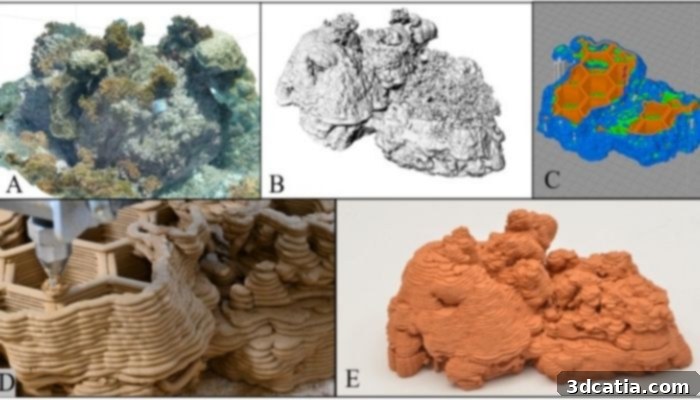
Photo Credits: Ofer Berman and Matan Yuval
This comprehensive and integrated process – encompassing high-resolution 3D scanning, precise environmental DNA sampling, and a data-driven 3D printing algorithm – allows for an in-depth and extraordinarily accurate examination of the reef’s complex data. Critically, this holistic approach extends beyond mere creation; it also provides robust mechanisms to check the level of effectiveness and efficiency of the structure long after its deployment. By combining biomimetic design with real-time ecological data, these artificial reefs are designed not just to exist, but to thrive and actively foster marine life. Ph.D. student Ofer Berman, from the Technion’s Architecture and Town Planning Faculty, elaborated on the profound implications of this methodology: “The use of three-dimensional printing allows extensive freedom of action in reality algorithm-based solutions, and the assimilation of sustainable production for the development of large-scale marine rehabilitation.” This statement underscores the potential for 3D printing to move beyond niche applications and become a cornerstone of sustainable, large-scale ecological restoration.
The culmination of this sophisticated process is the physical creation of the ceramic reef structures. Unlike other projects that have merely utilized 3D printing to create relatively simple, suitable bases for coral fragments to attach and grow, this Israeli initiative goes a significant step further. Their method actively seeks to replicate the complex, three-dimensional micro-habitats of the reefs themselves, effectively turning these printed structures into intricate foundations for continued life and biodiversity in the region. The choice of material is equally critical; the scientists opted for a unique ceramic compound. This material was specifically chosen because it exhibits natural porosity underwater, closely mimicking the texture and composition of natural coral skeletons. This property makes it not only an ideal and durable construction material but also perfectly suited to meet the specific biological and ecological restoration needs in the area, providing ample surface area and micro-niches for larval settlement and the growth of various marine organisms.
Global Impact and the Future of Ocean Conservation
This pioneering project from Israel stands as a powerful testament to how innovative additive manufacturing technologies, coupled with rigorous scientific research, can be harnessed to address some of the most pressing environmental crises of our time. The ability to create highly customized, biologically informed, and structurally complex artificial reefs offers an unprecedented tool for scaling up coral reef restoration efforts globally. This methodology is not only adaptable to different marine environments but also holds the promise of being more efficient and effective than previous approaches, potentially accelerating the recovery of degraded reefs. While challenges such as cost-effectiveness for truly massive deployments and long-term monitoring strategies remain, the progress made by the Israeli team paves the way for future advancements, including the exploration of new biocompatible materials, autonomous deployment systems, and advanced AI-driven monitoring networks.
Ultimately, the success of such initiatives will be measured by the return of biodiversity and the health of the entire marine ecosystem. By actively designing structures that encourage the recruitment and growth of diverse species, these 3D printed reefs contribute significantly to fostering a healthier, more resilient marine environment. This approach exemplifies how cross-disciplinary collaboration and technological innovation are indispensable for tackling global environmental challenges. It serves as a beacon of hope, demonstrating that with ingenuity and dedication, we can reverse the tide of ecological degradation and secure a healthier future for our oceans and, by extension, for our planet. For those interested in the scientific intricacies, the complete scientific paper detailing this groundbreaking research is available for download from ScienceDirect HERE.
What are your thoughts on this incredible initiative to save coral reefs using advanced 3D printing technology? We invite you to share your perspectives and insights in a comment below or join the conversation on our LinkedIn, Facebook, and Twitter pages! Don’t forget to sign up for our free weekly Newsletter here to receive the latest 3D printing news straight to your inbox! You can also find all our compelling videos on our YouTube channel, showcasing more innovations in additive manufacturing.
*Cover Photo Credits: Jerry Reid