
The Shifting Tides of 3D Printing: Industrial Slowdown vs. Entry-Level Surge in 2023 and the Outlook for 2024
The global economic landscape presented significant challenges in the past year, with inflation and elevated interest rates fueling widespread fears of a potential recession. Institutions like the International Monetary Fund have emphasized the critical need for policy interventions to avert a broader economic downturn. The additive manufacturing sector, commonly known as 3D printing, has not been immune to these pressures, experiencing varied impacts across its market segments. While certain areas of the industry have faced considerable headwinds, others have demonstrated surprising resilience and even growth. A recent in-depth analysis by CONTEXT, a leading market research firm, sheds light on these divergent trends, revealing a noticeable deceleration in industrial 3D printer shipments, juxtaposed with a remarkable boom in entry-level printer sales. This contrasting performance highlights crucial areas where the industry might anticipate sustained growth throughout 2024, prompting a re-evaluation of current market strategies and investment priorities.
The year 2023 proved to be a undeniably challenging period for the additive manufacturing industry. The market was characterized by a series of high-profile failed mergers, several companies reporting less-than-stellar earnings, and general instability within stock markets. These factors collectively generated considerable concern among investors and industry stakeholders. However, it’s worth noting that many of these anxieties may have been somewhat exaggerated, with numerous experts predicting a strong market rebound in the current year. Nevertheless, the recent report from CONTEXT provides a sobering perspective, particularly concerning the industrial segment of 3D printing. Its findings suggest that there is a genuine basis for strategic concern, indicating that companies within this sector may need to critically assess and adapt their offerings to better align with evolving market demands and economic realities. The resilience demonstrated by the entry-level segment, despite the broader economic climate, signals a potential shift in consumer and business priorities that could redefine the future trajectory of 3D printing.
A Significant Decline in Industrial 3D Printer Shipments
To properly contextualize the findings of CONTEXT’s latest report, it is essential to understand how 3D printers are categorized for analysis. CONTEXT employs a clear classification system, dividing the market into four distinct segments based on price points: industrial 3D printers, which are defined as those costing $100,000 or more; midrange printers, priced between $20,000 and $100,000; professional systems, ranging from $2,500 to $20,000; and entry-level 3D printers, which encompass all models priced under $2,500. This detailed segmentation allows for a granular tracking of sales performance across different user bases and applications, enabling a precise year-on-year (YoY) growth analysis for each category.
The report’s findings present a compelling counter-narrative to much of the prevailing logic within the additive manufacturing industry. While there has been a noticeable trend among manufacturers to develop and promote higher-priced professional solutions, often boasting advanced features and capabilities, consumer interest appears to be increasingly gravitating towards more accessible entry-level models. This divergence is particularly striking, as the entry-level printer market emerged as the sole category to exhibit positive growth during the third quarter of 2023. This trend suggests that while technological advancement at the higher end continues, the immediate market demand is strongly influenced by factors such as affordability and ease of access, potentially indicating a broader democratization of 3D printing technology.
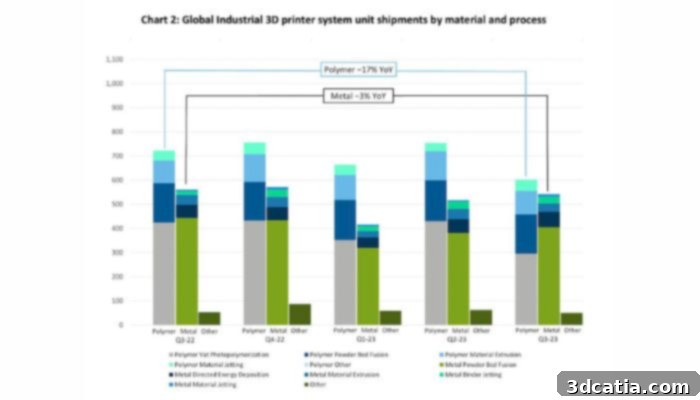
For industrial 3D printer shipments, the polymer segment was hit harder than metal (image credits: CONTEXT)
Delving deeper into the specifics, the CONTEXT report revealed a significant downturn in the industrial systems segment. Global shipments for industrial 3D printers experienced an overall drop of 11% in Q3 2023. This decline was not uniformly distributed across all industrial technologies; instead, the disparity was particularly stark between polymer and metal solutions. Shipments of industrial polymer 3D printers saw a substantial decrease of 17%, indicating significant market contraction for plastic-based additive manufacturing at the high end. This pronounced dip in polymer systems was largely attributed to the particularly weak performance of vat photopolymerization printers, which represent the largest sub-category within industrial polymer 3D printing. These systems, often used for detailed prototypes and end-use parts, likely faced reduced capital expenditure from businesses cautious about the economic climate. In contrast, metal 3D printer shipments, while still declining, experienced a much more modest reduction of only 3%. This suggests a relative resilience in demand for metal additive manufacturing, which is often integral to critical industrial applications in sectors such as aerospace, automotive, and medical, where the value proposition of 3D printed metal components remains robust even amidst economic uncertainty.
Within the metal additive manufacturing sector, the report highlighted further nuances. The overall segment’s performance was somewhat tempered by shortfalls in powder bed fusion (PBF) systems. However, this was partially offset by strong growth and increased revenues from larger build-volume, multi-laser powder bed fusion systems, which cater to more demanding industrial applications requiring higher throughput and greater efficiency. Additionally, other advanced metal additive manufacturing technologies contributed positively. A notable trend observed was the increasing penetration of Chinese companies into the metal 3D printing market, yielding promising results and intensifying global competition. Furthermore, Direct Energy Deposition (DED) printers demonstrated significant growth. Companies like Meltio, in particular, were identified as leading innovators and drivers of this segment, underscoring the increasing relevance and adoption of DED technology for repair, cladding, and large-format part production across various heavy industries.
The midrange 3D printer category also faced headwinds, with shipments falling by 5% during Q3. However, this segment’s performance was bolstered by robust shipments of lower-end PBF systems, such as the widely recognized Fuse 1 from Formlabs, which offers industrial capabilities at a more accessible price point. The domestic market in China also provided significant support, with strong contributions from manufacturers like UnionTech. Indeed, without the substantial impact of UnionTech’s sales, CONTEXT estimates that midrange 3D printer shipments would have plummeted by a far more alarming 17%. This highlights the critical role of specific regional markets and cost-effective solutions in mitigating broader market declines. In stark contrast, established market leaders like Stratasys, 3D Systems, and Markforged recorded particularly poor performances in this segment, indicating challenges for traditional players amidst a shifting competitive landscape. Yet, even this decline was dwarfed by the dramatic downturn witnessed in the professional price class. This segment experienced the most significant downward trend across all categories, with 3D printer sales plunging by an astounding 40%. This severe contraction is likely a direct consequence of users, faced with economic pressures, opting for cheaper alternative solutions, even if these alternatives offered comparatively lower performance or fewer advanced features, signaling a clear shift towards cost-efficiency in procurement decisions.
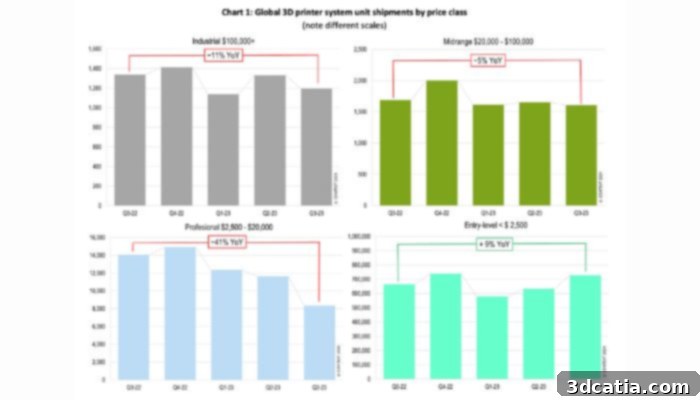
Data from CONTEXT shows that all sales in 3D printer categories, including industrial, except entry-level declined from previous years (image credits: CONTEXT)
What Does This Mean for the 3D Printing Industry?
While the broader market trends might appear disheartening, particularly for industrial and professional segments, the substantial growth observed in entry-level systems offers a significant silver lining. This segment recorded an impressive 9% increase in shipments during Q3, a clear indicator of sustained, robust interest in 3D printing technology. This growth, however, comes with an interesting implication: it suggests a degree of cannibalization of sales from the professional 3D printer category. As entry-level machines become more capable and user-friendly, they are increasingly meeting the needs of a wider range of users, including some who might previously have considered professional-grade equipment. This trend is powerfully underscored by the meteoric rise of companies like Bambu Lab and Elegoo, which have rapidly gained market share, while Creality continues to assert its dominance in this highly competitive and expanding market segment. These companies excel at delivering innovative, affordable, and accessible 3D printing solutions that appeal to hobbyists, small businesses, and educational institutions alike, driving a broader adoption of additive manufacturing.
The persistent strength of the entry-level market, coupled with the downturn in higher-end categories, strongly suggests that a recalibration of strategy may be necessary for the broader additive manufacturing market. The data indicates that users are increasingly prioritizing cost-effectiveness and ease of use, showing a greater inclination to adopt more basic, cheaper machines over expensive models equipped with a full suite of advanced features. This shift could reflect both economic prudence and the increasing sophistication of entry-level systems that now offer sufficient performance for many common applications. As we progress through the year, it will be fascinating to observe how major 3D printing companies respond to these evolving market dynamics. Will industrial powerhouses venture into the consumer-friendly space? Could the often-overlooked entry-level category see a significant resurgence of interest and investment from more established 3D printer manufacturers, seeking to capture this burgeoning demand? Irrespective of these strategic shifts, the intrinsic value of additive manufacturing for numerous industries remains undeniable, continuing to drive innovation and efficiency across diverse applications, from rapid prototyping to end-part production. You can delve deeper into CONTEXT’s insights regarding quarterly global industrial 3D printer shipments HERE.
What are your thoughts on this notable decline in industrial 3D printer shipments, juxtaposed with the evident rise of desktop and entry-level 3D printers? Do you believe this trend represents a temporary market correction driven by economic factors, or does it signify a more fundamental and lasting shift in the landscape of additive manufacturing that will continue to evolve throughout 2024 and beyond? We encourage you to share your insights and predictions in a comment below, or join the conversation on our social media platforms: LinkedIn, Facebook, and Twitter pages! For the latest updates and breaking news in the 3D printing world, don’t forget to sign up for our free weekly Newsletter here, delivered directly to your inbox. You can also explore our comprehensive video content and interviews on our dedicated YouTube channel, where we cover a wide range of topics related to additive manufacturing and its applications.