
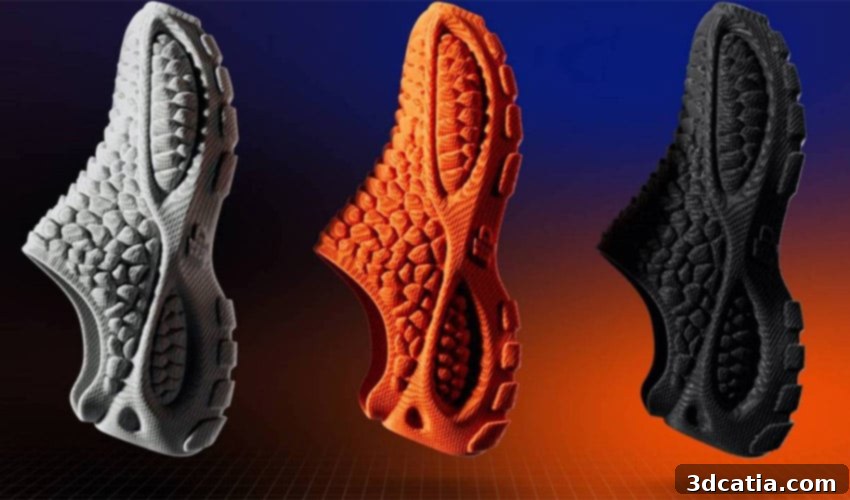
Heron Preston & Zellerfeld Unveil HERON01: The Game-Changing 3D-Printed Sneaker Revolutionizing Footwear Innovation
The landscape of footwear manufacturing is undergoing a significant transformation, driven by the innovative capabilities of additive manufacturing. For several years, forward-thinking players in both the footwear industry and the additive manufacturing sector have forged powerful collaborations, pushing the boundaries of design, production, and sustainability. We’ve witnessed remarkable advancements, from Adidas’ groundbreaking 3D-printed 4DFWD sneakers, which brought complex lattice structures to athletic performance, to Athos’ specialized 3D-printed climbing shoes, designed for unparalleled grip and precision. These examples underscore a clear trend: 3D-printed footwear is steadily moving from niche experimentation to mainstream adoption, promising a future of customizable, high-performance, and environmentally conscious shoes.
In this exciting evolution, a new beacon of innovation has emerged through an unexpected yet visionary partnership. Renowned fashion designer Heron Preston, celebrated for his avant-garde approach and knack for upcycling, has joined forces with the New York City Department of Sanitation. This unique alliance, coupled with the advanced manufacturing expertise of Zellerfeld, an American company founded by ambitious engineering students, has culminated in the creation of the HERON01 sneaker. The HERON01 is not just another shoe; it represents Heron Preston’s bold vision for a fully 3D-printed slip-on sneaker, meticulously engineered to require absolutely no stitching or glue. Its status as a single, monolithic unit makes it a truly rare product in an industry where additive manufacturing is typically confined to producing individual components, such as midsoles or specific decorative elements. This complete integration simplifies manufacturing, enhances durability, and paves the way for unprecedented design freedom.
Design Freedom and Sustainable Footwear Manufacturing with 3D Printing
The potential unlocked by additive manufacturing is truly boundless, as Heron Preston himself attests. “With additive manufacturing, the potential is limitless,” Preston shared in a statement, highlighting the revolutionary impact of this technology on his creative process. “I was able to design and print working and scalable prototypes in a matter of hours—with traditional manufacturing it would have taken months. I can’t wait to print more shoes and updates.” This dramatic reduction in development time is a monumental advantage, allowing designers to iterate rapidly, test concepts swiftly, and bring innovative products to market with unprecedented speed. Traditional footwear manufacturing cycles are notoriously long, often spanning 12-18 months from concept to retail. 3D printing shatters these timelines, fostering an environment where continuous innovation and immediate responsiveness to market trends become the norm.
Beyond speed, the HERON01 embodies a commitment to sustainability, a critical concern in today’s manufacturing landscape. Thanks to the inherent properties of additive manufacturing and the specific materials utilized in its production, the HERON01 is designed to be fully recyclable once its lifecycle has concluded. This is a significant step towards a circular economy in footwear. Traditional shoes, often composed of numerous different materials—plastics, textiles, leathers, foams—all held together by glues and stitches, are incredibly difficult to recycle. Disassembling them into their constituent parts for material recovery is a labor-intensive and often uneconomical process. The HERON01, as a single-material, glue-free, stitch-free structure, simplifies the recycling process dramatically. This not only reduces waste destined for landfills but also conserves valuable resources, aligning perfectly with the ethos of Heron Preston’s partnership with the NYC Department of Sanitation, which implicitly focuses on minimizing environmental impact and promoting responsible consumption.
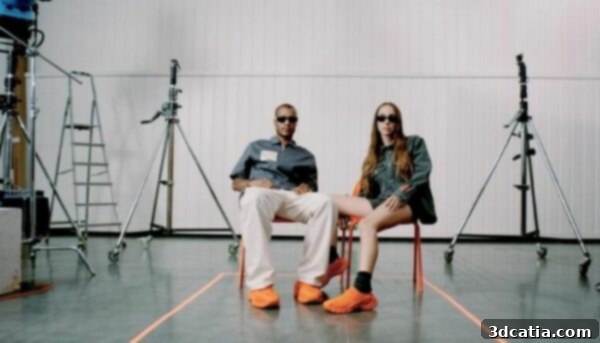
Personalization Using 3D Printing: A New Era of Custom Fit
The ability of 3D printing to create highly intricate, customized geometries has made it an invaluable tool across a multitude of industries. Whether in the medical sector, where personalized prosthetics and surgical guides are common, the fashion industry, pushing the boundaries of bespoke garments and accessories, or even the automotive industry, designing custom components and prototypes, 3D printing technology is now synonymous with the design of tailor-made parts. The HERON01 leverages this transformative capability to deliver an unparalleled level of personalization for consumers, promising shoes that are not just stylish but perfectly fitted to individual needs.
Heron Preston and Zellerfeld envision a future where every customer receives a shoe that is uniquely theirs. To achieve this, consumers will engage with a cutting-edge process: simply scanning their feet using a smartphone. This accessible technology captures precise anatomical data, which is then translated into a digital model for 3D printing. This means that each pair of HERON01 sneakers can be individually optimized for comfort, support, and overall fit, eliminating the compromises often found in mass-produced footwear. The implications for foot health, athletic performance, and general comfort are profound, moving beyond standard sizing to truly bespoke footwear that adapts to the wearer’s unique physiology.
For those eager to experience this blend of high fashion, innovation, and personalization, the HERON01 is readily available. It is offered in three distinct colorways through the popular online retailer, StockX, known for its dynamic marketplace for highly sought-after consumer goods. The collaboration with StockX is a testament to the sneaker’s cultural relevance and market appeal. As Deena Bahri, StockX CMO, articulated, “The StockX ethos of always challenging the status status quo is very much in line with Heron Preston’s vision as a designer and the brand values that guide Zellerfeld. Our partners have spent years pushing the boundaries of what’s possible in fashion, and this innovative 3D printed shoe is a direct result of that work.” This statement underscores a shared commitment to innovation and disruption, positioning the HERON01 not just as a product but as a statement about the future of fashion and manufacturing.
The Future of Footwear: Collaboration, Innovation, and Reshaping the Industry
The partnership between Heron Preston and Zellerfeld exemplifies a broader trend that is set to redefine the footwear industry. According to Cornelius Schmitt, CEO of Zellerfeld, the collaborations between visionary creators, innovative designers, and pioneering additive manufacturing companies are not just a passing fad but a burgeoning movement. He emphatically concludes: “Heron is a truly inspiring designer, and 3D printing will allow visionaries like him to reshape shoes for the better.” This bold statement highlights the profound impact that such partnerships are destined to have, moving beyond incremental improvements to fundamental paradigm shifts in how shoes are conceived, produced, and consumed.
The “reshaping for the better” encompasses multiple dimensions. It means shoes that are not only more comfortable and better performing due to custom fit but also inherently more sustainable, reducing waste and enabling easier recycling. It implies a significant acceleration of design cycles, allowing for quicker responses to consumer demands and rapid adaptation to new trends. Furthermore, 3D printing can foster greater design freedom, enabling the creation of complex geometries and functional structures that are impossible with traditional manufacturing methods. This opens up entirely new aesthetic possibilities, pushing the boundaries of footwear design far beyond conventional limitations.
Looking ahead, the success of the HERON01 serves as a powerful precedent. We can anticipate more designers and brands adopting full-shoe 3D printing, moving away from fragmented manufacturing processes towards integrated, digital workflows. This could lead to a future of localized production, where shoes are printed on demand closer to the consumer, drastically reducing shipping costs and carbon footprints. The technology also promises greater accessibility to bespoke footwear, democratizing personalization that was once the exclusive domain of luxury or specialized athletic gear. Ultimately, the synergy between artistic vision and technological prowess, as perfectly demonstrated by Heron Preston and Zellerfeld, is charting a course for a footwear industry that is more agile, more sustainable, and infinitely more innovative.
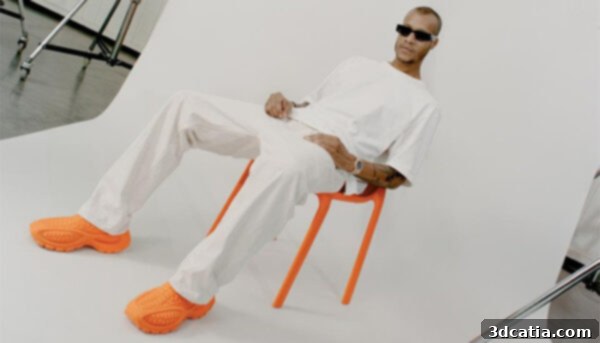
Designer Heron Preston confidently sporting the revolutionary HERON01 sneakers. (Photo Credit: Zellerfeld)
What are your thoughts on Heron Preston & Zellerfeld’s pioneering 3D-Printed HERON01 slip-on sneaker? Do you believe this marks a turning point for the footwear industry, heralding a new era of customization and sustainability? Share your insights and join the conversation by leaving a comment below or engaging with us on our Facebook and Twitter pages. For all the latest news and developments in the world of 3D printing, don’t forget to sign up for our free weekly newsletter, delivered straight to your inbox!
Cover Photo Credit: Zellerfeld