
Revolutionizing Automotive Lightweighting: Multi-Material 3D Printing for Stronger, Lighter Vehicles
In the rapidly evolving automotive industry, the pursuit of lightweighting remains a paramount objective. This fundamental concept—that lighter vehicles inherently offer superior fuel efficiency, extended battery range for electric vehicles, enhanced acceleration, improved braking performance, and more responsive handling—is not just a trend but a critical engineering imperative. Global demand for sustainable transportation, coupled with stringent environmental regulations and the accelerating shift towards electric mobility, places immense pressure on manufacturers to reduce vehicle weight without compromising structural integrity or occupant safety. However, this ambition frequently encounters significant hurdles, particularly when attempting to combine diverse materials like the robust strength of steel with the unparalleled lightness of aluminum. Historically, achieving seamless and durable bonds between such dissimilar metals has been a formidable challenge, often resulting in compromised mechanical properties due to the formation of brittle interfaces.
Today, a groundbreaking solution is emerging from the innovative minds at Tohoku University. Researchers from the Institute for Materials Research and the New Industry Creation Hatchery Center have achieved a remarkable breakthrough in multi-material metal 3D printing. Their novel technique promises to fundamentally transform how lightweight, durable automobile parts are designed and manufactured, effectively overcoming the long-standing obstacles associated with combining disparate metallic elements. This development signals a significant leap forward for the automotive sector, offering a viable path to create components that are not only lighter but also possess the required strength and longevity for demanding vehicle applications.
Additive manufacturing, more commonly known as 3D printing, has already cemented its place as a transformative technology within the car manufacturing sector. Its inherent ability to produce highly complex geometries, intricate internal structures, and customized parts with exceptional precision has made it immensely popular for prototyping, tooling, and even end-use component production. As highlighted in a press release from Tohoku University, the precision offered by 3D printing stands out, enabling the creation of unique, highly-customizable shapes that would be impossible or prohibitively expensive to achieve with conventional manufacturing methods. This design freedom opens up new avenues for optimizing part performance, consolidating assemblies, and reducing material waste. However, despite these advantages, the materials traditionally used in single-material 3D printing often have inherent drawbacks, pushing the industry to explore multi-material approaches. While multi-material 3D printing offers the promise of combining the best properties of different materials into a single component, this advanced manufacturing strategy has its own set of technical complexities and material science challenges, which are not always easily overcome.
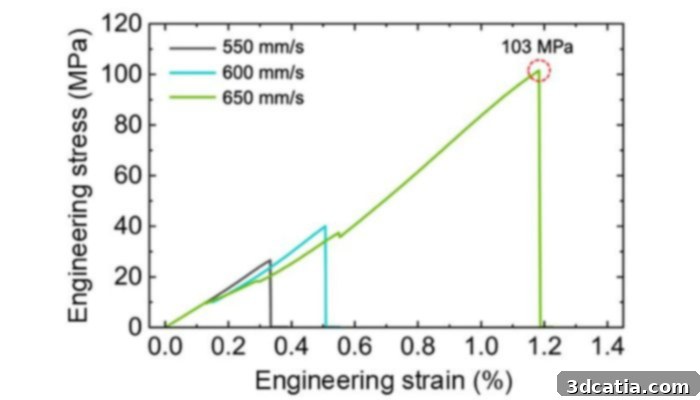
Interfacial strength for steel-aluminum alloy multi-materials melted using LPBF at different scan speeds (photo credits: Kenta Yamanaka et al.)
The primary challenge in multi-material additive manufacturing, particularly when it involves certain metal combinations such as steel and aluminum, lies in the formation of brittle intermetallic compounds at the dissimilar metal interfaces. Associate Professor Kenta Yamanaka, a leading figure in the research team, elaborates on this critical issue: “Multi-materials are a hot topic in the field of additive manufacturing due to its process flexibility. However, a major challenge in practical implementation is that for certain metal combinations, such as steel and aluminum, brittle intermetallic compounds can be formed at the dissimilar metal interfaces. So, while the material is now lighter, it ends up being more brittle.” These intermetallic compounds, specifically cited examples like Al5Fe2 and Al13Fe4, are notoriously fragile and can severely undermine the structural integrity of the entire component, transforming a potentially advantageous lightweight design into a mechanically unreliable part. This inherent brittleness has been a significant impediment to the widespread adoption of steel-aluminum multi-material components in applications where both strength and lightweight characteristics are paramount, such as in high-performance automotive parts.
Focused on one of the most prominent metal additive manufacturing processes in the automotive sector, Laser Powder Bed Fusion (LPBF), the Tohoku University research team embarked on a mission to produce a steel-aluminum alloy with the ideal combination of lightweight properties and robust strength. LPBF is a technique where a laser selectively melts metallic powder layer by layer, fusing it into a solid part. While powerful, controlling the interfacial reactions between dissimilar metals in LPBF has traditionally been complex. The team’s exhaustive investigations revealed a crucial insight: increasing the scanning speed of the laser during the LPBF process significantly suppresses the formation of these detrimental brittle intermetallic compounds, specifically Al5Fe2 and Al13Fe4. This discovery was pivotal, as it offered a direct process parameter that could be manipulated to overcome the Achilles’ heel of steel-aluminum multi-material parts.
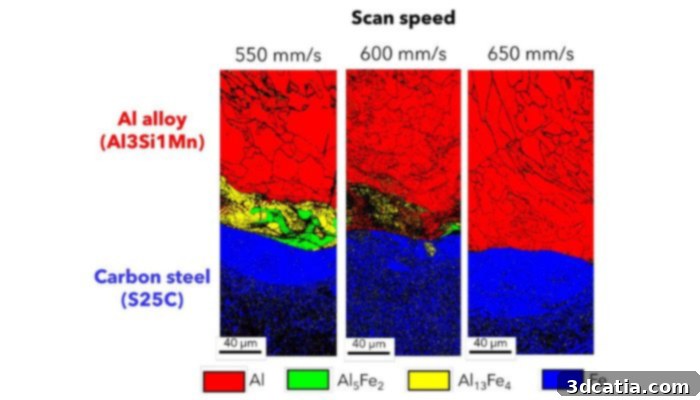
The results on bonding fr steel-aluminum alloys using LPBF at different scan speeds (photo credits: Kenta Yamanaka et al.)
The underlying mechanism behind this successful suppression is believed by the researchers to be a phenomenon known as non-equilibrium solidification. In simplified terms, by rapidly increasing the laser’s scanning speed, the molten metal cools and solidifies at an extremely fast rate, preventing the atoms of steel and aluminum from having sufficient time to diffuse and form the thermodynamically stable but brittle intermetallic phases. This rapid cooling essentially “freezes” the material in a non-equilibrium state, minimizing the undesirable partitioning of elements that typically leads to weak points and interfaces within the material. The ability to control this solidification process allowed the researchers to demonstrate strong, ductile bonding interfaces between steel and aluminum layers, a feat previously considered highly challenging. Specifically Appointed Assistant Professor Seungkyun Yim, another key member of the innovative team, underscored the importance of this deep understanding: “In other words, you can’t just slap two metals together and expect them to stick without a plan. We had to fully understand the in-situ alloying mechanism first.” This statement emphasizes the meticulous scientific rigor and detailed material characterization that underpinned their success, moving beyond trial-and-error to a fundamental understanding of the metallurgical interactions at play during the 3D printing process.
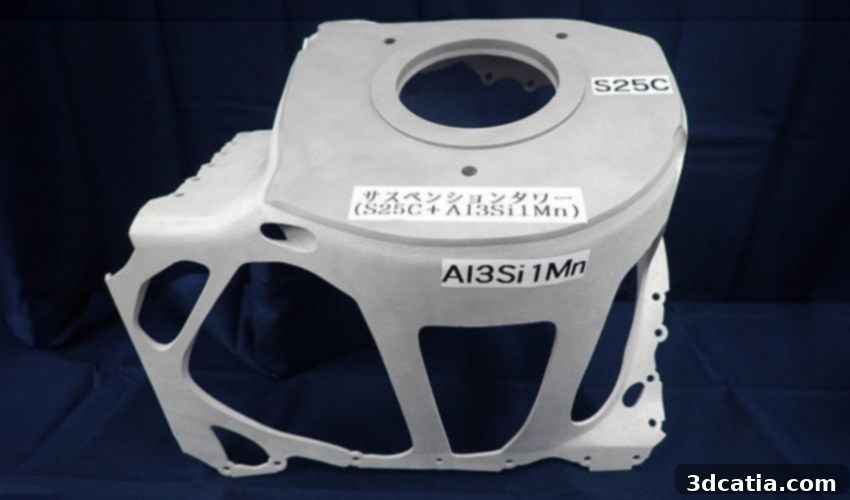
The culmination of this extensive research and development is truly impressive: a successful prototype of what the team proudly claims to be the world’s first full-scale automotive multi-material component with tailored geometry – specifically, a suspension tower. The suspension tower is a critical structural element in a vehicle, responsible for absorbing shocks and connecting the wheel assembly to the vehicle’s body. Fabricating such a crucial component using this novel multi-material 3D printing technique not only validates the process’s effectiveness in creating strong, lightweight parts but also demonstrates its scalability and applicability to complex, real-world automotive designs. The “tailored geometry” aspect further highlights the advantages of additive manufacturing, enabling designs to be optimized for specific load cases, potentially leading to even greater weight reductions and performance improvements compared to conventionally manufactured parts. This achievement represents a significant milestone, opening doors for automotive engineers to rethink component design and material selection with newfound freedom.
Looking ahead, the research group holds ambitious plans to extend the application of their findings to other challenging metal combinations. This future work aims to broaden the scope of multi-material additive manufacturing, unlocking even more potential applications across the automotive industry and beyond. Imagine chassis components, engine mounts, battery enclosures for electric vehicles, or even intricate interior structural elements that combine the ideal properties of multiple metals, all printed with unprecedented strength-to-weight ratios. Such innovations would not only contribute to significant advancements in vehicle performance and safety but also support global sustainability goals by reducing resource consumption and improving energy efficiency. You can delve into the comprehensive details of their pioneering study by accessing the full publication HERE.
This breakthrough in multi-material metal 3D printing for lightweight yet durable car parts presents a paradigm shift for the automotive industry. We are keen to hear your thoughts on this innovative technique and its potential impact. Do you foresee this becoming a standard manufacturing process for future vehicles? Share your insights and opinions in a comment below or join the conversation on our social media channels: LinkedIn, Facebook, and Twitter! For more cutting-edge news and developments in automotive 3D printing, you can always find additional resources HERE. Don’t miss out on the latest advancements – remember to sign up for our free weekly Newsletter here to receive the most current 3D printing news directly in your inbox! You can also explore all our insightful videos on our dedicated YouTube channel for visual updates and demonstrations.
*Cover Photo Credits: Kenta Yamanaka et al.