
Ford’s Innovative Revival: 3D Printing Restores Historic Michigan Central Station
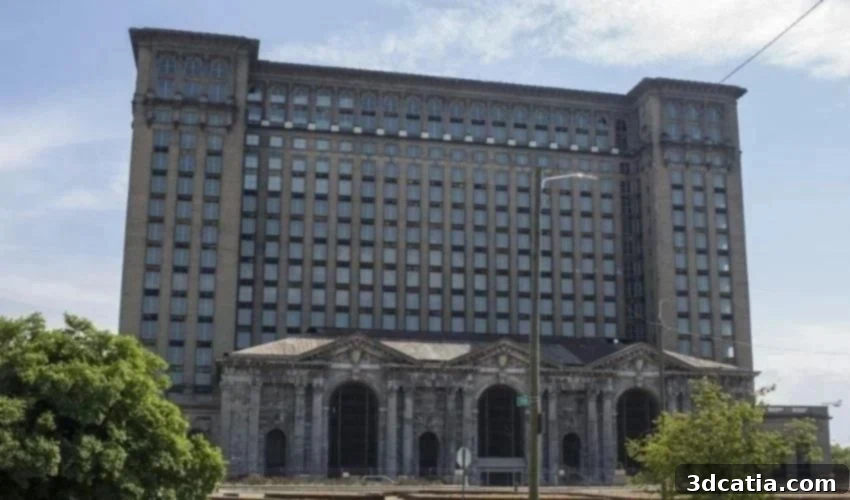
Ford, a pioneering force in the technology landscape, has long been at the forefront of adopting cutting-edge manufacturing techniques. For many years, the automotive giant has integrated additive manufacturing into its design and production processes, primarily for creating intricate automotive parts. However, in a remarkable departure from its usual applications, the American company has strategically deployed 3D technologies for a monumental historical preservation project: the renovation of the Michigan Central Station. This iconic landmark, nestled in southwest Detroit, stood dormant and empty since 1988 after ceasing passenger and train services. Its colossal structure remained untouched until 2018 when Ford embarked on an ambitious journey to acquire and revitalize the building, envisioning its transformation into a dynamic campus dedicated to innovation. This future hub is slated to host approximately 5,000 employees, and at the heart of its restoration lies the ingenious application of 3D printing technologies to meticulously reproduce damaged architectural elements and adorn the decaying station’s windows and ceilings.
The decision to embrace 3D technologies was a strategic move by Ford, maximizing its potential to replicate the Michigan Central Station’s original elements with unparalleled accuracy and authenticity. Traditional restoration methods often struggle with the complexity, cost, and time required to recreate historical details, especially when original blueprints are lost or unavailable. Additive manufacturing offers a precise solution, enabling the creation of intricate parts that perfectly match the building’s historical aesthetic. Harold Sears, technical manager for additive manufacturing technologies at Ford, eloquently captures this commitment, stating, “Ford could have decided to just modernize Michigan Central Station, but they’re taking great efforts to make sure this thing really reflects the way this building looked and felt inside and outside.” This statement underscores Ford’s dedication not merely to refurbishing the station but to breathing new life into its historical essence, ensuring that every detail resonates with its original grandeur.
To achieve such a high degree of fidelity, the U.S. company employed reverse engineering, a sophisticated technique widely utilized in various industries, including the automotive sector. This method is particularly invaluable for designing or reproducing components for vintage vehicles where original manufacturing plans are often non-existent. For instance, this precise technique was instrumental in the painstaking restoration of a 1919 Harley Davidson, showcasing its capability to revive historical artifacts with exactitude. In the context of Michigan Central Station, reverse engineering involved detailed 3D scanning of existing, often damaged, architectural features. These scans captured the exact geometry and dimensions of elements like decorative rosettes, filigrees, and ceiling tiles. The digital data was then processed to create highly accurate 3D models, forming the blueprint for printing perfect replicas. This methodical approach guaranteed that the newly fabricated parts would seamlessly integrate with the existing structure, preserving the station’s historical integrity while preparing it for a modern future.

Photo Credits : Ford
Reverse Engineering: The Precision Backbone of Michigan Central’s Revival
The implementation of reverse engineering, facilitated by a powerful combination of advanced 3D scanning and additive manufacturing, was absolutely pivotal to the success of the Michigan Central Station restoration. The project teams embarked on a meticulous process: first, existing architectural elements, many of which were severely degraded or missing, were precisely scanned to capture their intricate geometries. This data was then used to create accurate digital models. From these digital blueprints, nearly 550 replicas of the original rosettes, filigrees, and other ornate details were designed and fabricated. This process not only allowed for the faithful reproduction of historical aesthetics but also introduced unprecedented opportunities for precision and customization.
Beyond mere replication, the detailed modeling capabilities offered by 3D printing empowered professionals to make subtle yet significant modifications. For example, they were able to incorporate new features such as integrated suspension points into decorative pieces, allowing them to be securely and easily hung in specific locations. This kind of functional enhancement would be exceedingly difficult and costly using traditional fabrication methods. Furthermore, one of the significant advantages highlighted by Ford is that the 3D printed replicas are considerably lighter than their original counterparts. This reduction in weight not only simplifies installation but also minimizes stress on the historical structure, contributing to the building’s long-term preservation and safety. The company specified the use of thermoplastics for these creations, a choice that brings numerous benefits. While the exact type wasn’t disclosed, thermoplastics are known for their versatility, durability, excellent strength-to-weight ratio, and ability to be processed into complex shapes with fine detail, making them ideal for architectural ornamentation that must withstand environmental factors while maintaining aesthetic appeal.
The application of 3D printing in this context underscores its transformative potential beyond industrial manufacturing. For historical preservation, it offers a pathway to restore authenticity that was previously unimaginable or financially prohibitive. It allows architects and conservators to access a digital archive of a building’s past, creating precise reproductions that respect the original craftsmanship. This blend of historical reverence and technological innovation is a hallmark of Ford’s approach to the Michigan Central project, demonstrating a forward-thinking commitment to both heritage and future progress. The ability to produce hundreds of unique, intricate parts on demand, with consistent quality and reduced material waste, highlights the efficiency and sustainability benefits of additive manufacturing for such large-scale restoration efforts.
Ford’s Vision: Blending Heritage with a Future of Innovation
The restoration of Michigan Central Station is far more than just a renovation project; it is a profound statement about Ford’s strategic vision for the future and its commitment to Detroit. By transforming this long-abandoned landmark into a vibrant hub for innovation, Ford is not only preserving a significant piece of American history but also creating a dynamic ecosystem for future mobility solutions. The station, once a symbol of decline, is rapidly emerging as a beacon of progress and a central component of Ford’s ambitious plan to establish a cutting-edge urban campus. This campus is designed to foster collaborative innovation, attracting top talent and driving advancements in autonomous vehicles, electrification, and connectivity – areas critical to the future of the automotive industry and urban life.
If work continues on its ambitious schedule, Michigan Central Station was targeted to be ready to house Ford’s teams in early 2023. This timeline reflects the urgency and significance Ford places on bringing this vision to fruition. Bob Bedard, supervisor of additive manufacturing plastics at Ford, encapsulates the company’s ethos, concluding, “Part of our drive as a company is to bring new technologies into production applications when they’re ready, and to always be innovating to find a better, more sustainable, safer way to bring things to fruition.” This statement perfectly articulates how the Michigan Central Station project aligns with Ford’s broader corporate philosophy. It demonstrates a holistic approach where innovation, sustainability, and historical reverence coalesce. The use of 3D printing for restoration is a prime example of bringing advanced technologies into practical, impactful applications, showcasing how Ford continually seeks more sustainable and efficient methods for achieving its goals.
The broader implications of Ford’s work at Michigan Central Station extend beyond the automotive industry. This project serves as a powerful testament to the potential of additive manufacturing in architectural preservation and urban revitalization worldwide. It illustrates how forgotten relics can be transformed into modern centers of excellence without sacrificing their historical integrity. By leveraging 3D printing, Ford has set a new benchmark for how corporations can contribute to community development, honor historical legacies, and simultaneously propel technological progress. The re-imagined Michigan Central Station is poised to become a landmark of innovation, a testament to Detroit’s enduring spirit, and a vivid demonstration of how advanced manufacturing can shape a more sustainable and technologically advanced future.
What do you think of Ford’s pioneering restoration of Michigan Central Station using 3D printing? Share your thoughts in a comment below or join the conversation on our Linkedin, Facebook, and Twitter pages! Don’t forget to sign up for our free weekly Newsletter here, to receive the latest 3D printing news straight to your inbox. You can also find all our compelling videos and insightful discussions on our YouTube channel.
To find out more regarding the restoration of the Michigan Central Station, click HERE.
*Cover Photo Credits : Ford