
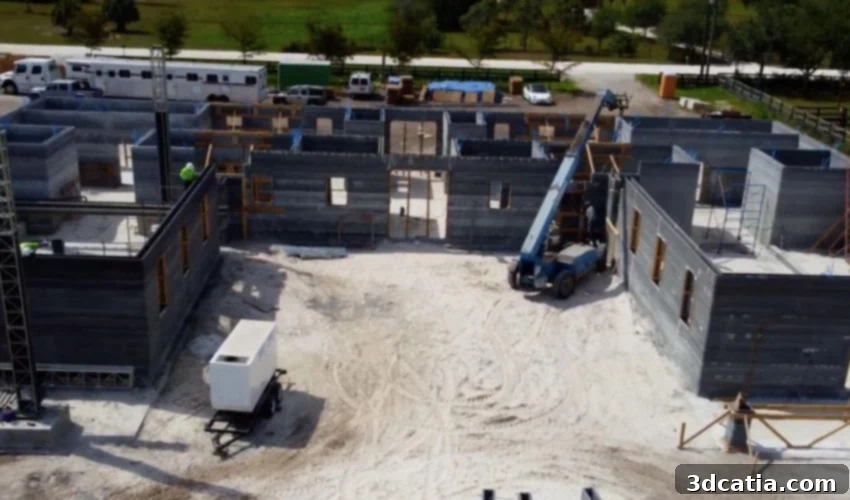
World’s Largest 3D Printed Building: Florida Sets New Construction Benchmark with Printed Farms & COBOD
The landscape of global construction is undergoing a revolutionary transformation, largely spearheaded by advancements in 3D printing technology. What was once confined to prototypes and small-scale models is now rapidly evolving into the fabrication of large, complex structures that are both innovative and incredibly resilient. This exciting progression is vividly demonstrated by the recent announcement from Printed Farms and COBOD: the successful completion of what they proudly claim to be the world’s largest 3D printed building, strategically located in Florida. This monumental achievement not only redefines the possibilities of additive manufacturing in construction but also addresses critical concerns such as extreme weather conditions prevalent in the region.
Spanning an impressive floor area exceeding 10,100 square feet (approximately 940 square meters), this groundbreaking structure is nearly 50% larger than the previous record holder situated in the Middle East – another burgeoning hub for additive manufacturing (AM) in the construction sector. More than just its record-breaking size, this facility has been meticulously designed and engineered to tackle Florida’s unique environmental challenges, including its notorious storms and intense heat. This project signifies a critical milestone, showcasing how 3D printing can deliver not only scale but also enhanced safety and sustainability in building practices.
A Legacy of Innovation: The Partnership Between Printed Farms and COBOD
The collaboration behind this colossal project brings together two formidable players with established track records in 3D construction. Printed Farms is no stranger to pioneering additive manufacturing in Florida. The company made headlines as early as 2021 by constructing the first 3D printed house in Tallahassee, the state capital. This earlier venture laid important groundwork, demonstrating the practical application and benefits of 3D printing for residential purposes within the state. Their sustained commitment to exploring and expanding the boundaries of 3D printed architecture positions them as key innovators in the field.
COBOD, on the other hand, is globally recognized as a leading provider of advanced concrete 3D printing solutions. Their flagship BOD2 printer is renowned for its modularity, efficiency, and ability to handle large-scale construction projects with remarkable precision. COBOD’s portfolio boasts an impressive array of completed 3D printed structures worldwide, including the world’s tallest 3D printed building, standing at 33 feet (9.9 meters) in Dubai. Furthermore, their technology was instrumental in the construction of the US’s first two-story 3D printed building in Texas, further cementing their reputation for pushing architectural and engineering boundaries. The addition of this record-breaking luxury horse barn in Wellington, Florida, to their growing list of achievements underscores their pivotal role in advancing additive manufacturing in the construction industry and highlights the increasing adoption and viability of AM technologies across diverse applications.
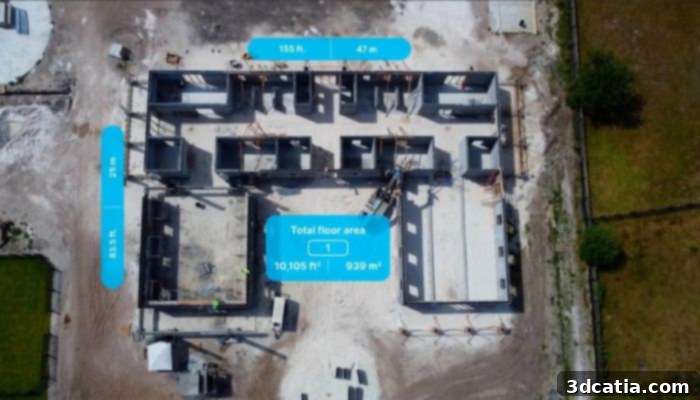
The final dimensions of the equine facility demonstrate the scale achieved.
Unveiling the Record-Breaking Structure: A Luxury Equine Oasis
The newly completed structure is not merely a testament to technological prowess; it serves a practical and luxurious purpose. It is a high-end horse barn, meticulously designed to cater to the needs of the equestrian community in Wellington, Florida – a renowned international hub for horse sports and culture. With a total floor area of 10,105 square feet (939 square meters), the sheer scale of this building is exceptional for a 3D printed project. Its impressive dimensions include a length of 155 feet (47 meters), a width of 83 feet (25 meters), and a height of 14 feet (4 meters). While its height does not challenge records for vertical construction, its sprawling footprint and total usable area undeniably set a new benchmark in the additive manufacturing construction sector.
Achieving such a significant floor area with 3D printing is a remarkable feat. Historically, many 3D printed construction projects have been constrained by the operational dimensions of the printers themselves, often resulting in smaller, more contained structures. This project, however, showcases how advanced modular 3D printing systems, like COBOD’s BOD2, can be scaled and adapted to create expansive, multi-functional facilities that rival traditionally constructed buildings in both size and utility. The success of this luxury horse barn demonstrates a vital evolution in 3D construction, moving beyond niche applications to address large-scale infrastructure requirements with efficiency and innovative design.
Engineered for Resilience: Withstanding Florida’s Challenging Climate
Beyond its impressive dimensions, a critical aspect of this 3D printed building’s design is its robust capability to endure Florida’s notoriously extreme weather conditions. The state is statistically the most hurricane-prone in the United States, having been hit by 125 hurricanes since 1851, 40 of which were classified as “major.” The design and construction methodologies employed for this equine facility directly address these formidable challenges, offering a compelling solution to concerns regarding the perceived safety and structural integrity of 3D printed buildings.
The concrete walls produced by the 3D printing process are inherently strong and dense, providing superior resistance to high winds and impacts typically associated with hurricanes and tropical storms. Unlike conventional block or frame construction that might require extensive reinforcement, 3D printed concrete walls can be designed with optimal internal geometries to maximize structural strength and minimize material usage. This approach not only enhances safety but also contributes to the longevity and durability of the structure in a demanding coastal environment. The ability of the technology to create monolithic, seamless structures significantly reduces potential points of failure often found in multi-part assemblies of traditional building methods.
Furthermore, the design of the building cleverly tackles Florida’s intense heat and humidity. The structure’s 3D printed walls are engineered to create an internal cavity and an air gap. This innovative feature facilitates natural cooling and ventilation throughout the facility, significantly reducing the reliance on energy-intensive air conditioning systems. The air pocket acts as an insulating layer, mitigating heat transfer from the exterior to the interior. This passive cooling strategy, made possible by the design freedom inherent in additive manufacturing, not only ensures a comfortable environment for the horses but also positions the building as a model for sustainable and energy-efficient construction in hot climates. Such sophisticated geometries are difficult and costly to achieve with traditional building techniques, highlighting a significant advantage of 3D printing.
The Technology and Vision Behind the Achievement
The successful completion of this project is a testament to the advanced capabilities of COBOD’s BOD2 3D printer. This modular construction printer is celebrated for its ability to operate on a large scale, offering unparalleled flexibility in building dimensions and designs. The BOD2 system’s precision ensures that complex architectural features, such as the internal cavities for insulation, are executed flawlessly, maintaining structural integrity while optimizing material usage. This efficiency translates into faster construction times, reduced labor costs, and a significant decrease in construction waste, aligning perfectly with modern sustainability objectives.
Philip Lund-Nielsen, COBOD co-founder and Head of Americas, succinctly captured the essence of this milestone: “Printed Farms has done a remarkable job in completing this massive structure, and the project demonstrates again how 3D printing is transforming the construction industry for the better. COBOD is proud to be technology supplier to yet another record-breaking 3D printing project on US soil, which comes only shortly after the completion of the US’ first 2-story 3D printed building in Texas, also using our BOD2 3D printer.” His statement not only applauds the execution by Printed Farms but also reinforces COBOD’s vision of being at the forefront of this industrial revolution. The consistent delivery of pioneering projects, from multi-story residential units to the world’s largest single-story structures, solidifies 3D printing’s role as a reliable, scalable, and innovative method for future construction needs.
This project offers compelling evidence that additive manufacturing is no longer a niche technology but a viable, robust solution for large-scale construction, capable of meeting stringent environmental and functional requirements. It paves the way for broader acceptance and adoption of 3D printing in both commercial and residential sectors, promising more sustainable, cost-effective, and resilient buildings worldwide. As the technology continues to mature, we can anticipate even more ambitious projects that push the boundaries of design, efficiency, and environmental responsibility.
What are your thoughts on Florida becoming home to the world’s largest 3D printed building? Do you foresee this project accelerating the widespread adoption of 3D printing in mainstream construction, especially in regions prone to extreme weather? We invite you to share your insights and predictions for the next record-breaking project in the additive manufacturing sector. Let us know in the comments below or connect with us on our LinkedIn, Facebook, and Twitter pages! Don’t forget to sign up for our free weekly Newsletter here to receive the latest 3D printing news directly in your inbox! You can also explore all our engaging videos and content on our YouTube channel.
*All Photo Credits: COBOD