
Transforming Manufacturing: The Journey of 3D Printing Beyond Prototyping to Mass Production
The landscape of industrial manufacturing is undergoing a profound and significant transformation, largely propelled by continuous advancements in additive manufacturing, more commonly known as 3D printing. A recent and comprehensive study conducted by Dimensional Research, and notably sponsored by Essentium, delves into the practical experiences and strategic perspectives of key stakeholders who have made substantial investments in 3D printing for actual production applications, moving decisively beyond its traditional and often limited role in simple prototyping. While the tremendous potential of 3D technology has been widely acknowledged for many years, its broad adoption for true mass production within industrial sectors has, until recently, been a rather slow and cautious process. This pivotal study from Dimensional Research meticulously gathers crucial data on the current uses and operational scale of 3D printing, and critically, attempts to identify and examine the primary challenges that are currently hindering its widespread integration into large-scale industrial processes. The insights and conclusions presented in this comprehensive report are founded on an extensive online survey, capturing the perspectives of 114 influential stakeholders who are directly responsible for making strategic decisions concerning the implementation of 3D printing for the creation of functional production parts, clearly differentiating these efforts from mere iterative design prototyping.
This in-depth analysis serves as a critical benchmark for the additive manufacturing industry, revealing not only the current state of its adoption but also projecting its anticipated trajectory in the coming years. It addresses fundamental questions that are crucial for understanding the evolving role of 3D printing: how various industries are currently leveraging this technology, what tangible benefits they are realizing from its application, and what significant hurdles still need to be surmounted for 3D printing to fully realize its promise as a core and indispensable manufacturing method. The findings provide invaluable data and strategic insights for anyone involved in digital fabrication, from material scientists and innovative machine developers to astute manufacturing strategists and forward-thinking business leaders aiming to integrate advanced production techniques into their complex operations. A nuanced understanding of these dynamics is absolutely essential for accurately forecasting future trends, making informed investment decisions, and guiding the strategic direction of additive manufacturing technologies across a diverse range of industrial sectors, ensuring sustainable growth and technological relevance.
Key Findings: Unlocking the Potential of Industrial 3D Printing
As clearly articulated by the survey, industrial 3D printing is demonstrating a wide and expanding array of applications across numerous sectors, proving its versatility in creating intricate designs and highly customized components. Despite these proven capabilities, the issue of **scale remains the most significant limiting factor** impeding its widespread adoption in mainstream industrial manufacturing. A compelling 83% of all respondents indicated that their largest production runs employing 3D printing technology consisted of only a few hundred parts or even fewer. This statistic critically highlights the current reality where additive manufacturing is frequently confined to niche, low-volume, or specialized production roles, primarily for rapid prototyping cycles, rather than competing directly with high-volume traditional manufacturing lines. However, this long-standing scenario is now poised for a dramatic transformation, with a clear and consistent consensus emerging that the utilization of 3D printing for producing functional parts is projected to grow substantially and rapidly in the immediate future.
The prevailing optimism regarding the future of additive manufacturing is overwhelmingly positive, painting a vivid picture of an industry on the brink of significant expansion. A remarkable 100% of the surveyed stakeholders unequivocally recognized the profound and transformative benefits of integrating 3D printing into their large-scale production manufacturing operations. This unprecedented unanimity signals a deeply ingrained belief in the technology’s power to fundamentally redefine efficiency, enhance flexibility, and optimize cost structures within various industrial environments. Moreover, an impressive 99% of respondents confirmed their expectation that the deployment and use of 3D printing within their respective organizations would substantially increase over the next three to five years. This projected surge is indicative of a strategic shift, as companies progressively move beyond experimental or pilot phases into more robust, full-scale implementation. More importantly, 57% of these industry leaders anticipate that their future production runs will comfortably extend into the **thousands of parts**, signifying a pivotal transition from niche, specialized applications to more commonplace, mainstream industrial production volumes. These forward-looking projections are not merely based on hopeful speculation but are firmly grounded in observable ongoing technological advancements, a deeper understanding of additive manufacturing’s economic advantages, and a growing confidence in its industrial maturity.
Source: Dimensional Research
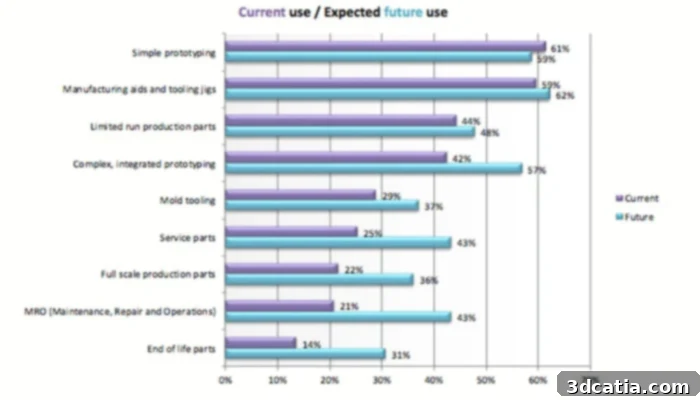
Consistently echoing findings from other influential industry analyses, such as the widely cited report from 3D Hubs, simple prototyping continues to represent the most prevalent and widely adopted application of 3D printing today. This initial entry point offers companies an unparalleled ability to rapidly iterate designs, thoroughly test new concepts, and significantly reduce the time-to-market for innovative products without the substantial financial investment associated with traditional tooling. However, the compelling data from the Dimensional Research survey strongly suggests that this predominant focus on prototyping is poised to evolve dramatically in the coming years, shifting strategically towards more comprehensive and integrated production applications. The critical transition from prototyping to full-scale manufacturing necessitates overcoming distinct sets of challenges, including fundamental advancements in material science, ensuring robust process repeatability, implementing rigorous quality assurance protocols, and crucially, optimizing the overall cost per part when produced at higher volumes. Recognizing these challenges, the industry is actively investing in innovative solutions to bridge this crucial gap, thereby paving a clearer path for 3D printing to become a truly integral and indispensable component of the modern production workflow.
Beyond the critical aspect of scalability, the survey also robustly underscored the immense economic benefits anticipated by visionary industry leaders. An impressive 88% of the surveyed stakeholders collectively agreed that the widespread and strategic adoption of additive manufacturing holds the potential to unlock **billions of dollars in production cost savings** across the entire industrial sector. These projected savings are multifaceted, stemming from various operational efficiencies: significantly reduced material waste through optimized design and precise deposition, substantial optimization of complex supply chains via on-demand and localized manufacturing capabilities, the elimination of expensive and time-consuming tooling for producing intricate geometries, and the innovative ability to consolidate multiple traditional parts into a single, more efficient, and often lighter component. Such profound cost reductions represent pivotal drivers for the adoption of any new manufacturing technology and comprehensively explain the exceptionally high level of interest, ongoing investment, and unwavering optimism surrounding the future of 3D printing in industrial applications.
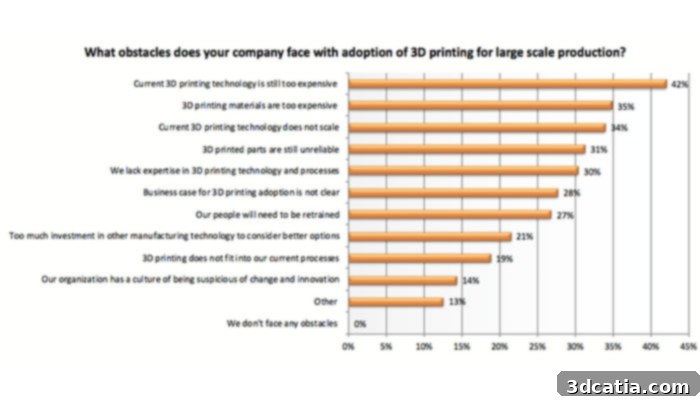
Despite the compelling benefits and highly optimistic projections, the ultimate path to mass adoption of industrial 3D printing is unequivocally not without its significant and persistent hurdles. In fact, every single respondent – a resounding 100% – reported encountering specific obstacles when attempting to implement 3D printing solutions for truly large-scale production. Identifying, thoroughly understanding, and proactively addressing these challenges is paramount for the sustained growth and deeper integration of additive manufacturing into the mainstream. The most frequently cited obstacle, highlighted by 42% of respondents, was the **current technology cost**. This encompasses the substantial initial investment required for high-performance industrial 3D printers, along with the associated infrastructure and software. Following closely were the **cost of specialized materials (35%)**, which often significantly exceed the prices of traditional manufacturing feedstocks due to their advanced properties, specialized formulations, and smaller production volumes. The inherent **lack of scalability of current technology (34%)** itself, referring to existing limitations in terms of speed, overall throughput, and unwavering reliability for truly very high-volume production, was another major concern, directly linking back to the primary limiting factor discussed earlier. Additionally, the perceived **unreliability of printed parts (31%)**, encompassing crucial issues like consistency in mechanical properties, surface finish, and complex post-processing requirements, continues to pose a significant barrier, particularly for mission-critical applications in highly regulated industries such as aerospace, automotive, and medical devices. Other notable challenges included a persistent lack of a sufficiently skilled workforce trained in additive manufacturing, difficulties in seamlessly integrating AM processes into existing legacy workflows, and legitimate concerns about intellectual property protection in a digitally driven manufacturing paradigm. These combined factors paint a comprehensive picture of the multifaceted hurdles that the industry is diligently working to overcome through continuous innovation and strategic collaboration.
Insights from Essentium CEO, Blake Teipel: Navigating the Future of Additive Manufacturing
 To gain a deeper, more nuanced understanding of these compelling survey results and the strategic importance of this pivotal study, we engaged in an insightful conversation with Blake Teipel, the visionary CEO of Essentium. He generously shed light on the company’s rationale for sponsoring such a comprehensive and industry-defining investigation into the current state and future trajectory of industrial 3D printing. Teipel emphasized, “The survey was meticulously designed not merely to gather data, but to furnish us with a more profound and nuanced understanding of how 3D printing is currently perceived, strategically implemented, and actively utilized within a broad spectrum of industrial manufacturing sectors. Furthermore, it provides us with invaluable, forward-looking insights into the emerging and transformative trends shaping digital fabrication, offering unparalleled clarity on the precise methodologies manufacturers are employing to effectively integrate 3D printing into their daily operational workflows, and crucially, their long-term anticipations regarding the technology’s evolutionary trajectory and ultimate role in the future of manufacturing.”
Teipel further elaborated on the foundational and often challenging questions that the study was specifically designed to answer, particularly those pertaining to the persistent barriers to widespread growth. “Crucially, a primary objective was to thoroughly understand the lingering obstacles that continue to impede the sustained growth and broader market penetration of this revolutionary technology within the dynamic additive manufacturing industry. The inherent promise of additive manufacturing has always been truly immense, offering unprecedented design freedom, geometric complexity, and remarkable manufacturing agility. However, this profound and transformative promise has historically been severely constrained by the fundamental **inability to scale** production effectively and economically. The central and most enduring question that has perpetually challenged the industry, and indeed our company, is: how can this revolutionary technology be leveraged not just to create one or two bespoke products, but to cost-effectively produce hundreds of thousands, if not millions, of high-quality, repeatable units? We sought to empirically ascertain if this challenge remained a significant impediment to widespread adoption and whether the application of 3D printing for true mass production continued to be limited, primarily focusing on small batch runs and custom orders. The comprehensive survey results provided invaluable, data-driven insights to definitively address these long-standing questions, confirming both the existing challenges and illuminating a clear, actionable path forward for industrial scalability.” This forward-thinking perspective underscores Essentium’s unwavering commitment to relentlessly pushing the boundaries of what industrial 3D printing can achieve, particularly in high-volume applications where economic scalability and reliability are absolutely paramount.
Source: Dimensional Research
Delving more deeply into the specific, and at times surprising, findings of the survey, Blake Teipel candidly admitted his astonishment at the unanimous agreement among all respondents regarding the direct and tangible benefits of employing 3D printing for genuine large-scale production manufacturing, a perception that extends far beyond its traditional and often exclusive use in mere prototyping. This widespread and unified recognition signals a critical and irreversible shift in both perception and strategic intent within the industrial manufacturing sector. In fact, the survey compellingly revealed that over half of the responding organizations are actively and strategically preparing for a significant transition towards full-scale 3D printing production runs, clearly indicating a strong and accelerating momentum towards its robust industrialization. Even more remarkably, 21% of these forward-thinking organizations are already utilizing 3D printing for full-scale production part runs, conclusively demonstrating that this transformative shift is not merely theoretical but is being actively and successfully implemented across various industries. Teipel confidently attributed this accelerating adoption to the rapid and groundbreaking technological progress observed across multiple fronts: “The technology is currently witnessing unprecedented advancements in crucial areas, such as the ever-expanding range of materials that can be effectively processed, now encompassing incredibly robust polymers, advanced composite materials, and a growing array of industrial metals. Concurrently, there is burgeoning and relentless innovation in printer design and precision engineering, resulting in the development of highly sophisticated machines capable of producing superior quality outputs at significantly faster production rates. A primary and undeniably compelling driving force behind this intensified push for widespread adoption is the undeniable potential for substantial, quantifiable cost-savings for organizations across the entire globe, enabling them to optimize their complex operations and gain a decisive competitive edge in highly competitive markets.” These continuous advancements directly address many of the persistent obstacles previously identified by respondents, from material limitations and processing speed to critical concerns regarding part quality and reliability, paving the way for wider acceptance and integration.
The Transformative Potential of Additive Manufacturing: A Vision for the Future
When queried about his overarching vision for the future of the additive manufacturing industry, Blake Teipel articulated a compelling and expansive picture of an industry poised to fundamentally revolutionize global production paradigms. He confidently stated, “The immense and transformative potential of 3D printing within the colossal $12 trillion market that constitutes global industrial manufacturing is finally starting to be unlocked with unprecedented velocity. We are standing at a pivotal historical moment where this technology will very soon fundamentally change the traditional way products are conceived, meticulously designed, efficiently produced, and critically, how the entire intricate supply chains involved are structured, managed, and optimized. This is far from being merely an incremental improvement; it represents a profound paradigm shift towards a more agile, inherently resilient, highly customized, and remarkably efficient manufacturing ecosystem.” This powerful statement unequivocally underscores the deeply held belief that 3D printing will not merely augment existing manufacturing processes but will radically redefine industrial practices on a truly global scale, impacting every facet from raw material sourcing and strategic design to final product delivery and lifecycle management.
Teipel further elaborated on the evolving and increasingly sophisticated expectations of modern manufacturing executives. “The survey distinctly highlights that while manufacturing executives are undeniably excited and optimistic about the inherent potential of 3D printing to significantly reduce manufacturing costs – a long-understood and widely acknowledged core benefit of 3D printing – many are now eagerly anticipating a future where they can seamlessly and economically deliver **mass customization**.” This forward-looking vision extends well beyond mere cost reduction, pointing decisively towards a future where individual consumer needs and highly specific preferences can be met with unprecedented flexibility, precision, and efficiency. Mass customization, a capability uniquely enabled by the toolless nature of 3D printing and its intrinsic ability to produce unique geometries without incurring additional setup or retooling costs, represents a powerful and innovative differentiator in today’s increasingly competitive and consumer-driven global markets.
The implications of widespread mass customization are truly profound, benefiting both businesses and end-consumers alike. Teipel elucidated, “They foresee 3D printing as providing them with the essential and transformative means to deliver products that are meticulously tailored to the individual. This groundbreaking capability makes it entirely possible to cater more intimately, precisely, and responsively to the dynamic and evolving demands of modern consumers, who are increasingly seeking personalized, unique, and on-demand goods and services. We are witnessing exciting new possibilities manifesting across a diverse spectrum of critical sectors, including the demanding automotive industry, the precision-driven aerospace sector, the fast-paced consumer goods market, and critically, the life-saving biomedical industries, where customization can literally be life-changing for patients.” In the automotive sector, this could translate to lighter, more complex parts optimized for specific vehicle models, enhancing performance and fuel efficiency. In aerospace, it means customized interior components or functional parts with optimized weight and strength characteristics, crucial for flight safety and fuel economy. In consumer goods, examples range from personalized footwear and eyewear to bespoke electronic casings and fashion accessories. In biomedical applications, 3D printing enables patient-specific implants, prosthetics, and surgical guides that offer superior fit, function, and improved patient outcomes. The ability to produce bespoke items at industrial scale without prohibitive costs is unequivocally set to redefine product development, market offerings, and consumer expectations globally.
Furthermore, the deeper integration of 3D printing into core manufacturing processes is poised to fundamentally reshape existing global supply chains. By enabling localized, on-demand, and distributed production capabilities, companies can significantly reduce their reliance on distant, single-source factories, thereby mitigating risks associated with geopolitical instabilities, natural disasters, or global pandemics. This strategic decentralization also leads to substantially decreased lead times and reduced shipping costs, enhancing overall operational efficiency. This emerging paradigm of decentralized manufacturing offers greater resilience, enhanced agility, and increased responsiveness, allowing businesses to react more rapidly and effectively to volatile market fluctuations and evolving consumer demands. The comprehensive vision presented by Teipel is one where additive manufacturing is not merely a specialized technological tool but a foundational strategic enabler for a more responsive, inherently sustainable, and deeply personalized global economy. The capacity for continuous innovation in advanced materials and sophisticated machinery continues to grow exponentially, further solidifying the indispensable role of 3D printing as a cornerstone of advanced industrial production for decades to come.
Essentium, recognized as a leading innovator in high-speed additive manufacturing solutions, continues to spearhead innovation in this rapidly evolving and dynamic field. Recently, the company successfully secured a significant $22M investment round. This substantial capital injection is strategically earmarked to further accelerate the development and meet the surging market demand for their advanced high-speed 3D printing solutions. A key and primary focus of this significant investment is their groundbreaking High Speed Extrusion (HSE) FDM 3D printing platform. The HSE platform is specifically engineered and meticulously designed to directly tackle the critical industry challenges of scalability, high throughput, and cost-effectiveness in industrial additive manufacturing, offering unparalleled speed, unwavering reliability, and extensive material versatility for truly large-scale production applications. For those eager to explore the specifics of Essentium’s cutting-edge technologies and understand how they are actively enabling and shaping the future of industrial manufacturing, more detailed information can be readily found on their official website HERE.
We highly value your insights and opinions on the transformative potential of 3D printing in industrial manufacturing. We encourage you to share your thoughts, experiences, and predictions in a comment below or join the vibrant conversation on our Facebook and Twitter pages! To ensure you never miss out on the latest groundbreaking news and crucial innovations in additive manufacturing, be sure to sign up for our free weekly Newsletter, which delivers all the essential updates and industry insights straight to your inbox every single week!